
The AI industry evolved from Generative AI to the Agentic AI era at a breakneck pace. Are AI Agents fact or fiction? The reality is somewhere in between, and buyers remain skeptical. As technology leaders race to implement artificial intelligence across the enterprise, many organizations are experiencing a paradox. Despite increasing investments in AI technology, the maturity of enterprise AI adoption has declined nine points year over year, according to ServiceNow’s latest AI maturity index survey.
Additionally, Lopez Research data shows that companies struggle to show meaningful business outcomes from early AI proof of concepts, leading to fewer than anticipated AI projects moving from pilot into production. The use cases shared at ServiceNow’s Knowledge 2025 conference revealed a crucial insight: there’s still tremendous business upside available in automating existing processes. However, organizations need effective orchestration, governance, and data quality to unlock the promise of these sophisticated AI tools without creating complexity.
Orchestration: Moving Beyond Isolated AI Tools
Agentic AI is the buzzword of 2025. Technology vendors, like ServiceNow, are racing to showcase maturing AI offerings that will deliver on the promise of automated work. ServiceNow used its Knowledge 2025 conference to showcase its vision for orchestrated, agentic AI, which are autonomous AI entities that can reason, plan, and take action independently across systems and departments.
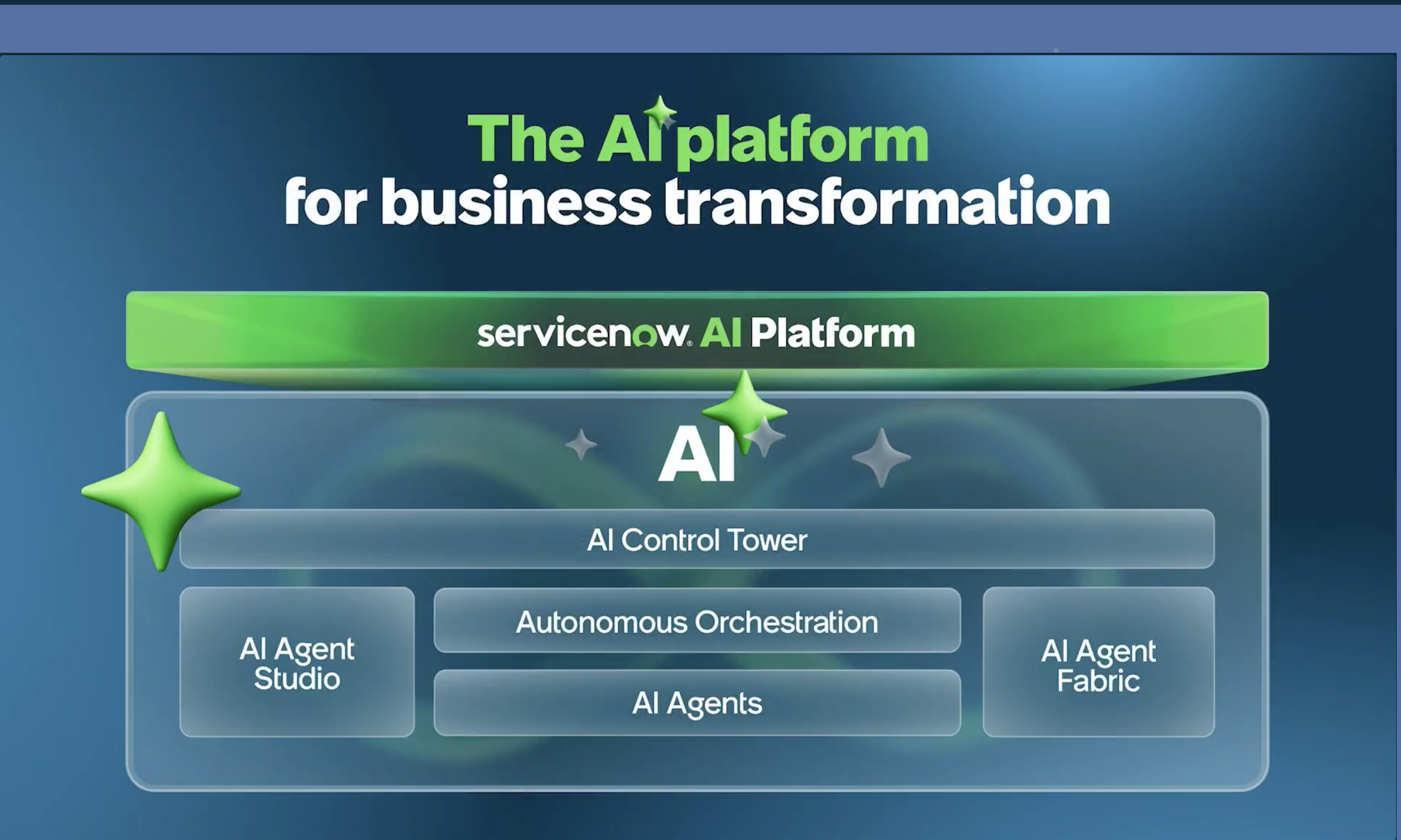
“What they are is a new digital workforce,” explained John Sigler, EVP of ServiceNow’s AI platform, during the keynote presentation. “And ServiceNow is in a great spot to provide the management of that new workforce with the AI Control Tower, where you can manage, govern, secure, onboard, and offboard, and update all your AI agents.”
ServiceNow’s focus on orchestration and governance addresses a critical gap Lopez Research has identified in the enterprise AI landscape. While many vendors have spent 2024 defining what agents are and how to create them, few have tackled the orchestration and governance challenges that would allow organizations to confidently deploy these agents autonomously across the various data and software silos. Even with fully baked technology, the potential brand, business, and compliance risk associated with automated workflows provides a significant roadblock to delivering production Agentic AI systems today.
Sigler showed how the AI Control Tower enables organizations to manage, govern, and secure their AI agents, provide visibility into agent actions, and monitor outcomes. The demo showcased how an employee can drill down into individual agents to see the tasks they perform and the benefits they deliver.
Orica has already realized these benefits in their IT Service Desk, boosting deflection rates from 18% to 94% and doubling the number of fully resolved cases without human intervention—a testament to the power of automation and agents.
Reimagining Processes, Not Just Automating Them
Unlike previous automation waves that often simply accelerated existing workflows, the next wave of agentic AI innovation will emphasize improving processes rather than automating them. The evolution beyond robotic process automation (RPA) was evident in how ServiceNow positions its AI agents.
In a software demonstration, Joe Davis, EVP of Engineering for Platform and AI, showed how a contract renewal issue typically involving multiple departments and taking days or weeks to complete can be compressed into minutes using autonomous agents working across systems. The key shift here is shepherding a process across what were previously disparate data and application silos.

Demo view of multi-agent orchestration of ServiceNow and third-party agents. Source: ServiceNow
Chris Taylor, Group CDIO at Stellantis, reinforced this approach: “What we see is an incredible momentum building. We’ve passed the initial fear factor, and people are starting to use it, adopt it, and create tangible value. It’s less of a threat, more of a way to enhance their productivity and enhance their job satisfaction.”
Stellantis has redesigned its processes around these capabilities, with Taylor noting, “In Europe, 85% of our cars are scheduled and loaded onto transporters using AI. It’s faster. We connect to the customer needs, and we get higher quality.”
Using Stellantis as an example, ServiceNow showcased a demo of a supply chain specialist alerted by an AI agent that detected a 25% increase in battery cell costs that could impact production. The agent recommended an alternate approved supplier and conducted a comprehensive analysis to ensure the new supplier could deliver the correct product requirements. This integration utilized ServiceNow’s Workflow Data Fabric to bring together data from internal and external systems, enabling the specialist to resolve a major supply chain issue.
When network transactions began dropping at a Jeep plant, AI agents diagnosed the problem by analyzing the scale of the issue, identifying that it was isolated to network services, and recommending rolling back a change to a Kubernetes container. After approval, the agents executed the rollback, confirmed network performance stabilization, and created a knowledge base article documenting the fix, preventing disruption to car production.
The demo highlighted more than just automation of existing processes, but a fundamentally better way to detect, diagnose, and resolve network issues, with AI agents working proactively rather than reactively.
Data Quality: The Foundation for Effective AI
A fundamental challenge for implementing effective AI remains data access and quality. During the keynote, ServiceNow referenced a Gartner statistic stating that 60% of AI projects will be abandoned by 2026 due to a lack of AI-ready data.
Gaurav Rewari, SVP and GM of Data and Analytics at ServiceNow, who presented on data strategy, underscored this point: “Here’s the uncomfortable truth. AI agents like the ones you just saw are only as powerful as your data.” This acknowledgment that “the journey to an agentic AI heaven goes through a data hell” represents a significant AI implementation challenge that Lopez Research sees in designing effective AI: data readiness. It’s 2025, and we still struggle with the “Garbage In: Garbage Out” problem.
To address this, ServiceNow unveiled its strategy for AI-ready data, which includes:
- RaptorDB: A new database offering designed to handle billions of complex transactions supporting operational and analytical workloads in real-time.
- Workflow Data Fabric: ServiceNow’s data integration and semantic layer that connects structured and unstructured data across the enterprise.
- Workflow Data Network: An ecosystem of 100+ integrations with data platforms including Snowflake, Teradata, AWS, Cloudera, Databricks, Google Cloud, Microsoft, and Oracle.
- Data Catalog and Governance: The announced acquisition of data.world to manage, harmonize, and govern data at scale.
It’s good to see a set of AI platform offerings that focus on data quality instead of just the mechanics of how agents work. Canada Life has already leveraged these data capabilities with their AI-powered catalog builder and Now Assist for Creator to automate self-service management, reducing catalog creation development time by 200%—showing how data-driven AI can transform specific business processes.
Simplifying Agent Creation
The low-code/no-code movement isn’t new. Still, we’re seeing a new round of innovation as we move into the AI era/ ServiceNow is making agent creation accessible to business users through AI Agent Studio, allowing non-technical users to create and deploy agents that can transform business processes. By putting these tools in the hands of those who genuinely understand the business, ServiceNow enables organizations to reinvent inefficient processes to be more intelligent and dynamic. To improve return on investment, Lopez Research sees enterprise buyers landing and refining a few specific AI use cases before expanding these tools across the organization.
“It’s important for everyone to be able to build these AI agents,” said Sigler, before Joe Davis demonstrated creating a research and development agent in about a minute. “You can see it’s low code. You provide instructions using natural language, and you give the agent access to a set of tools.”
Lloyds Bank has taken advantage of this approach, transforming HR and workplace services with Now Assist and GenAI virtual agents, automatically deflecting up to 90% of HR-related cases and saving teams over 4,000 workdays—demonstrating how business-led AI initiatives can drive significant operational improvements.
The conference also highlighted how AI agents can transform customer experience processes. Terence Chesire VP, CRM and Industry Workflows at ServiceNow stated during the keynote, “in customer service, you need more than just great omni-channel intake, you need to also orchestrate and automate the hard part, which is resolution and fulfillment, whether it’s a dispute in banking, ordering a telco service, or processing a warranty claim in manufacturing.” This approach to end-to-end process transformation, rather than simple task automation, represents a significant evolution in how organizations approach AI implementation.
Workforce Transformation: Connecting Front Office to Front Line
The true power of agentic AI extends beyond process automation to fundamentally transforming how the workforce operates. As CEO of UKG, Jennifer Morgan highlighted at Knowledge 2025, “About 80% of the workforce is made up of frontline, field hourly employees,” yet “only 23% of frontline employees feel that they have access to the technology and the insight that they need.”
There’s a significant opportunity for AI agents to bridge the gap between the front office and the frontline workers who are the face of the organization to customers. By creating what UKG describes as “a single point of interaction,” organizations can connect field employees back to enterprise systems and data.
AstraZeneca offers a compelling example of this transformation in action. By revolutionizing their onboarding process with ServiceNow, they’ve streamlined the integration of 20,000 new employees annually, saving over 90,000 hours through optimized workflows. As Cindy Hoots, Chief Digital Officer and CIO, AstraZeneca, explained: “We’ve been able to take processes that used to take 20 minutes, 30 minutes, and now get them to the point that we can do that in just mere seconds.”
This workforce transformation extends to scientific operations as well. In AstraZeneca’s laboratory environments, AI agents are helping lab managers monitor equipment, automatically detect issues through image recognition, determine warranty status, and even place supply orders based on sensor data. What previously required manual inventory checks and paperwork now happens autonomously, giving valuable time to researchers focused on life-saving discoveries.
The Missing Link: Governance by Design
AI Governance shouldn’t be an afterthought designed to remediate compliance issues. AI governance should start as a framework of policies, guidelines, and oversight mechanisms that guide the development, deployment, and use of artificial intelligence to ensure safety, fairness, and transparency. AI governance should be part of developing, deploying, and modifying AI models, systems, and agents.
ServiceNow emphasized governance as a foundational element of its AI strategy. The AI Control Tower provides a central hub for managing, monitoring, and governing AI agents across the enterprise.
This approach embeds governance into the design phase rather than treating it as an afterthought, allowing organizations to deploy autonomous agents more confidently. Yet, organizations must maintain a critical eye by continuously monitoring agents and processes. The system provides visibility into how agents are used across departments, what LLMs they use, and the specific tasks and benefits each agent provides. As AI agents become more autonomous and more widely deployed, this governance capability will be crucial for ensuring security, compliance, and alignment with business objectives.
Governance matters because real business value requires the right people and agents to have the correct permissions to manage and use data. In one demonstration, ServiceNow showcased how AI agents could help sales representatives prepare for doctor meetings by aggregating insights from various systems, generating presentation materials, and even remembering the doctor’s lunch preferences. When these AI capabilities extend to patient services, they can orchestrate complex multi-organization workflows, such as automatically generating insurance justification forms and rebate cards while protecting the patient’s data.
Strategic Partnerships: Accelerating the AI Journey
The conference highlighted ServiceNow’s partnership approach as crucial to its AI strategy. The company showcased collaborations with data and cloud providers like AWS, Cloudera, IBM, Snowflake, and Teradata, and strategic technology partnerships with Microsoft and NVIDIA.
These partnerships reveal that the AI capabilities showcased at Knowledge 2025 aren’t overnight developments. The first Knowledge 2025 keynote included a discussion between ServiceNow CEO Bill McDermott and NVIDIA CEO Jensen Huang, who noted they had been working together for six years to reach this point in AI development.
This historical context is important—it reminds us that we’ve reached a tipping point where we’re seeing the fruits of many years of research and development. The seemingly sudden explosion of AI capabilities is the culmination of sustained investment and strategic collaboration.
Orchestrating Tomorrow: The New Business Operating System
If done well, AI agents are not mere automation tools but transformative elements that can reimagine how work gets done across the enterprise. ServiceNow has addressed several key challenges that have limited the impact of AI initiatives by creating enhancements to orchestration, data quality, processes, and governance.
As enterprises navigate this transition, the shift from isolated AI tools to orchestrated AI agents working across departments represents a fundamental change in how work gets done, transforming tasks that once took days into processes completed in minutes, and turning the promise of AI from a technology buzzword into tangible business results.
The future of work isn’t just about automating what we do today—it’s about reimagining what’s possible when AI agents can work autonomously and collaboratively across systems, data sources, and departments. It’s about creating what Lopez Research calls Right-time Experiences that deliver the correct information to the right person or thing at the right time. The shift from what we discussed in the 2014 Right-time Experiences book is that those “things” are intelligent connected devices and AI agents working with humans to complete workflows round-the-clock. ServiceNow’s customer use cases and product demonstration suggest this future is well on its way to becoming a reality.
Leave a Reply