Category: Uncategorized

  • Why Enterprises Need an AI Operating Model | IBM Think 2026

    Why Enterprises Need an AI Operating Model | IBM Think 2026

    Last year produced several sobering research findings on AI’s business value. The McKinsey “State of AI in 2025: Agents, innovation, and transformation” survey found that only 6 percent of organizations are seeing a significant financial impact from AI. Deloitte’s research puts typical payback timelines at two to four years. While the exact numbers vary by study and sector, the pattern is consistent: most enterprises are managing something genuinely difficult. AI is a technology that changes every few months, costs more than projected, and carries real governance and security risks that regulators, boards, and risk teams take seriously. Eighty-eight percent of organizations now use AI in at least one business function. The McKinsey study found that approximately one-third have begun to scale it across the enterprise. No matter what research report you review, including those from Lopez Research, you’ll find the number is less than 50%. The gap between “using AI” and “running the business on AI” is real, and it exists for legitimate reasons — fragmented data, evolving tools, integration complexity, and compliance requirements that don’t pause while the technology moves fast. IBM’s Think 2026 announcements are aimed squarely at that gap. The company is calling its approach an AI Operating Model, comprising four connected systems: agents, data, automation, and hybrid infrastructure. Arvind Krishna, IBM’s Chairman and CEO, framed the urgency directly in the Think 2026 keynote: “The enterprises pulling ahead are not deploying more AI — they’re redesigning how their business operates. Running AI in the enterprise requires a new operating model, and IBM is enabling organizations to manage AI-driven systems with the same rigor, governance, and scale as their most critical infrastructure.” IBM argues that these problems are connected, and solving them one at a time, such as buying a point solution here, running a pilot there, is why many AI programs stall. Yet, companies have told Lopez Research they can’t wait for a complete AI strategy before acting. That tension is real, and IBM is trying to help enterprises navigate it.Here’s what it means for organizations in that position. 

    The Real Reason AI Projects Stay in Pilot Mode

    The standard explanation for slow AI scaling is that organizations aren’t moving fast enough. That framing isn’t fair.Deloitte’s 2025 AI survey of 1,854 executives found that 85 percent of organizations increased AI investment over the past year, and 91 percent plan to increase it again. These are not organizations standing still. They are organizations that have invested heavily and are still waiting for returns that take longer than expected. Deloitte found that most executives expect significant AI payback to take 2 to 4 years — far longer than the 7- to 12-month payback period they expect from traditional technology investments. The reasons are structural, not motivational. Lopez Research discussions found that: 

    • Data hygiene issues persist. Most enterprise data is siloed, static, and inconsistent. AI systems — especially agentic ones that take actions on your behalf — need real-time, reliable data to make decisions you can trust. Lopez Research’s 2025 Enterprise AI Benchmark found that 85 percent of companies were struggling to find AI ROI, with data quality problems the most consistently cited cause. McKinsey’s research reaches the same conclusion: fragmented data and legacy architecture are the most persistent blockers to AI scaling, across industries and company sizes.
    • Governance that hasn’t caught up. Deloitte’s 2026 State of AI report found that only one in five companies has a mature model for governing autonomous AI agents. The Cloud Security Alliance (CSA) puts a finer point on why that matters. In its December 2025 CSA study, only 1 quarter of organizations reported having comprehensive AI security governance in place. Companies with governance policies were twice as confident in their ability to protect AI systems.  Governance isn’t just a compliance exercise. It’s the factor most strongly correlated with successful AI adoption.
    • Security exposure is growing faster than most organizations realize. The Cloud Security Alliance’s April 2026 survey of 418 IT and security professionals found that 82 percent of organizations have unknown AI agents running in their IT infrastructure — agents deployed by employees or teams without central visibility. Sixty-five percent have experienced an AI agent-related security incident in the past twelve months, with consequences including data exposure (61%), operational disruption (43%), and financial losses (35%). This isn’t a theoretical risk. It’s happening now, in organizations that believe they have reasonable visibility into their AI deployments.
    • Integration debt continues to escalate. McKinsey projects that IT infrastructure costs will increase by two to three times by 2030 as AI workloads expand, while budgets remain flat. Organizations are being asked to adopt new tools on top of existing tools that were already expensive to operate and difficult to connect.

    These are structural constraints, not capability gaps. IBM’s AI Operating Model is designed around them. 

    What IBM Announced and What It Solves

    IBM defines the AI Operating Model as the system by which enterprises move from fragmented AI experimentation to AI that runs the business. Where most technology vendors frame AI adoption as a capability question — which models, which tools, which platforms — IBM frames it as an operational question: how do you connect intelligence, action, operations, and trust into a system that functions at enterprise scale? The four pillars are designed to be sequential. Intelligence comes first, because AI amplifies whatever data foundation it sits on — fragmented data produces fragmented decisions, faster. Actions follow, because insight without the ability to act is observation, not transformation. Operations addresses the scale problem: individual AI actions become valuable only when they can run across thousands of systems and decisions simultaneously. Trust closes the loop, allowing an action to be audited and explained. Rob Thomas, IBM’s Senior Vice President, Software and Chief Commercial Officer, frames the progression not as a linear journey but as a zigzag — organizations will move two steps forward and one step back — with the meaningful milestone being the transition from isolated pilots, to connected projects, to a program where AI is embedded in daily operations. IBM is addressing multiple specific problems that enterprise buyers have told it matter most. 

    Giving developers an AI partner that understands enterprise constraints, not just code.

    IBM Bob, now generally available, is an agentic development partner designed to work across the full software development lifecycle — from requirements gathering and architecture planning through code generation, testing, security scanning, and documentation. Bob is not only a code autocomplete tool. Coding assistants can respond to individual prompts, but IBM’s Bob also functions as a persistent team member that reads your organization’s standards, follows your approval gates, and meets the same compliance requirements as any other developer on the team.For organizations running core workloads on mainframes, IBM Bob Premium Package for Z extends these capabilities to IBM Z environments—a detail worth noting for financial services, insurance, and government agencies, where Z infrastructure handles the most sensitive transaction processing. IBM reports that 80,000 of its developers are using Bob, with an average productivity improvement of 45 percent. Those are IBM’s own numbers, but the Dublin development team featured in the keynote reported independently: a 70 percent reduction in onboarding time, 40 percent faster feature implementation, and sprint forecast variance tightening from 35 percent to 15 percent.

    Managing agents you didn’t all build yourself. — and the ones you didn’t know you had.

    IBM watsonx Orchestrate is IBM’s answer to a problem every scaling enterprise will face. AI agents are proliferating faster than the ability to govern them. In most large organizations, agents are already being created across different teams, tools, and frameworks — some built in-house, some embedded in vendor applications, some procured as point solutions. What has been missing is a way to manage that reality without forcing teams to rebuild what they already have. Orchestrate addresses this through an agentic control plane that brings agents into a single operational layer regardless of how they were built or where they run. Today, that includes IBM native agents, LangGraph agents, Langflow agents, and agents built on the open A2A protocol, with broader interoperability planned. Beyond connectivity, Orchestrate adds observability and tracing across agent interactions, build-time, and runtime evaluation. It adds a governed catalog, which is a centralized registry of agents and tools with performance metrics, certification workflows, and lifecycle management. The catalog allows organizations to see which agents exist and assess their trustworthiness. The positioning is deliberate. IBM is not leading with agent-building tooling. The argument is that enterprises don’t need another way to build agents — they need a way to operationalize the ones they’ve already built. As organizations scale from a handful of AI agents to dozens, hundreds, or thousands, built by different teams on different platforms, the governance problem grows faster than the deployment problem. Orchestrate is designed to enforce policy, log actions, and provide accountability across agents regardless of which vendor produced them. This matters because the agent governance gap is already visible in breach data, not just survey responses. Having a place to see what agents are doing, what they’re accessing, and whether they’re operating within sanctioned boundaries is a reasonable requirement before deploying them in consequential workflows. The 82 percent unknown-agent figure from CSA is the risk case for why this capability exists.

    Giving AI access to data that reflects what’s happening now.

    IBM acquired Confluent and is integrating the company’s Kafka streaming and Flink processing capabilities into watsonx.data. The practical effect: AI systems can act on data that’s current, not data that was accurate several hours ago.Most enterprise AI runs on batch data with snapshots taken at intervals and loaded into a system that the AI then queries. For low-stakes use cases, that’s fine. For AI agents making supply chain decisions, resolving customer service issues, or assessing fraud, the gap between what the data says and what’s actually happening in real time poses real risk. In the keynote, Krishna described the logic directly: “Confluent, which is the data streaming platform used by over 6,500 enterprise clients and 40% of the Fortune 500, brings real-time streaming data into our data foundation. After all, AI agents are only going to be as good as the data they can access.” The Confluent acquisition is recent, so buyers should validate the depth of integration in production scenarios before committing.

    Fixing security vulnerabilities, not just finding them.

    Concert Secure Coder addresses a gap that every enterprise security team lives with. Scanners surface vulnerabilities, and developers don’t always fix them. It’s not because developers don’t care. Developers struggle because fixing a dependency that’s been in production for years requires understanding what else will break. The blast radius of a patch is often unknown, which means the patch doesn’t happen. Concert provides visibility into the dependency chain first, then uses an AI agent to execute the fix, verify the result, and create the pull request. Dinesh Nirmal, SVP of IBM Software, described the Sovereign Core design philosophy in terms that apply equally here: “AI has made sovereignty a runtime requirement, not a policy statement.” The same shift applies to security — from point-in-time scanning to continuous, embedded remediation.

    Giving regulated enterprises a sovereignty foundation they actually control.

    IBM Sovereign Core is a full-stack deployment foundation designed for organizations where data residency, model governance, and operational control are non-negotiable — particularly in Europe, where the EU Sovereignty Framework issued in October 2025 introduced a measurable eight-criteria standard for evaluating sovereignty claims. The distinction from conventional approaches is meaningful: most vendor-sovereignty offerings stop at contracts, data-residency commitments, and policy documentation. Sovereign Core goes further — the control plane, secrets, keys, identity, and access all stay within the customer’s environment boundary, and the customer decides what runs inside it. It ships with 160 compliance frameworks out of the box, continuously monitored and automatically verified, with proof generated at the ready rather than reconstructed at audit time. It is also explicitly architected for replaceability. A customer can retain a credible exit strategy rather than trading one form of dependency for another. For organizations in heavily regulated industries — financial services, healthcare, government — Sovereign Core is positioned as the answer to whether a company can adopt AI at scale without surrendering operational control. But the harder problem is the accountability gap. Governance frameworks from NIST AI RMF and ISO 42001 require explicit accountability lines for AI decisions — specific people with documented oversight responsibilities. In practice, security teams assume compliance owns model monitoring. Compliance assumes security owns it. When an agent makes a consequential error, the question “who approved that decision?” often generates no clear answer. 

    What’s Still Hard

    IBM’s portfolio addresses structural problems, but structural problems don’t resolve quickly. For example: 

    1. Observability consolidation takes time. Concert’s value proposition — currently in public preview — depends on bringing signals from applications, infrastructure, network, and cost into a single view. Most enterprises already have Datadog, Dynatrace, Splunk, or a combination of these tools handling parts of that job. IBM’s positioning is that Concert doesn’t require replacing those tools. That’s the right framing, but integration depth varies, and the work required to connect existing tooling into a coherent view should be factored into any realistic timeline.
    2. AI infrastructure costs are continuing to rise. Deloitte found that AI is now the fastest-growing line item in corporate technology budgets, with cloud costs rising roughly 19 percent in 2025 for many enterprises. IBM’s GPU-accelerated Presto capability, co-developed with NVIDIA and currently in private preview, aims to reduce data processing costs. IBM cites 83 percent cost savings and a 30x price-performance improvement from a proof-of-concept with Nestlé spanning 186 countries. That reference is credible, but a proof-of-concept in one environment is not a production benchmark. Test against your own data before treating it as a baseline expectation. General availability is targeted for later in 2026.
    3. The governance gap isn’t policy — it’s proof. Many, but not all, enterprises have AI governance strategies. For those with governance in place, many are still missing the audit trail that demonstrates it’s working. The EU AI Act comes into full effect on August 2, 2026. High-risk AI systems, such as those that touch employment decisions, essential services, or critical infrastructure, must have conformity assessments completed, human oversight mechanisms operational, and technical documentation ready for regulatory inspection.

    What the Customer Evidence Actually Shows

    IBM’s strongest proof point is internal. Krishna cited $4.5 billion in annualized productivity gains from applying AI and automation across IBM’s own operations — a reported figure in financial filings, not a projection. Eighty thousand IBM developers use Bob, achieving an average productivity improvement of 45 percent. External customer evidence is early but directional. Aramco, whose partnership with IBM dates to 1947, described moving AI from experiments to field-scale operations across upstream, refining, and corporate functions — generating more than $5.2 billion in value from AI executions, with over 50 percent of that coming from production deployments rather than pilots. Elevance Health described investing approximately $1 billion in AI to simplify the healthcare experience for members, providers, and internal staff — using 500 data points to match members with appropriate providers and deploying AI to help members understand their benefits through a virtual assistant. These are meaningful reference points. They also reflect organizations with substantial data infrastructure, technical teams, and leadership commitment already in place. Neither story starts from zero.

    One Thing to Remember

    In the Think 2026 keynote, Krishna drew a historical parallel worth taking seriously. He traced the arc from computing in the 1960s through the internet era of the 1990s and 2000s. In each case, the organizations that redesigned their business model around the new technology pulled decisively ahead of those that used it only at the margins. His assessment of where most enterprises stand today: “Most enterprises run AI at the margin. The core end-to-end processes — how an enterprise makes money, makes decisions — are largely untouched.” That observation is accurate, and the data support it. The organizations making progress with AI are not the ones with the most tools. They are the ones who have connected the right data to the right processes with clear accountability for what happens when AI gets it wrong. IBM is not the only company providing these types of AI strategies. Different vendors have one or more of these aspects; however, it’s good to see that IBM’s portfolio is built to address real enterprise challenges.
  • Hello World!

    Welcome to WordPress! This is your first post. Edit or delete it to take the first step in your blogging journey.

  • AI Agents in Action: ServiceNow’s Knowledge 2025 Vision for Enterprise Workflow Transformation

    AI Agents in Action: ServiceNow’s Knowledge 2025 Vision for Enterprise Workflow Transformation

    The AI industry evolved from Generative AI to the Agentic AI era at a breakneck pace. Are AI Agents fact or fiction? The reality is somewhere in between, and buyers remain skeptical. As technology leaders race to implement artificial intelligence across the enterprise, many organizations are experiencing a paradox. Despite increasing investments in AI technology, the maturity of enterprise AI adoption has declined nine points year over year, according to ServiceNow’s latest AI maturity index survey.

    Additionally, Lopez Research data shows that companies struggle to show meaningful business outcomes from early AI proof of concepts, leading to fewer than anticipated AI projects moving from pilot into production. The use cases shared at ServiceNow’s Knowledge 2025 conference revealed a crucial insight: there’s still tremendous business upside available in automating existing processes. However, organizations need effective orchestration, governance, and data quality to unlock the promise of these sophisticated AI tools without creating complexity.

    Orchestration: Moving Beyond Isolated AI Tools

    Agentic AI is the buzzword of 2025. Technology vendors, like ServiceNow, are racing to showcase maturing AI offerings that will deliver on the promise of automated work. ServiceNow used its Knowledge 2025 conference to showcase its vision for orchestrated, agentic AI, which are autonomous AI entities that can reason, plan, and take action independently across systems and departments.

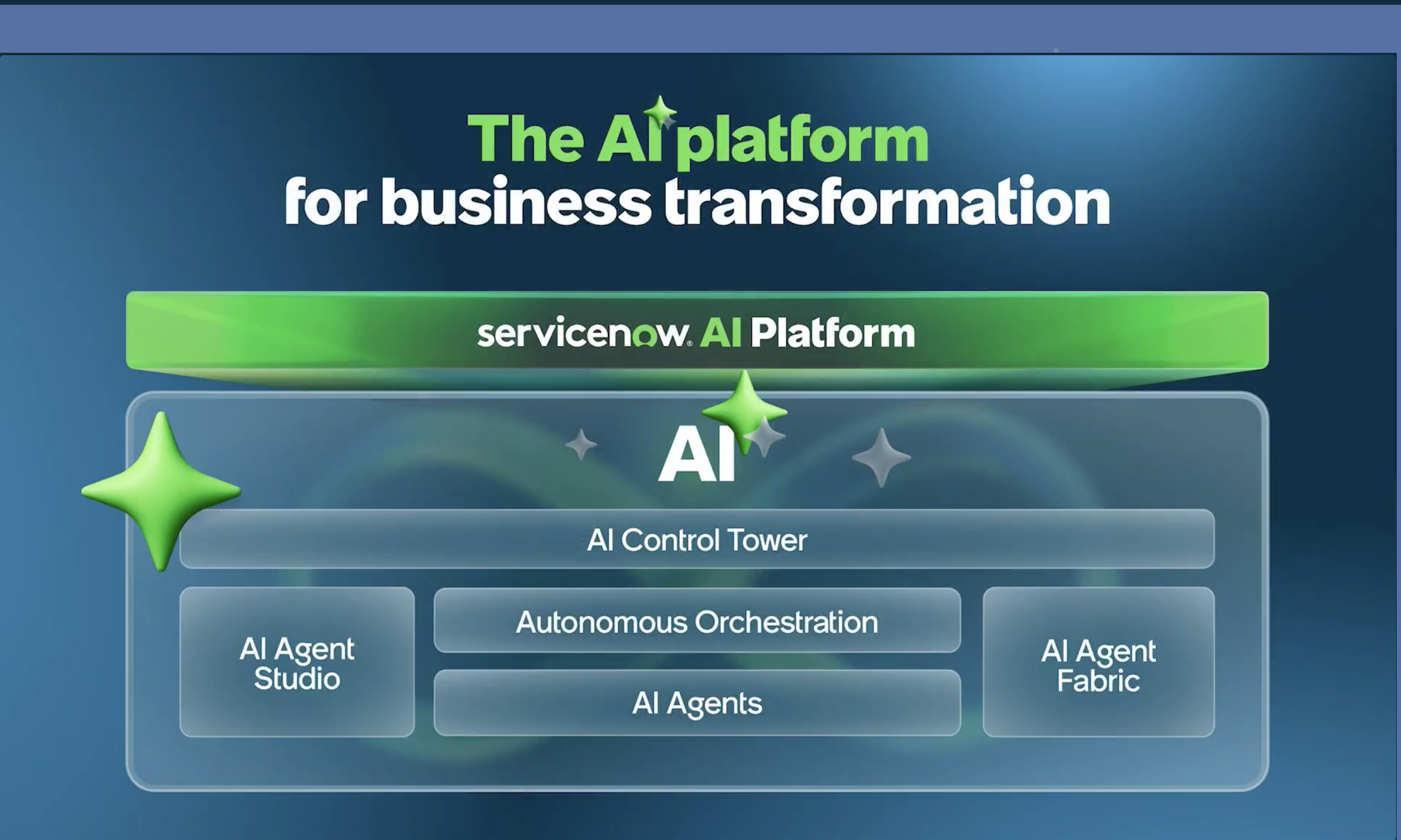
    “What they are is a new digital workforce,” explained John Sigler, EVP of ServiceNow’s AI platform, during the keynote presentation. “And ServiceNow is in a great spot to provide the management of that new workforce with the AI Control Tower, where you can manage, govern, secure, onboard, and offboard, and update all your AI agents.”

    ServiceNow’s focus on orchestration and governance addresses a critical gap Lopez Research has identified in the enterprise AI landscape. While many vendors have spent 2024 defining what agents are and how to create them, few have tackled the orchestration and governance challenges that would allow organizations to confidently deploy these agents autonomously across the various data and software silos. Even with fully baked technology, the potential brand, business, and compliance risk associated with automated workflows provides a significant roadblock to delivering production Agentic AI systems today.

    Sigler showed how the AI Control Tower enables organizations to manage, govern, and secure their AI agents, provide visibility into agent actions, and monitor outcomes. The demo showcased how an employee can drill down into individual agents to see the tasks they perform and the benefits they deliver.

    Orica has already realized these benefits in their IT Service Desk, boosting deflection rates from 18% to 94% and doubling the number of fully resolved cases without human intervention—a testament to the power of automation and agents.

    Reimagining Processes, Not Just Automating Them

    Unlike previous automation waves that often simply accelerated existing workflows, the next wave of agentic AI innovation will emphasize improving processes rather than automating them. The evolution beyond robotic process automation (RPA) was evident in how ServiceNow positions its AI agents.

    In a software demonstration, Joe Davis, EVP of Engineering for Platform and AI, showed how a contract renewal issue typically involving multiple departments and taking days or weeks to complete can be compressed into minutes using autonomous agents working across systems. The key shift here is shepherding a process across what were previously disparate data and application silos. 

    Demo view of multi-agent orchestration of ServiceNow and third-party agents.  Source: ServiceNow

    Chris Taylor, Group CDIO at Stellantis, reinforced this approach: “What we see is an incredible momentum building. We’ve passed the initial fear factor, and people are starting to use it, adopt it, and create tangible value. It’s less of a threat, more of a way to enhance their productivity and enhance their job satisfaction.”

    Stellantis has redesigned its processes around these capabilities, with Taylor noting, “In Europe, 85% of our cars are scheduled and loaded onto transporters using AI. It’s faster. We connect to the customer needs, and we get higher quality.”

    Using Stellantis as an example, ServiceNow showcased a demo of a supply chain specialist alerted by an AI agent that detected a 25% increase in battery cell costs that could impact production. The agent recommended an alternate approved supplier and conducted a comprehensive analysis to ensure the new supplier could deliver the correct product requirements. This integration utilized ServiceNow’s Workflow Data Fabric to bring together data from internal and external systems, enabling the specialist to resolve a major supply chain issue.

    When network transactions began dropping at a Jeep plant, AI agents diagnosed the problem by analyzing the scale of the issue, identifying that it was isolated to network services, and recommending rolling back a change to a Kubernetes container. After approval, the agents executed the rollback, confirmed network performance stabilization, and created a knowledge base article documenting the fix, preventing disruption to car production.

    The demo highlighted more than just automation of existing processes, but a fundamentally better way to detect, diagnose, and resolve network issues, with AI agents working proactively rather than reactively.

    Data Quality: The Foundation for Effective AI

    A fundamental challenge for implementing effective AI remains data access and quality. During the keynote, ServiceNow referenced a Gartner statistic stating that 60% of AI projects will be abandoned by 2026 due to a lack of AI-ready data.

    Gaurav Rewari, SVP and GM of Data and Analytics at ServiceNow, who presented on data strategy, underscored this point: “Here’s the uncomfortable truth. AI agents like the ones you just saw are only as powerful as your data.” This acknowledgment that “the journey to an agentic AI heaven goes through a data hell” represents a significant AI implementation challenge that Lopez Research sees in designing effective AI: data readiness. It’s 2025, and we still struggle with the “Garbage In: Garbage Out” problem.  

    To address this, ServiceNow unveiled its strategy for AI-ready data, which includes:

    1. RaptorDB: A new database offering designed to handle billions of complex transactions supporting operational and analytical workloads in real-time.
    2. Workflow Data Fabric: ServiceNow’s data integration and semantic layer that connects structured and unstructured data across the enterprise.
    3. Workflow Data Network: An ecosystem of 100+ integrations with data platforms including Snowflake, Teradata, AWS, Cloudera, Databricks, Google Cloud, Microsoft, and Oracle.
    4. Data Catalog and Governance: The announced acquisition of data.world to manage, harmonize, and govern data at scale.

    It’s good to see a set of AI platform offerings that focus on data quality instead of just the mechanics of how agents work. Canada Life has already leveraged these data capabilities with their AI-powered catalog builder and Now Assist for Creator to automate self-service management, reducing catalog creation development time by 200%—showing how data-driven AI can transform specific business processes.

    Simplifying Agent Creation

    The low-code/no-code movement isn’t new. Still, we’re seeing a new round of innovation as we move into the AI era/ ServiceNow is making agent creation accessible to business users through AI Agent Studio, allowing non-technical users to create and deploy agents that can transform business processes. By putting these tools in the hands of those who genuinely understand the business, ServiceNow enables organizations to reinvent inefficient processes to be more intelligent and dynamic. To improve return on investment, Lopez Research sees enterprise buyers landing and refining a few specific AI use cases before expanding these tools across the organization.

    “It’s important for everyone to be able to build these AI agents,” said Sigler, before Joe Davis demonstrated creating a research and development agent in about a minute. “You can see it’s low code. You provide instructions using natural language, and you give the agent access to a set of tools.”

    Lloyds Bank has taken advantage of this approach, transforming HR and workplace services with Now Assist and GenAI virtual agents, automatically deflecting up to 90% of HR-related cases and saving teams over 4,000 workdays—demonstrating how business-led AI initiatives can drive significant operational improvements.

    The conference also highlighted how AI agents can transform customer experience processes. Terence Chesire VP, CRM and Industry Workflows at ServiceNow stated during the keynote, “in customer service, you need more than just great omni-channel intake, you need to also orchestrate and automate the hard part, which is resolution and fulfillment, whether it’s a dispute in banking, ordering a telco service, or processing a warranty claim in manufacturing.” This approach to end-to-end process transformation, rather than simple task automation, represents a significant evolution in how organizations approach AI implementation.

    Workforce Transformation: Connecting Front Office to Front Line

    The true power of agentic AI extends beyond process automation to fundamentally transforming how the workforce operates. As CEO of UKG, Jennifer Morgan highlighted at Knowledge 2025, “About 80% of the workforce is made up of frontline, field hourly employees,” yet “only 23% of frontline employees feel that they have access to the technology and the insight that they need.”

    There’s a significant opportunity for AI agents to bridge the gap between the front office and the frontline workers who are the face of the organization to customers. By creating what UKG describes as “a single point of interaction,” organizations can connect field employees back to enterprise systems and data.

    AstraZeneca offers a compelling example of this transformation in action. By revolutionizing their onboarding process with ServiceNow, they’ve streamlined the integration of 20,000 new employees annually, saving over 90,000 hours through optimized workflows. As Cindy Hoots, Chief Digital Officer and CIO, AstraZeneca, explained: “We’ve been able to take processes that used to take 20 minutes, 30 minutes, and now get them to the point that we can do that in just mere seconds.”

    This workforce transformation extends to scientific operations as well. In AstraZeneca’s laboratory environments, AI agents are helping lab managers monitor equipment, automatically detect issues through image recognition, determine warranty status, and even place supply orders based on sensor data. What previously required manual inventory checks and paperwork now happens autonomously, giving valuable time to researchers focused on life-saving discoveries.

    The Missing Link: Governance by Design

    AI Governance shouldn’t be an afterthought designed to remediate compliance issues. AI governance should start as a framework of policies, guidelines, and oversight mechanisms that guide the development, deployment, and use of artificial intelligence to ensure safety, fairness, and transparency. AI governance should be part of developing, deploying, and modifying AI models, systems, and agents. 

    ServiceNow emphasized governance as a foundational element of its AI strategy. The AI Control Tower provides a central hub for managing, monitoring, and governing AI agents across the enterprise.

    This approach embeds governance into the design phase rather than treating it as an afterthought, allowing organizations to deploy autonomous agents more confidently. Yet, organizations must maintain a critical eye by continuously monitoring agents and processes. The system provides visibility into how agents are used across departments, what LLMs they use, and the specific tasks and benefits each agent provides. As AI agents become more autonomous and more widely deployed, this governance capability will be crucial for ensuring security, compliance, and alignment with business objectives. 

    Governance matters because real business value requires the right people and agents to have the correct permissions to manage and use data. In one demonstration, ServiceNow showcased how AI agents could help sales representatives prepare for doctor meetings by aggregating insights from various systems, generating presentation materials, and even remembering the doctor’s lunch preferences. When these AI capabilities extend to patient services, they can orchestrate complex multi-organization workflows, such as automatically generating insurance justification forms and rebate cards while protecting the patient’s data.

    Strategic Partnerships: Accelerating the AI Journey

    The conference highlighted ServiceNow’s partnership approach as crucial to its AI strategy. The company showcased collaborations with data and cloud providers like AWS, Cloudera, IBM, Snowflake, and Teradata, and strategic technology partnerships with Microsoft and NVIDIA.

    These partnerships reveal that the AI capabilities showcased at Knowledge 2025 aren’t overnight developments. The first Knowledge 2025 keynote included a discussion between ServiceNow CEO Bill McDermott and NVIDIA CEO Jensen Huang, who noted they had been working together for six years to reach this point in AI development.

    This historical context is important—it reminds us that we’ve reached a tipping point where we’re seeing the fruits of many years of research and development. The seemingly sudden explosion of AI capabilities is the culmination of sustained investment and strategic collaboration.

    Orchestrating Tomorrow: The New Business Operating System

    If done well, AI agents are not mere automation tools but transformative elements that can reimagine how work gets done across the enterprise. ServiceNow has addressed several key challenges that have limited the impact of AI initiatives by creating enhancements to orchestration, data quality, processes, and governance. 

    As enterprises navigate this transition, the shift from isolated AI tools to orchestrated AI agents working across departments represents a fundamental change in how work gets done, transforming tasks that once took days into processes completed in minutes, and turning the promise of AI from a technology buzzword into tangible business results.

    The future of work isn’t just about automating what we do today—it’s about reimagining what’s possible when AI agents can work autonomously and collaboratively across systems, data sources, and departments. It’s about creating what Lopez Research calls Right-time Experiences that deliver the correct information to the right person or thing at the right time. The shift from what we discussed in the 2014 Right-time Experiences book is that those “things” are intelligent connected devices and AI agents working with humans to complete workflows round-the-clock. ServiceNow’s customer use cases and product demonstration suggest this future is well on its way to becoming a reality.

  • Key Trends AI in Marketing and Communications

    Artificial intelligence, once only accessible to highly technical individuals, has evolved from an obscure to mainstream use across consumers and businesses. AI promises to deliver practical tools that will transform how marketing and communications professionals operate. Drawing insights from a recent conversation with Tim Marklein, CEO of Big Valley Marketing, alongside the latest industry developments, this article explores how AI is reshaping marketing and communications—and what business leaders need to know to navigate this transformation effectively.

    The Current State of AI Adoption in Marketing

    Despite widespread discussion about AI revolutionizing marketing, the reality is more nuanced. As Marklein points out, “depending on what survey you look at, you’ll hear AI is changing everything in marketing communications and others where people will say they’re not using it really at all.” The truth lies somewhere in between—many organizations are still testing rather than fully integrating AI into their workflows. While AI tools have become increasingly accessible, many marketing departments are in an experimental phase, selectively applying AI to specific tasks rather than implementing comprehensive AI strategies.

    Three Key Areas Where AI Is Gaining Traction

    According to Marklein, marketing teams are finding value in areas such as search alternatives, pattern analysis and writing assistance. This assessment aligns with Lopez Research’s industry observations.

    It’s clear that LLMs have become a powerful alternative to traditional search engines, enabling business professionals to quickly gather information about trends, topics, and industry developments. Tools like Perplexity and others are enabling marketers to ask conversational questions and receive synthesized answers instead of sifting through pages of search results. Of course, marketers must still place a critical eye on search findings and review the source links.

    One of AI’s strongest applications is identifying patterns across large datasets. Marketing teams are using AI to analyze audience behaviors, summarize interviews, extract themes from reports, and understand what industry analysts, journalists, and customers are saying. Identifying patterns supports market research and content planning efforts but also provides the opportunity to boost top line revenue by discovering trends that lead to new product offerings.

    AI excels at helping transform content from one format to another—such as simplifying technical content, converting long-form content into shorter pieces, and adapting messaging for different channels. Leading marketing teams will leverage AI to scale their content production while maintaining consistency and brand voice.

    How do you differentiate in an AI Era?

    Perhaps the most crucial insight from industry leaders is where AI falls short: generating original thinking and authentic brand positioning. As Marklein emphasizes, “There’s going to be a premium on original thinking,” particularly in the B2B context where customers seek a company’s unique perspective based on their expertise and frontline experience.

    While everyone is talking about reasoning models and AI becoming more human-like, it’s important to note that today’s AI can and should augment human creativity rather than replace it. The most effective marketing strategies will leverage AI for efficiency while preserving human ingenuity for differentiation. Personally, I’m pleased and relieved to hear other individuals discuss that there’s still room for humans in content creation.

    AI and Workflow Integration: The Key to Value

    A recurring theme in both the podcast and recent industry developments is the importance of integrating AI into existing workflows. Standalone AI tools provide limited value; the real potential emerges when AI is embedded within the tools marketers already use daily.

    However, as Marklein notes, this creates a new challenge: “The AI tools that we would like to use aren’t the ones that are necessarily integrated into the workflow.” Organizations are still navigating this disconnect, often using different AI tools for different use cases while waiting for more seamless integration solutions.

    Metrics and Measurement: Evolution, Not Revolution

    When it comes to metrics, AI isn’t necessarily changing what marketing teams measure, but rather how they measure it. Traditional marketing objectives and KPIs remain relevant—what’s changing is the ability to analyze data more efficiently and extract insights more effectively.

    As Marklein explains, AI probably won’t “tell you anything new about how you should measure brand growth, equity, and value,” but it can help marketers track and instrument these measurements more effectively, especially when connected to existing data streams.

    Navigating Authenticity and Ethics

    Trust remains a significant concern in AI adoption. During the podcast, Marklein highlighted research showing that while disclosure about AI use is often recommended, “80% of people don’t trust AI. So disclosing that you’re using AI actually makes people trust it less in the short term”.

    To develop trusted AI, organizations needed to take both a broader and more nuanced approach that focuses on emphasizing appropriate use of AI rather than just responsible use. Additionally, organizations must be transparent about who is using AI and why they’re using it. AI governance needs to be part of the marketing strategy at the outset.

    As AI capabilities continue to evolve, the organizations that thrive will be those that strategically balance automation with authentic human insight, using technology to amplify their unique voice rather than replace it.

    You can review Big Valley Marketing’s research on AI disclosure and transparency here. If you found this article useful, please share it on your social channels and subscribe to my channels. Subscribe to my YouTube channel here: https://www.youtube.com/@AIwithMaribelLopez and my podcast here: https://bit.ly/3R0Etal.

  • Cisco Attacks AI Cybersecurity Threats With New AI Defense

    Companies need security solutions that protect against AI cybersecurity threats

    Over the past several years, the security landscape rapidly evolved with the introduction of AI, specifically generative AI. AI spawned numerous new categories of AI cyber threats, such as data inference, transfer learning attacks and model inversion. Additional, AI-enhanced phishing attacks are driving increased breaches and data loss. Today, companies need specialized security solutions that protect AI systems and their components from various security threats (e.g., adversarial attacks) and vulnerabilities (e.g., data poisoning). These security products must protect the data, algorithms, models, and infrastructure involved in AI applications.


    What Cisco Announced
    Last week, Cisco unveiled its latest security innovation called Cisco AI Defense. The solution offers a new approach to targeting AI safety and security challenges. Let’s break down Cisco’s announcement, the AI-specific features of its latest offering, and the benefits it provides to security operations (SecOps) teams.

    Today, every security vendor worth evaluating offers new AI-enhanced products with features such as conversational AI assistants and streamlining alerts to help highlight relevant security threats. The Cisco AI Defense platform builds on Cisco’s existing Secure Access technology and incorporates new features designed specifically for the AI ecosystem. Specifically, AI Defense aims to address two core AI problems: 1) securing enterprise access to AI applications and 2) ensuring the safety and security of AI models and applications built by organizations.

    What are the AI-Specific Features of Cisco AI Defense

    Cisco’s security solutions leverage threat intelligence from over 50 billion daily events and integrates data from tools like Splunk and other third-party feeds. The data from these events helps detect AI-specific vulnerabilities and threats. However, the company also added more AI-specific features such as:

    See full article at: https://www.forbes.com/sites/maribellopez/2025/01/21/cisco-attacks-security-threats-with-new-ai-defense-offering/

    I no longer post the full article because there are websites that just scape my content and won’t even acknowledging me as the author.

  • Palo Alto Networks Simplifies Cybersecurity with Cortex Cloud

    Palo Alto Networks Simplifies Cybersecurity with Cortex Cloud

    With the average organization using dozens of cybersecurity tools, security and IT leaders are drowning in complexity and expense. According to Palo Alto Networks’ research, the average organization faces nearly 2 million security-related findings, making it impossible for security teams to prioritize and address all potential threats effectively.

    Adding to this complexity, cloud infrastructure changes rapidly, creating an ever-evolving risk landscape. The company’s research shows that 45% of cloud infrastructure risks change monthly. Meanwhile, adversaries are using AI to deliver more effective attacks more efficiently, cutting their time to data theft in half over recent months. While attackers may benefit from new AI capabilities, new AI-infused security solutions will also benefit defenders.

    Market research firms, such as Gartner and IDC, have predicted the convergence of cloud security and traditional security operations as a key trend that will minimize these challenges. For example, IDC’s “FutureScape: Worldwide Security and Trust 2024 Predictions” projected that by 2026, 60% of enterprises will consolidate their cloud security tools into unified platforms that integrate with security operations. Meanwhile, companies shared with Lopez Research that they are looking for AI-powered solutions to minimize alert fatigue and provide intelligent remediation recommendations based on correlating data across multiple products.

    Cortex Cloud Aims to Improve and Simplify Security

    Palo Alto Networks took this challenge head-on with the announcement of its Cortex Cloud platform. Cortex Cloud integrates and evolves its Prisma Cloud capabilities. This shift represents more than a simple rebranding for Palo Alto because it’s a fundamental re-architecture of the platform that aims to unify cloud security with security operations center (SOC) capabilities.

    This platform integration enables security teams to see the complete picture of their security landscape, from application code to cloud infrastructure to runtime environments. Cortex Cloud also integrates with third-party security tools and scanners to preserve existing security investments while benefiting from unified analytics and automation. Specifically, the Cortex Cloud platform offers four components that enable companies to:

    • Minimize application security vulnerabilities. Cortex Cloud identifies and prioritizes issues across the development pipeline with end-to-end context across code, runtime, cloud and third-party scanners. This part of the solution supports preventing issues in app development before they become production issues that attackers can target.
    • Create unified cloud posture visibility. Cortex Cloud builds on Prisma Cloud’s capabilities. It unifies visibility in one natively integrated platform, including cloud security posture management (CSPM), cloud infrastructure entitlement management (CIEM), data security posture management (DSPM), AI security posture management (AI-SPM), compliance and vulnerability management (CWP). It also supports AI-driven prioritization and automation-first remediation of multi-cloud risks.
    • Update Cloud runtime features to stop attacks in real-time. Cortex Cloud natively integrates the unified Cortex XDR agent, enriched with additional cloud data sources, to prevent threats with advanced analytics.
    • Deliver AI-driven SOC transformation. Cortex Cloud natively integrates cloud data, context and workflows within Cortex XSIAM to significantly reduce the mean time required to respond (MTTR) to modern threats with a single, unified Security Operations (SecOps) solution.

    How Does Cortex Cloud Benefit Buyers?

    The platform’s unified approach brings several practical benefits, such as unified dashboards and reporting across all security functions. At the heart of Cortex Cloud is its unified data plane, which integrates data from various sources, including cloud posture, runtime and application security. When security incidents occur, teams no longer need to manually coordinate between different departments and tools — all relevant information is available in one place, with unified reporting and consistent role-based access controls. However, Cortex Cloud goes beyond simply identifying security issues; it provides rich contextual information to help security teams understand the full scope and impact of security incidents.

    Cortex Cloud leverages advanced analytics and machine learning to prioritize alerts and security threat findings intelligently. The platform helps security teams focus on the most pressing issues that require immediate attention by considering factors such as threat intelligence, asset criticality and risk profiles. This AI-powered approach significantly reduces the time and effort needed to identify and address potential security breaches, enabling organizations to respond more effectively to evolving threats. This contextual awareness is particularly valuable in complex, multi-layered cloud environments where the relationships between different components can be challenging to discern.

    One of the other key benefits of Cortex Cloud is its automation capabilities. The platform can automatically remediate specific security issues, such as misconfigurations, without manual intervention. This feature reduces the workload on security teams and ensures that potential vulnerabilities are addressed promptly, minimizing the risk of exploitation. By automating routine tasks, Cortex Cloud empowers security professionals to focus on more strategic initiatives and proactive threat hunting.

    Meeting Customers Where They Are

    Palo Alto Networks’ move can potentially disrupt existing market prices by offering all multiple capabilities in a single package rather than requiring separate purchases for different controls. In one case, Palo Alto Networks demonstrated how its pricing would compare with that of one of its competitors using publicly available rates on the AWS Marketplace. In that scenario, the Cortex Cloud pricing was approximately 50% less than competitive solutions while providing more comprehensive coverage.

    But this doesn’t translate into a one-size-fits-all buying approach for customers. For existing Prisma Cloud customers, Palo Alto Networks offers flexible migration options, including like-for-like upgrades at no additional cost. The company emphasizes that adding the new Cloud Runtime Security or SOC capabilities is optional, and buyers can work with channel partners and their sales representatives to select what’s right for the organization.

    Accelerating the Industry Shift

    The announcement represents a significant shift in how enterprise security and cloud teams could achieve a more holistic security approach. Rather than treating cloud security as a separate domain, organizations can now manage it as part of their broader security operations strategy with shared intelligence, unified workflows and automated responses. For organizations struggling with alert fatigue and siloed security tools, Palo Alto Networks’ integrated approach could provide a more manageable and effective way to secure their cloud environments.

    There’s a significant opportunity for Palo Alto to gain a larger share of wallet as companies move from fragmented point solutions to more comprehensive security platforms such as Cortex Cloud. However, the platform transition also presents distinct challenges. Organizations that have recently invested in various security products will understandably be hesitant to abandon these investments before realizing their full value. Additionally, enterprises must carefully weigh the benefits of platform consolidation against the potential risks of becoming overly dependent on a single vendor’s ecosystem. Overall, the shift towards leveraging AI and creating platforms represents a leap forward in simplifying and improving an organization’s ability to prevent cybersecurity threats.

  • Wendy’s Serves Up Generative AI To Boost Its Customer Experience

    Wendy’s Serves Up Generative AI To Boost Its Customer Experience

    How generative AI changes the quick service restaurant industry

    Every industry, including the quick service restaurant (QSR) market, plans to transform its business with artificial intelligence (AI), especially generative AI. Several years ago, Wendy’s embarked on its AI journey, leveraging cloud computing services and generative AI to enhance employee and customer experiences. The drive-thru experience presents numerous challenges for QSR restaurants due to the complexities of menu options, limited-time offers, special requests, and ambient noise.

    Wendy’s chose to tackle the drive-thru experience with AI because 75 to 80 percent of Wendy’s customers choose the drive-thru as their preferred ordering channel. The company saw a tremendous opportunity to improve the customer experience by creating a seamless ordering experience using AI automation in the drive-thru.

    In an interview with Maribel Lopez of Lopez Research, Wendy’s CIO Matt Spessard shared how its AI program had advanced over the past year and shared advice for other leaders looking to tackle AI within their business. In 2024, Wendy’s announced an expansion of its partnership with Google Cloud, tapping into Google’s AI technology and resources to enhance its generative AI platform called Wendy’s FreshAI. Wendy’s Fresh AI aims to address challenges that traditional AI couldn’t solve, such as understanding casual conversations and handling the extensive customizations of Wendy’s menu. For example, the back-and-forth nature of conversations is an intensely complicated technical challenge for AI. It also added Spanish as a language option in 2024.

    Traditional rule-based AI chatbots weren’t the answer because they can’t easily support natural conversations’ diverse and dynamic nature. For example, Wendy’s realized there are over 200 billion combinations of words and options to order a Dave’s Double. Additionally, it can take years of development and tremendous work to maintain, modify, and expand capabilities within these more rigid rules-based solutions. Today, Wendy’s uses generative AI to interpret conversations, create responses, and adapt in real-time instead of following a narrow set of rules.

    While many AI discussions focus on job loss issues, Wendy’s shared that its AI efforts also benefit its employees. Wendy’s FreshAI works alongside restaurant teams, eliminating ordering issues while empowering crew members to focus on preparing and completing orders efficiently.

    How does Wendy’s measure AI success and return?

    Wendy’s takes a pragmatic view of what AI success means. Its efforts focus on delivering speed, accuracy, and consistency to customers. It measures these results with metrics such as how many orders were submitted without human intervention and the consistency of the customer experience at the drive-thru. What have been the results thus far? The percentage of orders successfully handled by Wendy’s FreshAI without restaurant team member intervention averaged 86%, and it expects the average to increase.

    One test site showed service times 22 seconds faster than the Columbus, Ohio market average. Wendy’s noted that other QSR companies define “accuracy” as any order started by the AI assistant and submitted to the point-of-sale system, including orders where a crew member joins the conversation to correct an inaccuracy. Wendy’s shared that if it uses that broader definition of accuracy, its FreshAI success rate reaches nearly 99%.

    What’s next for AI at Wendy’s

    Wendy’s FreshAI has moved from pilot to production. It is now available in nearly 100 restaurants across 17 states with Spanish language capabilities. There’s still tremendous upside to expanding the technology deployment as Wendy’s operates over 7,000 restaurants globally. Going forward, Wendy’s sees the Fresh AI assistant as a platform that will scale across various ordering channels, such as mobile apps, kiosks, and smart devices.

    Advice on tackling AI innovation?

    Wendy’s CIO Spessard said the company learned many lessons along the way. He provided the following key pieces of advice for organizations looking to adopt AI:

    1. Identify the right use case and technology. Wendy’s emphasizes that organizations need to think pragmatically about the use cases where AI can provide the most value and then select the appropriate AI technology (e.g., generative AI, traditional machine learning) to fit that specific need. AI is a broad spectrum of technologies, so the “right tool for the right job” approach is essential.
    2. Start with small-scale experiments. Spessard recommends that companies start with small-scale experiments within the organization, exposing employees to AI capabilities. This exposure helps organically grow the usage of AI as more use cases are identified. Spessard said Wendy’s had to resist the urge to deploy too widely and quickly. Iterating in the early stages of its AI deployment helped Wendy’s achieve its desired accuracy and consistency.
    3. Emphasize continuous improvement. Wendy’s stressed the importance of a feedback loop, continuous iteration, and a mindset of even 1% improvement every day. It regularly analyzes customer and employee feedback, allowing Wendy’s to refine aspects like tone, cadence, and phrasing in Wendy’s FreshAI. These refinements were critical to enhancing the AI assistant’s performance.
    4. Engage stakeholders early and often. Wendy’s found it very valuable to regularly perform demonstrations of the AI assistant’s capabilities and progress to key stakeholders like franchisees. These demos helped build trust and support for the initiative as stakeholders could see the improvements over time. Additionally, Wendy’s noted that the rapid democratization of AI technologies is making change management easier, as employees are already familiar with using AI in their personal lives, setting the expectation for it in the workplace as well.

    A key takeaway from the discussion was to ground AI innovation in iterative improvement, continuously engage employees and partners in the process, and cultivate a willingness to experiment and learn rather than trying to perfect the technology before deployment.

  • SAP Unveils Business Data Cloud and Strengthens Databricks Partnership

    SAP Unveils Business Data Cloud and Strengthens Databricks Partnership

    Last week, SAP announced a major evolution in its enterprise data management platform with the launch of SAP Business Data Cloud. SAP Business Data Cloud represents a significant advancement in how enterprises can manage, analyze, and derive value from their data. As Irfan Khan, Chief Product Officer and President of Data and Analytics at SAP, explained in an interview with Maribel Lopez of Lopez Research: “Business data cloud takes all of SAP core business applications and shares the data in a zero copy fashion with whomever the consumer may be.”

    The Databricks Partnership

    One of the most significant aspects of this announcement is the deepened partnership with Databricks. The integration brings Databricks’ capabilities directly into SAP Business Data Cloud, creating a powerful combination for enterprises looking to leverage AI and machine learning. As Khan noted, “SAP Databricks now is part of the building materials of our business data cloud,” which he explains will radically improve time to market and value for customers.

    Addressing Key Industry Challenges

    The announcement comes at a crucial time, as organizations continue to struggle with data quality and integration. According to SAP’s global survey of 1,200 business and technology leaders, 55 percent cite poor data quality as their biggest challenge, with nearly half struggling to harmonize data across ecosystems.

    At the SAP analyst innovation summit, companies using the early preview of business data cloud shared under NDA their enthusiasm for the speed at which they could develop systems that leveraged a variety of business data and the insights that could be gained from turning this information into AI-led intelligence. Markus Hartmann, Corporate Vice President and Head of Business Technology at Henkel, echoed this perspective in the SAP blog when he stated: “SAP Business Data Cloud will help us unlock the value of our data and drive innovation across our business. Its semantically rich data products and deep Databricks integration will connect and enhance our existing data products, ensuring long-term adaptability.”

    Looking Ahead

    For organizations wondering where to begin, Khan offers clear guidance: start with Business Warehouse modernization. “Look no further than the most critical data that you have typically sit inside a BW (business warehouse) environment,” he advises, highlighting the opportunity to leverage existing data for AI and advanced analytics initiatives.

    The platform is designed with openness and customer choice in mind, featuring integrations with partners like Collibra, Confluent, and DataRobot, with more strategic partnerships on the horizon. This ecosystem approach, combined with the Databricks integration, positions SAP Business Data Cloud as a significant step forward in enterprise data management and AI enablement.

  • Analyst Perspective: 3 Ways AI Improves Business Processes

    Companies mentioned: Juniper Networks, Microsoft, NICE

    Summary:

    In today’s competitive business landscape, harnessing the power of artificial intelligence (AI) is essential for organizations to thrive. This transition from exploration to implementation can be daunting, but it’s crucial for companies to align AI initiatives with their core business objectives to drive immediate value. This article outlines three key areas where AI can significantly enhance business processes: elevating customer experience through personalized interactions, streamlining software development with generative AI tools, and optimizing network performance using AI Operations (AIOps) to proactively manage and troubleshoot issues. By leveraging AI in these strategic areas, businesses can not only improve operational efficiency but also enhance customer satisfaction and gain a competitive edge in their respective industries.

    You can download the report here:

    3_Ways_AI_Improves_Biz Processes03_12_24

  • Microsoft Demonstrates Generative AI Customer Momentum

    Image of Emily He at Microsoft
    Emily He, CVP Microsoft

    The entire software market is going through a rather substantial change based on advancements such as generative AI. After Microsoft’s Build, Charles Lamana and Emily He of Microsoft shared an update with industry analysts on the state of AI across Microsoft’s portfolio. Many remember Marc Andreessen’s famous quote saying that software was eating the world. Lamana described how the software evolved from green screens to browser-based SaaS applications but that, as an industry, we hadn’t fundamentally changed the software industry’s economics, workflow, and operations. In a revised take on Andreessen’s quote, Lamana said, “AI is eating software.” It aptly describes how we’re entering a new era of software and technology rapidly changing by adding AI capabilities.


    The market experienced a seismic shift in AI innovation in the past six months focused on how foundation models change what’s possible in software through natural language understanding, image, and video generation, and simplification of software programming. These large-scale transformer models can also deliver new functions, such as Windows UI automation.


    AI has the potential to change the way a company tracks its financials, delivers goods and how it services to its customers. AI will also launch new applications, experiences, and data-driven products. To that end, Microsoft announced a plethora of assistive tools that it calls Copilots across its suite of products. The idea behind a copilot is that it will assist, not replace, an individual by providing the right data within the task context. AI copilots accelerate an individual’s productivity by collecting information, automating workflows, and accelerating task completion.


    Microsoft shared many examples of how it anticipates generative AI will change workflows and processes across the business. For example, a copilot can assist a customer service agent by surfacing the latest information found across a company from a vast set of internal documents, including previously resolved case notes and published knowledge articles. It shared a real-world example based on its use of the technology.


    Today all of Microsoft Azure’s thousands of support engineers use the Dynamics 365 customer service Copilot to provide Azure support to Azure customers. With this software, the agent doesn’t have to spend time searching for information. Dynamics 365 customer service knows the context from the company’s internal data, including customer names and relevant knowledge articles. It can surface all the relevant information and timelines for the case an agent is working on. The Copilot expands on the right side of an agent’s screen and can help the agent draft a reply to a customer with just one click using generative AI.


    In sales, a copilot can summarize a call with a prospect and generate a draft of a follow-up email. Across the general business, an AI-enhanced workspace suite can help employees draft emails, prepare for meetings, and explore data. Marketing teams will benefit from content ideas, data inspiration, and social media post suggestions. For supply chain and finance teams, it can assist with items such as status reports.


    Lopez Research describes these as right-time experiences because it provides the right information and insights at the point of need. Today’s artificial intelligence services are different from what we discussed three years ago, which had focused more on the automation of routine. Three years ago, the technology wasn’t there to build copilots from an infrastructure and AI foundation model perspective. Lamana described this as “AI before foundation models, and AI after foundation models’ as the pivot point for why we can offer AI-assisted applications today.


    Emily He shared a business update demonstrating that the concepts resonated with customers. While the technology had been in limited preview, Microsoft said that it had over 40,000 organizations using these generative AI capabilities in Microsoft business applications, which surprised me. At one point, the company said 600 customers were trialing various features. Whether it’s prompt engineering or even figuring out how a company can create custom-tune versions of chat GPT, Microsoft said its latest announcements were driven by customer feedback.


    One item that has surprised the market is the rapid cadence of Microsoft’s co-pilot releases across its software portfolio. During Microsoft Build, we learned that Microsoft created a co-pilot framework to scale the design of new copilots. It has also invested heavily in engineering, AI infrastructure, Microsoft-created AI models, and partnering with Open AI for several years. Coupling its AI investments with OpenAI’s foundation models has proven a successful strategy, given the myriad announcements Microsoft has made since March of 2023.


    Yet, AI is not without its challenges for organizations. Companies must design data strategies that allow them to use a combination of open source and more private generative AI models without compromising security, privacy, and regulatory compliance. It’s a crucial question that many IT buyers have asked Lopez Research. To alleviate these concerns, Microsoft offers Azure OpenAI Services allowing an organization to use its data with OpenAI and Azure storage encrypted at rest with Microsoft Managed Keys within the same region as the resource. This structure preserves all the security and permissions without placing proprietary data directly into open-source models.


    For years I’ve been discussing the potential of AI for business, but it always lacked the connection to the applications and the workflow. Today, Microsoft and other technology vendors are pulling these core capabilities into their applications to seamlessly integrate AI into business workflows to make individuals more productive without needing to learn how to use AI. This is a great step for the industry.

  • Managing Multi-Cloud Madness

    Managing Multi-Cloud Madness

    [et_pb_section fb_built=”1″ admin_label=”section” _builder_version=”3.22″][et_pb_row admin_label=”row” _builder_version=”3.25″ background_size=”initial” background_position=”top_left” background_repeat=”repeat”][et_pb_column type=”4_4″ _builder_version=”3.25″ custom_padding=”|||” custom_padding__hover=”|||”][et_pb_text admin_label=”Text” _builder_version=”3.27.4″ background_size=”initial” background_position=”top_left” background_repeat=”repeat”]
    Vittorio Viarengo VMware


     Companies of all sizes embraced cloud computing, with organizations deploying workloads and applications across a mixture of private infrastructure and public clouds. The terms multi-cloud and hybrid cloud are part of today’s technology lexicon. Multi-cloud refers to using multiple cloud computing services from different vendors in a hybrid infrastructure. Instead of relying on a single vendor for all its cloud computing needs, a business may use multiple clouds to access best-of-breed cloud services, diversify infrastructure risk and minimize vendor lock-in.

    While multi-cloud computing provides impressive benefits, it’s not without challenges. Cloud vendors use different technologies, making it more difficult for IT leaders to standardize on a single set of tools and processes. An increasingly diverse set of infrastructure solutions makes it challenging to manage the performance, security and governance of data and applications that operate across multiple clouds. Constrained IT teams lack the headcount to have a dedicated staff to manage the various clouds.

    The 2022 Lopez Research enterprise benchmark survey revealed demand for such solutions, with 72 percent of respondents agreeing that their company needs tools to reduce multi-cloud complexity. When speaking with Lopez Research, potential buyers expressed a desire for a multi-cloud management solution. Ideally, organizations would like to provide an environment where developers can provision services from any cloud provider without understanding each cloud provider’s specific setup and configuration details. However, many IT leaders claimed multi-cloud services were too good to be true.

    Simplifying the multi-cloud management challenge

    Companies need to simplify cloud management, but the question is how to accomplish such a Herculean task. Recognizing an opportunity, VMware introduced a set of multi-cloud solutions to abstract complexity, similar to how it created virtualization to abstract the underlying hardware layer in the data center.

    VMware’s Cross-Cloud services portfolio aims to create a unified way to build, operate, access, and secure any application on any cloud from any device. The portfolio includes services for application development, cloud management, cloud infrastructure, security and networking, and secure user access. At VMware Explore 2022, VMware also introduced a new multi-cloud management portfolio—VMware Aria—which will provide end-to-end solutions for managing cloud-native applications and infrastructure. The portfolio promises to help customers manage their costs, performance, configuration, and delivery across public and private clouds.

    For a separate project, I interviewed Vittorio Viarengo, the Vice President of Cross-Cloud Services at VMware, to learn more about the company’s perspective on multi-cloud management. During my discussion with Viarengo, I shared the skepticism I heard from IT leaders. He countered, “We are used to that objection because we heard it with virtualization. There is always a tradeoff between performance versus simplicity when you create abstractions. It comes down to the ability to manage multiple items versus going deep into a specific area.”

    The many faces of multi-cloud management
    My conversations with large cloud computing providers yield a slightly different perspective. Hyperscalers argue they provide all the management and security tools for their clouds and offer solutions that support multi-cloud environments. Meanwhile, Viarengo says the choice isn’t binary. In some areas, you’ll need to use the specific tools of one cloud; in other cases, you can simplify management by using cross-cloud services. It’s about leveraging the best of both worlds.

    He said, “For example, when using VMware Cross-Cloud services, like Aria for management or Tanzu for application development, we never hide the underlying infrastructure. If you’re deploying something on Google or Azure, the company has access to all the underlying APIs. We provide a customer running applications in multiple places, such as on Microsoft’s Azure, on-prem and on AWS, with a single console to manage applications across all clouds. Developers can check the health and performance of applications across locations. Now, if a developer wants to stop a machine learning workload in a specific cloud (e.g., Google Cloud), the developer will have to log in to that cloud to terminate the workload.”

    In my mind, Viarengo’s comments surface an important market distinction and opportunity. Often, developers embrace a particular cloud for its specific features, and the buyer would want to preserve those benefits. However, technology leaders also need visibility for application performance and security across clouds. An abstraction layer provides balance for both developers and cloud admins. Viarengo explained that cross-cloud services like Aria address application performance issues and security data risks by providing a company with visibility across all its cloud assets. He said, “Without the visibility and models of Aria Hub and Aria Graph, you cannot answer questions, like how much these applications cost, how are they performing, and what is the infrastructure they’re running on? Have you properly configured the security? Without that model, Operations must collect that information from multiple consoles.”

    Monocloud and repatriation are terms we also hear IT leaders discuss. However, IT leaders will not return to the days when most of their applications resided in private data centers or used a single public cloud. Lopez Research expects companies to rightsize cloud computing investments but continue to place workloads in the best location to achieve the task at hand. Sometimes this is a specific public cloud or on-premises. Viarengo said, “If we agree that 75% of organizations are using two or more or more clouds, that is where the value of a cross-cloud service comes in.”


    Where do you begin?
    While every company is at a different place in its cloud journey, I asked Viarengo to categorize the first several use cases a company should adopt. He shared the following advice. First, a company should anchor its technology deployments to its business goals, such as saving money, increasing agility, or growing revenue.

    Viarengo said there are several use cases that many types of companies could employ. One potential use case is the ability to switch deployment environments quickly to meet cost, functionality, or resiliency requirements. Cross-cloud application management, using tools such as ARIA, is another important consideration, as is security. For example, using a service mesh like Tanzu can allow for creating Service Level Agreements (SLAs) and automatically scaling microservices across multiple clouds. Meanwhile, topology visibility and micro-segmentation improve security by ensuring that the same security policies are applied consistently to every cloud in your cloud estate. These are just a few examples of the many possibilities that a multi-cloud management strategy can offer.


    Technology never stands still.
    The cloud continues to evolve, and so does VMware. Organizations have been working with VMware since the late 1990s; much has changed. At the close of our discussion, I asked Viarengo to share what’s different about VMware that may not be evident today.

    He said, “I’d love our customers and prospects to realize this is a new VMware. We’ve been so successful in the private cloud, but over the last five years, we have pivoted the company to address this multi-cloud world. We are using the lingua franca of the native cloud, solving multiple problems with APIs, microservices, and Kubernetes. There are use cases where it makes sense for enterprise workloads to use vSphere and VMware Cloud, but VMware is increasingly investing in solving the problems of native multi-cloud.” The key phrase in this discussion is native cloud. Any vendor that wants to be successful must have a set of solutions designed from the ground up as cloud-native services.


    “VMware believes in enterprise pragmatism. We realize that every customer is on a different journey. Some companies have on-premises infrastructure and applications they want to modernize and optimize with vSphere. If they move to the cloud, we can help them move hundreds of workloads in months, not years, with VMware Cloud. If they are cloud-native and building applications across multiple clouds, they have Cross-Cloud services to help them with multi-cloud. We allow companies to adopt the cloud at their own pace. This is what differentiates VMware from the competition and excites me.”

    Key Takeaways.
    The multi-cloud management problem is real. From where I sit, it’s clear that VMware’s picked up on a market need, but that doesn’t mean it’s without its challenges. Cloud services don’t stand still, so VMware must rapidly innovate to prove it is the cross-cloud provider of choice. Additionally, I expect more software technology vendors to mimic VMware’s approach. Viarengo acknowledges this. Even cloud providers like Google Cloud, with its Anthos product, want to offer a version of Cross-Cloud services. Still, it’s good to see established providers like VMware weigh in to provide support for such a critical use case. CIOs need to focus on creating a multi-cloud strategy rather than firefighting the randomness of supporting multiple cloud services.

    [/et_pb_text][/et_pb_column][/et_pb_row][/et_pb_section]
  • Microsoft Showcases How Companies Are Using Technology To Thrive During A Pandemic

    Microsoft Showcases How Companies Are Using Technology To Thrive During A Pandemic

    The COVID-19 pandemic forced companies of all sizes to shift business practices. Technology plays an increasingly important role as organizations enable remote work and contactless engagement. Microsoft showcased many examples of how companies were transforming their business at the Microsoft Business Applications Summit. Alysa Taylor, Corporate Vice President Microsoft Business Applications & Global Industry, launched her keynote with a discussion of how the world and Microsoft have changed. “This is a whole new era for us. Historically, big transformation initiatives that would happen over the years have condensed out of necessity to weeks or even in days.”

    Systems that enable agility are critical. Microsoft’s Taylor described how L’Oreal expanded from manufacturing beauty products to creating hand sanitizers as an example of how technology can support adaptive, flexible businesses.  Companies are also moving faster with their deployments. For example, C3.ai  moved from selecting to deploying Dynamics 365 within several weeks.

    Taylor spoke of how Dynamics 365 and the Power Platform were helping companies move from reactive to proactive business workflows where employees could take intelligent actions based on data. Today, everything from connected devices to data in the supply chain and collaborative applications is a source of potential insight.  Microsoft describes this as a digital feedback loop that captures and utilizes information from products, assets, customers and people (employees). Each touchpoint offers more data that enhances the feedback. Microsoft also highlighted the importance of having a cloud strategy where you can securely store data and comply with nation-state regulations.

    Enter Microsoft with the mega stack.

    Unfortunately, IT struggles to incorporate this type of context into legacy apps. Companies need to redesign or purchase solutions that can integrate and analyze data from a wide range of sources.

    None of these concepts are new. What’s different today is that vendors, such as Microsoft, are delivering more comprehensive portfolios. In the past two years, Microsoft integrated various assets from app development to customer engagement into what it calls the Power Platform, which includes Power BI, Power Apps, Power Automate, and Power Virtual Agent. Many of the tools were design to allow everyone, not just professional developers and data scientists, to create applications and analyze data. Additionally, Microsoft integrated these functions with the Dynamics 365 applications and Azure to enable a closed-loop process from data collection through insight and action.

    Leading companies are delivering rich customer experiences.

    The Microsoft Business Applications Summit is typically an event where customers come to showcase and share ideas on how to use Microsoft’s technology. With the change to a virtual event, Microsoft took the lead in sharing how its customers are delivering proactive and intelligent engagement. For example:

    Chipotle creates a data-driven customer profile.

    It uses a combination of Microsoft’s Power Platform, Dynamics 365 Customer Insights and Azure to unify the company’s current customer information and enrich the customer profile with proprietary signals from the Microsoft Graph. Chipotle leveraged its existing investment and third-party sources using connectors in the Microsoft platform to create a 360 view of the customer from multiple data sources, such as the point of sale transactions, digital transactions, reward information, web, and mobile usage data.

    With a unified customer profile, Chipotle can create segments that provide important insights, such as loyalty members and frequent repeat customers. Chipotle can analyze the average spend across regions and use that data to prioritization decisions. Additionally, Chipotle can connect to Microsoft power automate to trigger workflows, in response to customer actions and signals in real-time. For example, when a customer places an order and completes the purchase on a mobile app, the customer profile is instantly updated. These customer profiles and new engagement models are even more important in a world where Chipolte has to deliver contactless engagement.

    Companies want to provide the right information to their employees at the right-time. Lopez Research calls these a right-time experience (RTE). For example, by scanning a customer’s QR code in the app, the store associate can see the full purchase history, and all past activities, all in one place. This information enables the store associate to provide the next best actions, such as a pre-delivery for the following order, based on analyzing contextual data stored in the cloud for scalable processing. Using tools such as Azure synapse analytics, organizations can ingest operations and other streaming data at petabyte scale, allowing them to develop custom AI and machine learning models.

    Chateau St. Michelle uses Dynamics 365 to shift from in-winery to online sales.

    Cloud computing and SaaS services have been critical in allowing companies to work remotely and offer new services. Chateau St Michelle talked of how it had to shut down and move to a new facility during the COVID crisis, which it said would have been impossible if they were using homegrown customer systems. Initially, 90% of the direct consumer was through the wineries, and 10% was via e-commerce. In the last couple of weeks, Chateau St Michelle flipped to 90% via e-commerce, completely changing its distribution model within a few hours using the Microsoft suite.

    IKEA improves the multi-channel sales process and workforce management.

    IKEA uses the power platform and Dynamics 365 to create a better omnichannel experience. Microsoft showcased how IKEA combined online kitchen cabinet configuration, virtual agents, power automate and Dynamics 365 resource scheduling to improve the customer’s kitchen design experience. In creating conversation interfaces, IKEA was able to use the Microsoft tracing feature that allows the app developer to simulate what a customer would experience and then see how a chatbot would respond.

    IKEA employees use power apps on a tablet to improve the customer’s in-store experience. IKEA used power apps data connectors so it could leverage existing systems. Microsoft’s UI flow provided the capability to connect legacy application data and new data into a business process. It took the project a step further by using mixed reality, which meant it could add kitchen visualization to the app without the team needing to understand AR Kit, 3D models, and writing code.

    While the focus on the customer is vital, the solution must provide the right information to IKEA’s employees as well. For example, IKEA’s store managers can use Power BI to visualize all the booked appointments, where the appointments originated (online or in-store), and view the close rate for in-store appointments. It also uses Microsoft’s resource scheduling to ensure it has the right number of employees to support demand at various times.

    Are we there yet?

    Microsoft upped its game in Dynamics 365 and made itself more relevant by integrating with other products in its portfolio, such as the Power Platform and Azure cloud services. Yet, this brings up a consistent technology buyer lament where the buyer says it only works if they purchase many products from a single vendor. In truth, the buyers have a solid point. Vendor lock-in is a legitimate concern. However, the counterpoint is that it takes significant integration across multiple products to deliver an accurate 365-degree view of the customer. The integration work is time-consuming, challenging and quickly breaks down if any one piece of the puzzle changes.

    A company can’t and shouldn’t source everything from one vendor. However, a company should be looking for a modern suite of pre-integrated products that allow them to leverage legacy apps through connectors where necessary. Companies have multiple CRM, ERP and homegrown systems. Microsoft spoke on how it can use the hundreds of connectors it created in the Power Platform to help companies build specific business process workflows that pull together legacy systems and solve problems off-the-shelf applications can’t. A new suite should also provide enhancements such as machine learning, visualization, and easy workflow creation. Ideally, it would be modular and cloud-native.

    Is everything as easy as Microsoft made it sound? Probably not. It never is easy for an organization to make these transformations. However, Microsoft made its solutions more powerful and easier to use. At the summit, Microsoft said over half of the Fortune 500 are leveraging Dynamics 365, and the company achieved a 50% year over year growth in the Dynamics 365 business. It would be hard to argue that the company’s strategy isn’t working.

    Follow me on Twitter or LinkedIn. Subscribe to my newsletter to get the latest from Lopez Research