Category: Agentic AI

  • HPE Updates Hardware, Private Cloud And Networking For  Agentic AI Era

    HPE Updates Hardware, Private Cloud And Networking For Agentic AI Era

    When public cloud computing emerged in the late 2000s and began scaling through the early 2010s, the prevailing theory was straightforward. Cloud computing theory claimed nearly every workload would eventually migrate off-premises. The economics were compelling, the convenience undeniable, and the momentum felt unstoppable. More than 15 years later, enterprise IT leaders are still managing substantial on-premises infrastructure — and many are actively investing in upgrades.

    Today, various research reports estimate that between 35 and 50 percent of workloads have moved to the cloud. Whether that figure is above or below 50 percent, it’s clear that workloads remain distributed. Cost, data sensitivity, regulatory compliance, latency requirements, and operational control all shape where a given workload belongs. The public cloud became one option in a complex portfolio, and the same will be true for AI workload placement. 

    Organizations have absorbed that lesson. In the early days, everyone ran AI proofs of concept in the cloud, but enterprise leaders are asking more specific questions on how to design scalable AI architecture. Today’s discussion centers on which AI workloads belong where and under what conditions? Cost recently surfaced as a major concern as AI token use skyrocketed. In many cases, AI costs escalated due to flawed policies that incentivized employees to consume as many tokens as possible to prove they were using AI.

    Today, organizations are considering the rationale for keeping workloads on-premises and whether upgrading their on-premises technology will be a cost-benefit or a disadvantage. It is not an easy question to answer. No technology vendor has delivered a definitive framework or spreadsheet that simplifies that decision. What has happened is that every major cloud and hardware vendor now offers some combination of managed AI services and pre-validated AI factory reference designs intended to help organizations scale AI deployments beyond proof of concept.

    The Hybrid AI Reality Is Already Here and Continues to Gain Momentum

    Walk into a strategy conversation with a large enterprise today, and you will rarely encounter a pure cloud or pure on-premises AI strategy. Hybrid deployments are the operating assumption. The more substantive discussion is about placement logic — what drives a workload toward private infrastructure, what drives it toward a public cloud, and what governance and connectivity model bridges the two. It is worth noting up front that HPE, as a hardware and infrastructure company, has a clear commercial interest in upgrading on-premises deployments. That context does not invalidate the market need, but it is relevant when evaluating how the company frames its positioning.

    Regulated financial institutions, healthcare systems, defense contractors, and national governments all have data residency requirements, sovereignty mandates, and security classifications must consider partitioning workloads between cloud and updated on-premises infrastructure.

    The AI Infrastructure Market Responds to Private and Sovereign Demand

    In 2026, most vendors are discussing which infrastructure advancements are needed to support agentic AI. While there were many hardware announcements at HPE’s annual Discover conference, the company also discussed updates to private cloud and sovereign AI infrastructure for agentic AI. HPE launched its first private cloud offerings roughly 2 years ago. 

    HPE is not alone in this space. Dell, Lenovo, and others have announced comparable on-premises AI infrastructure products built around Nvidia accelerators. Google Cloud was among the early movers in offering air-gapped, disconnected cloud offerings for regulated industries. The differentiation between these offerings — at the architecture, software, and services layer — is still being established in the market and warrants scrutiny from buyers evaluating alternatives. 

    HPE CEO Antonio Neri described the AI infrastructure decision as inseparable from data governance and sovereignty. Lopez Research has found this framing is consistent with what enterprise buyers in regulated industries report when asked about deployment constraints. HPE is delivering a pre-validated, purpose-built on-premises environment for AI workloads that reduces integration complexity and accelerates deployment timelines relative to assembling components independently. HPE also announced a Sovereign AI Factory configuration targeting governments and regulated industries, with built-in defense-grade security hardening, federal compliance readiness, and air-gapped operation. Let’s talk specifically about some of the ways HPE is addressing the agentic AI challenge. 

    Agentic AI Adds New Complexity to the Security and Governance Problem

    Neri articulated a theme that was consistent across the 2026 enterprise technology conference season when he discussed how AI has moved beyond generative assistants to autonomous AI agents. Technology vendors have discussed AI agents for more than a year. Many enterprises are already encountering agentic AI through their existing SaaS platforms. More advanced organizations are building and deploying their own agents. Lopez Research’s conversations with early adopters consistently surface the same operational pain points, including multi-agent orchestration across enterprise applications, securing and permissioning AI agents, governance, and company-wide observability into what agents are doing.

    Agentic AI introduces a security and governance surface for every organization that most existing enterprise security stacks were not designed to handle. Today’s security products were designed for individuals, not AI agents. These solutions are anchored on user credentials, access policies, and behavioral patterns. An AI agent, if allowed to do so, can operate autonomously, continuously, and at machine speed across multiple systems simultaneously. Bad situations propagate across workflows fast before any human reviewer is aware that something has gone wrong.

    HPE’s response at Discover included a three-tier identity model for agentic workloads that includes user verification, agent-level governance, and human approval gates for sensitive actions. It also offers the ability to wrap agents built in any framework with security controls, including API protection, identity management, and encryption, without requiring code changes. Integration with Nvidia OpenShell provides isolated execution environments per agent. NeMo Guardrails enforce policy at the model level. Zerto integration enables rollback to a clean state if an agent executes incorrectly.

    Private Cloud AI now includes a governed data layer with deep integration into the Nvidia AI Data Platform, giving enterprises a unified way to access, prepare, and manage data across their existing environments — no custom pipelines required. The HPE Alletra Storage MP Extend 1000 serves as the storage foundation, purpose-built for the performance demands of modern AI workloads. It adds real-time metadata enrichment and native MCP support, so agents and applications can retrieve the right data and context faster across both structured and unstructured data. HPE claims the result is a 7–12x faster time to value compared to building the environment yourself.

    Once your data is governed and ready, Private Cloud AI delivers the infrastructure to scale inference. Multi-node inference allows larger models to be served across multiple systems, so capacity grows naturally with demand. A new unified gateway gives teams a single API for accessing both frontier and open-source models, with centralized credentials, budgets, and policies built in. New configurations now scale up to 256 GPUs, which includes the new ProLiant DL394 with Nvidia GPUs optimized specifically for inferencing and long-context workloads. Additionally, shared KV cache capabilities eliminate the need to repeatedly recompute context, reducing cost per first token and delivering significant performance gains across the board.

    No architecture from any specific vendor will ever fully address a company’s governance or security problems. Still, buyers need to ensure that their vendors are addressing the problem and that they are willing to work with others to support a holistic approach. What HPE’s offering does represent is a concrete, specific engineering response to a recognized gap. Rami Rahim, HPE’s EVP and President of Networking, expanded on this in a separate day 2 session, arguing that the network itself must become an active enforcement layer for agentic security through zero-trust architecture, AI-driven anomaly detection, and automated policy enforcement. 

    Familiar AI Themes, With A Focus on Execution

    Assessed across the first half of the 2026 enterprise technology conference season, HPE Discover did not introduce themes that were new to the industry conversation. Sovereign AI requirements, the governance gap in agentic systems, and hybrid placement logic have all been visible in analyst briefings, vendor roadmaps, and customer conversations for some time. 

    That observation, however, should not diminish the significance of what Neri and Rahim presented. Identifying a trend early is necessary but not sufficient. The value of HPE Discover lies not in the novelty of the concept but in the focus of execution. What HPE customers were looking for was the degree to which the company has translated an accurate read of market direction into deployable infrastructure that enterprises and governments can procure and operate today. Whether HPE’s implementation proves durable competitive differentiation in a space where competitors are moving quickly is a question the next twelve months will answer. 

    HPE’s position is architecturally sound and consistent with broader industry direction. The customer deployments already underway illustrate there’s real demand in this space from various industry segments. The U.S. Defense Information Systems Agency (DISA) awarded HPE a ten-year contract to modernize its digital and AI platform capabilities, requiring a NIST-compliant private cloud environment that meets federal security classifications. In Europe, HPE is building the HammerHAI system at the High-Performance Computing Center Stuttgart (HLRS) in Germany. It is a sovereign AI installation delivering more than 15 exaflops of peak AI inference performance for research institutions and industrial organizations that must comply with European data residency requirements. In healthcare, St. Jude Children’s Research Hospital is using HPE Private Cloud AI to bring AI capabilities to its clinical and research teams while protecting sensitive pediatric oncology data. These three deployments — federal defense, national research infrastructure, and regulated healthcare — represent the segment of buyers for whom private and sovereign AI is a requirement, not a preference.

    Scaling AI Requires A Portfolio Approach

    The cloud never won all of the workloads. The economics, the regulations, and the operational realities of enterprise IT ensured that on-premises infrastructure remained relevant long after public cloud momentum suggested otherwise. The same dynamics are now shaping AI infrastructure decisions. 

    For organizations in regulated industries, private and sovereign AI is not a conservative hedge against innovation. For many, it is the enabling condition for AI adoption at all. But private AI infrastructure is not a complete exit from cloud services, and buyers should be cautious about treating it as such. 

    Even organizations running heavily on-premises AI environments (regulated or not) will almost certainly rely on the public cloud for a portion of their AI workloads. The question is how much. AI model training is the most frequently cited example — training large foundation models requires burst compute capacity that few enterprises can justify owning outright. But the dependencies extend further. AI experimentation and prototyping typically benefit from the speed and low commitment of cloud environments before workloads are validated for on-premises production. And accessing specialized frontier models — from providers like Anthropic, Google, OpenAI, or open-source alternatives — will often happen via cloud APIs, particularly for capabilities that do not require fine-tuning on proprietary data.

    In some cases, even those cloud touchpoints will need to meet sovereign requirements. Major hyperscalers have developed sovereign cloud offerings for regulated industries. A growing tier of neoclouds is positioning explicitly around sovereign infrastructure for organizations requiring local data residency, compliance certification, and jurisdictional control within a managed cloud model. The decision, in most cases, is not binary — it is a portfolio question about which workloads run where and what governance conditions each environment must satisfy.

    Regardless of the type of organization you are, validated reference designs for private deployment that can scale in a reasonable timeframe with minimal execution risk serve a real purpose. AI is not trivial to engineer independently. Pre-validated stacks lower the barrier for organizations that need private AI the most but have the least tolerance for deployment risk. HPE has made a substantive set of announcements in this space. So have others. Organizations keep getting better solutions to the “How do I build AI?” question nearly every month. Perhaps, the bigger question businesses need to focus on is “What do we need to build?” 

  • The Enterprise AI Time Bomb Is Ticking.  Cisco Shares Its Plan.

    The Enterprise AI Time Bomb Is Ticking. Cisco Shares Its Plan.

    At Cisco Live in Las Vegas this week, the company delivered a sobering security message for enterprise buyers. AI helps the bad actors move faster, and the window to get ahead of it is closing quickly.

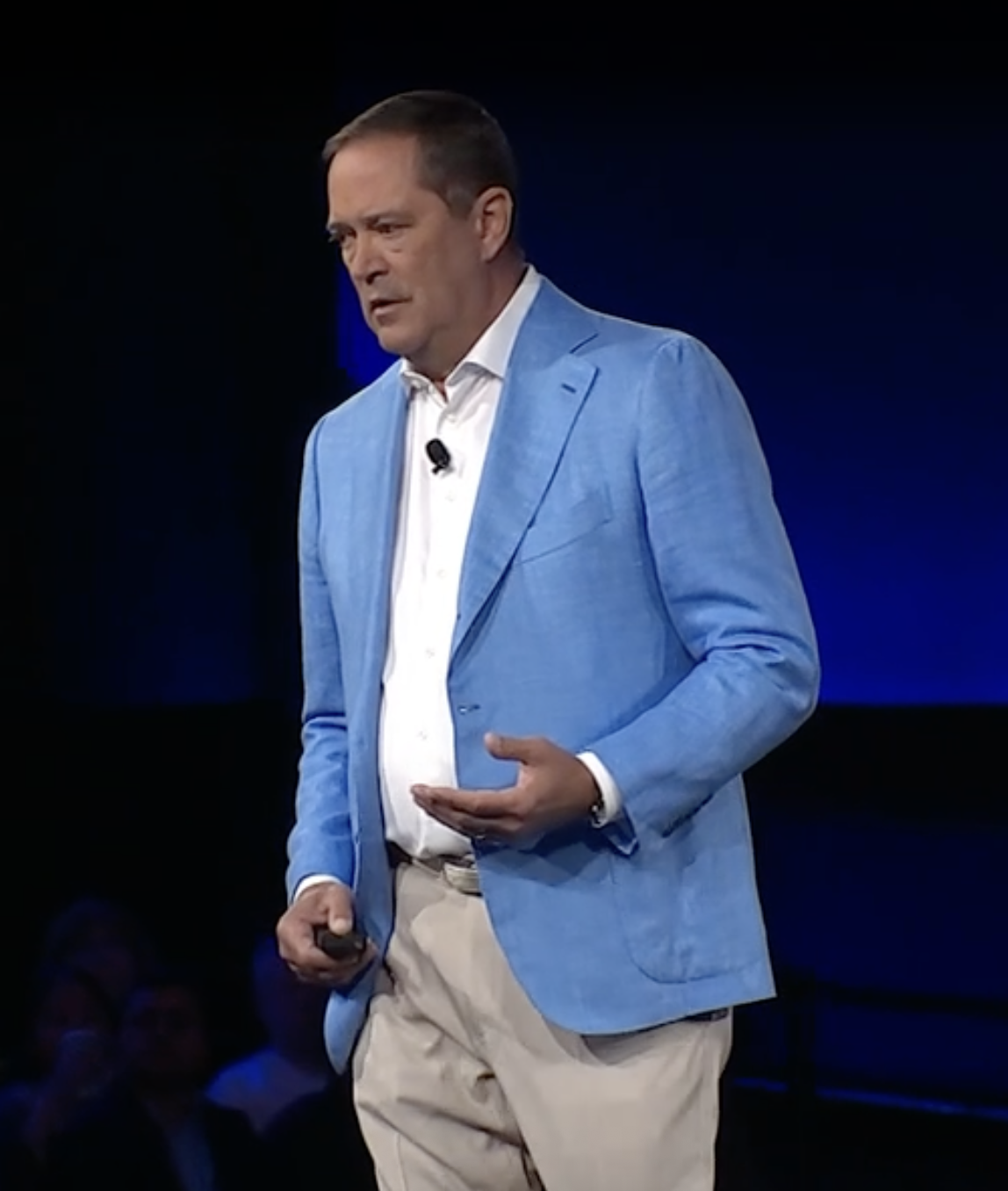
    “AI changes the speed of defense. The bad corollary to that is it’s empowering our adversaries at a pace that we’ve never seen in our careers. These models are as bad today as they’re ever going to be,” Cisco CEO Chuck Robbins told the packed keynote audience — a line that landed with more weight than a typical tech conference applause line. He wasn’t talking about AI being ineffective. He was talking about it being weaponized.

    A New Kind of Threat

    The cybersecurity industry has spent years warning about AI-powered attacks. What’s changed in 2026 is that frontier AI models — particularly Anthropic’s Claude Mythos have made those warnings concrete.

    What sets Mythos apart from prior AI models is not general intelligence but what it can do in a cybersecurity context. According to Anthropic, it can autonomously identify and exploit software vulnerabilities at a level that outpaces almost all human security experts. In controlled testing, the model has been shown to identify thousands of zero-day vulnerabilities over several weeks — a pace no human security researcher or team could match.

    The dual-use nature of that capability is what makes Mythos a defining moment for enterprise security. The same model that can find and patch vulnerabilities at unprecedented speed can, in the wrong hands, find and exploit them. CrowdStrike’s 2026 Global Threat Report found an 89% increase in attacks by adversaries using AI — and Mythos-class capability represents a meaningful step change in what those adversaries can bring to bear.

    Anthropic has acknowledged that “models of this capability level require stronger cyber safeguards before they can be generally released,” which is why public access has been withheld while safety work continues. But what this tells us is that enterprises must prepare for a post-Mythos threat environment where any number of increasingly capable open and commercial models can and will help bad actors exploit vulnerabilities in legacy or unpatched systems. We can also see that patching isn’t enough.

    Robbins warned that the capability floor for AI-assisted attacks had just risen significantly and will not come back down. The most alarming shift is speed. Where it once took days or weeks for bad actors to move from a disclosed vulnerability to a working exploit, that timeline has compressed to minutes. Cisco’s own security team demonstrated the flip side of that same capability. Robbins said in the past eight weeks, Cisco used AI to scan 1.8 billion lines of code across 25 programming languages. Before these models existed, Robbins said, that would have taken approximately eight years.

    The implication is uncomfortable but unavoidable. The same technology accelerating legitimate security work is accelerating attacks at the same pace. Neither side has an obvious advantage, and the defender’s job — protecting a complex, distributed enterprise — is structurally harder than the attacker’s.

    Agents Make Everything Harder

    If AI-powered threats were the only problem, that would be manageable. But Cisco’s President and Chief Product Officer, Jeetu Patel, outlined a second, compounding challenge: the rapid proliferation of AI agents is creating an attack surface that enterprises are almost entirely unprepared for.

    The AI industry evolved from chatbots that respond to questions to AI agents that can act autonomously. Patel said Cisco’s research found that a single AI agent generates roughly 450% more network traffic than a human performing the same task. Multiply that by thousands of agents running across an enterprise, and the infrastructure and security implications are significant.

    More importantly, agents have access to tools. Agents call APIs, query databases, submit code, and interact with external services. The goal of an agentic AI system is to perform tasks without a human in the loop. Patel’s framing was blunt: “Agents are like teenagers. They’re supremely intelligent, but they have no fear of consequence.”

    Agentic AI creates new attack vectors that aren’t easy to manage with existing solutions. For example, prompt injection attacks can manipulate an agent’s behavior. Data poisoning can corrupt its decision-making. Meanwhile, bad actors can perform tasks at high speed with a compromised agent  before anyone notices anything is wrong.

    While agentic AI has great potential, most enterprises lack the proper visibility, security and management to handle agents. Companies need a systematic way to know how many agents are running in their environment, what those agents are authorized to do, or whether they are behaving as intended. This is one security gap Cisco is racing to close alongside other security companies, hyperscalers, and startups.

    The Identity Problem Nobody Has Solved

    Businesses are just waking up to the problem of non-human identity posed by AI agents. Every person accessing a corporate system has an identity with a role, credentials, and permissions. Machines, services, and AI agents largely do not, at least not in any consistent or governed way.

    In May, Cisco acquired Astiix Security, an AI company focused on the non-human identity category.  Before enterprises can enforce meaningful controls on agent behavior, they need a reliable way to know which agents exist, what they have access to, and what they should be allowed to do. The platform helps organizations discover, govern, and protect machine identities, preventing unauthorized access and securing AI agents from malicious attacks. Cisco can integrate this technology into its Cisco Identity Intelligence and zero-trust products, such as Duo and Secure Access, to safely manage the proliferation of AI agents.

    This is not a theoretical future problem. Enterprises are deploying agents today, and most are doing so without the right identity infrastructure to govern them. If they deploy agents within a specific SaaS stack, permissions and governance are typically handled by that software. Once we start discussing multi-agent workflows that cross applications, the challenge becomes more complex. Astrix gives Cisco more capabilities to support identity for an agentic future.

    Cisco’s Response In Three Moves

    Beyond the Asterix acquisition, Cisco announced a set of products and capabilities aimed directly at the threat landscape it described.

    1. AI Defense, extended for agents. Cisco launched AI Defense roughly 18 months ago to provide visibility and guardrails for AI models and applications. The updated version adds capabilities specifically for agentic deployments: adaptive testing, behavioral guardrails, security for agentic supply chains, and support for all major agent platforms, including Claude, Codex, and OpenAI.
    2. Zero trust that gets an update for AI agents. The traditional zero trust model is built around access control: verify identity, grant minimum necessary permissions, and monitor behavior. Cisco correctly argues that today’s access control is insufficient for agents. What enterprises need is action control — the ability to intercept and verify every action an agent takes, not just whether it was authorized to log in. This is a meaningful architectural shift, and one that Cisco is embedding into its platform rather than offering as a standalone product.
    3. An agentic SOC. The cybersecurity talent shortage is severe. Approximately 4 million positions go unfilled annually in the US alone, according to Cisco. The volume of security alerts already exceeds human capacity to investigate. Cisco’s answer is an AI-powered Security Operations Center where agents autonomously triage alerts, identify anomalies, and, in time, predict and prevent breaches. The foundation is Cisco Data Fabric, a Splunk-powered platform that ingests petabyte-scale telemetry from network, security, application, and third-party sources.

    The Galileo Acquisition: Watching the Watchers

    Governing AI agents requires knowing what they are doing — not just whether they are authorized to act, but whether they are producing the outcomes they were designed for. This is the observability problem, and it is harder than it sounds.

    To address it, Cisco acquired Galileo, an AI observability company founded by researchers who previously worked with Google and DeepMind. Galileo’s technology powers what Cisco calls full-stack agent observability. This is visibility into infrastructure performance, model behavior, application runtime, and agent output quality. It also includes whether agents consume tokens at a sensible rate.

    That last point surfaced repeatedly during the keynote and reflects a real operational concern. A runaway agent that has been misconfigured or has drifted from its intended behavior can consume an entire organization’s annual AI budget in a matter of days. Token cost management is not a glamorous feature, but it is required for this new era of infrastructure.

    Cisco Cloud Control: The Platform Beneath All of It

    One of the more surprising announcements was the newly launched Cisco Cloud Control. For anyone who’s followed networking and Cisco for years, the concept of a true unified management console has been discussed for many years, and it’s devilishly difficult to execute. Every part of the portfolio had its own management tools that were loosely coupled at best, if at all. Cisco Cloud Control aims to be a new unified management platform that consolidates the company’s entire product portfolio under a single interface with single sign-on. Cloud Control is the operational layer through which Cisco intends to deliver its AI security and observability strategy.

    The security-specific capabilities embedded in Cloud Control, such as agent security monitoring, cross-domain threat correlation, and policy enforcement in natural language, represent a meaningful shift from how enterprise security tools have historically operated. Rather than logging into separate dashboards for networking, security, and operations, administrators can query their entire infrastructure environment in natural language and receive correlated, actionable insights across domains.

    The demos made it look like Cisco had finally cracked the code. Whether that vision holds up at enterprise scale remains to be tested. But the architecture Cisco described — silicon to semantics, from custom networking chips to AI agents operating on top of them — reflects a deliberate bet that the company’s control of the full infrastructure stack is a genuine competitive advantage in an AI-defined security landscape.

    The Reality. Enterprise AI Threats Are Real.

    Cisco’s keynote was, of course, a product announcement. But stripped of the stage production, the underlying argument is sound and worth taking seriously.

    AI is compressing attack timelines. Agents are expanding the attack surface in ways that existing security architectures can’t handle. The cybersecurity workforce is not growing fast enough to compensate. And most enterprises are deploying agents today without the governance infrastructure to know what those agents are doing, let alone control them.

    The organizations that will navigate this well are not necessarily the ones that move fastest. They are the ones that treat agent governance — identity, authorization, behavioral monitoring, and action control — as a first-class infrastructure concern rather than an afterthought. Enterprise technology leaders want and need their existing technology stack providers to evolve their security and management stacks to support AI threats. Cisco is making a significant bet that enterprises will pay for that infrastructure. Given the threat landscape it described, the bet seems rational.

    This article was originally published on Forbes.com.

  • The New AI Math: Time-to-Token and Cost-per-Token Gets Highlighted at Dell Technologies World

    The New AI Math: Time-to-Token and Cost-per-Token Gets Highlighted at Dell Technologies World

    At Dell Technologies World this morning, Michael Dell introduced new metrics for measuring whether enterprise AI infrastructure is actually delivering. The AI infrastructure conversation has been dominated by GPU counts, cloud-versus-on-premises debates, and model benchmarks. Dell’s opening keynote added two measures that tie those inputs to outcomes. The first is  how quickly your infrastructure generates tokens, and the second is at what cost.

    Uptime, GPU capacity, and model advances are all foundational. GPUs are what get you to tokens in the first place. But they are not enough on their own to make infrastructure decisions. Organizations are now facing a more challenging optimization problem. Companies face a seemingly endless demand for AI compute and the energy required to support it. Businesses must also balance the performance of these evolving AI workloads within budgetary and location constraints.

     Time-to-token and cost per token are the metrics that tie these competing priorities together. They measure how quickly and how cheaply your infrastructure converts data and compute into intelligence that agents and models can act on. Jensen Huang reinforced this on stage alongside Dell, and OpenAI’s Greg Brockman made the same point independently on X today: “tokens are rapidly becoming the universal input for solving problems.” When the infrastructure providers and the model providers converge on the same metrics within weeks of each other, that is a directional signal worth acting on.

    What Michael Dell described was a two-year refinement of the Dell AI Factory with NVIDIA, informed by 5,000 enterprise customers now running production AI workloads on it. The announcements were substantial. What they mean for enterprise buyers is worth unpacking.

    The Data Bottleneck Is the Real Constraint

    Michael Dell said something on stage that every CIO needs to hear: “If your data is siloed, your agents are blind.” That is a concise description of why so many enterprise AI programs stall after the pilot. It also echoes what Irfan Khan and Muhammed Alam described as the need for business context at SAP’s Sapphire and in an online event about business data

    Most organizations are simultaneously trying to prepare data for AI and reengineer the data infrastructure needed to support it. Those are two hard problems happening at the same time, on top of each other. Dell’s announcements around the Dell AI Data Platform addressed both directly.

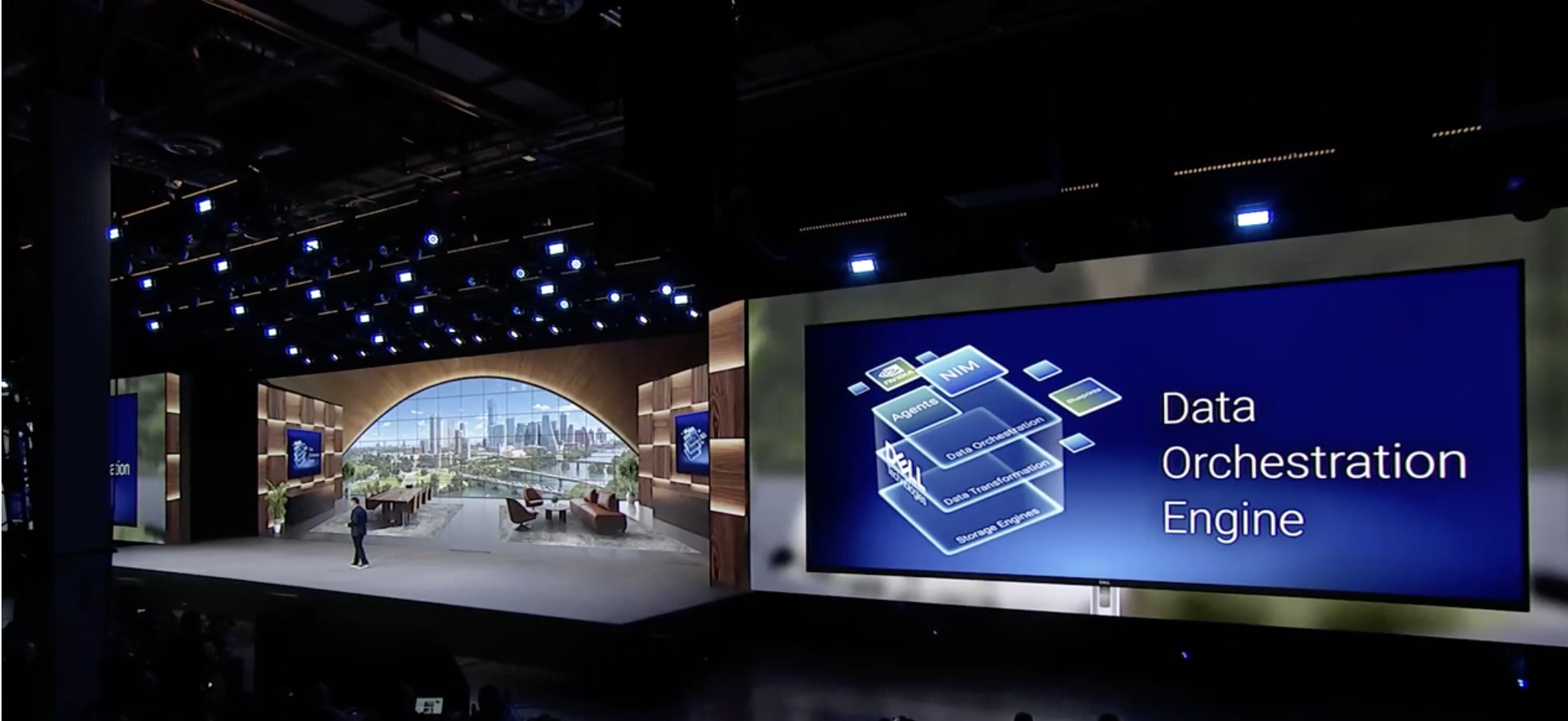
    One of the things that has changed is the data orchestration engine, the intelligent control center within the Dell AI Data Platform that turns raw, fragmented enterprise data into production-ready AI fuel. It indexes billions of unstructured files of all types, builds governed data pipelines, connects them to the models and agents that need them, and delivers structured outputs at speeds that make agentic workflows viable. Dell claims the platform now delivers 12 times faster vector indexing, 6 times faster data querying, and 19 times faster time to first token than prior generations. While the claims still need to be verified, the direction is exactly what enterprise buyers need.

    Why does this matter? AI agents need business context to be useful. An agent that can reason brilliantly but cannot reliably access your CRM, internal knowledge bases, operational systems, or proprietary data is not doing useful work. The data orchestration engine is what connects the model to the context. Without it, you have a powerful system with nothing meaningful to act on.

    Dell’s approach integrates orchestration, search, and governed pipelines natively into the platform. Getting that platform connected to your actual data sources still requires integration work. Budget for it before you buy the hardware.

    AI Infrastructure Is a Team Sport

    The broader lesson from the Dell Technologies keynote is not about any specific product. It is about what has changed in two years.

    When Dell announced the Dell AI Factory with NVIDIA in 2024, it was largely a hardware and partnership story. Today, with 5,000 enterprise customers running production workloads on it, the conversation has shifted to execution. How do you get from pilot to production? How do you keep agents from being blind to your actual business data? How do you manage cost curves as token consumption scales? How do you maintain security and governance when agents are operating autonomously at machine speed?

    Part of Dell’s answer is its ecosystem. The new Dell AI Ecosystem Program gives AI software providers a validated path to certify solutions on Dell infrastructure. For enterprise buyers, this speeds AI deployments by reducing integration some of the integration burden. Rather than assembling a custom stack from scratch, you get pre-validated blueprints that automate the deployment of software, services, and models together. That automation is a direct lever for reducing time-to-token at the program level. Dell claims it can deliver hundreds of AI racks a week to a given customer and have them generating outcomes within hours. Part of this is also achieved with ecosystem partner blueprints for automation. 

    The ecosystem also extends to the agent layer itself. Jensen Huang described on stage how agents do not run directly on the large language model. They run on a harness. The harness sits in a secure, governed container called a sandbox. It manages the agent’s reasoning loop, handles tool use, controls what data and systems the agent can access, and determines when to call the larger model and when to use a smaller local model instead. NVIDIA’s OpenShell is the open-source sandbox now supported across the entire Dell AI Factory. For enterprise buyers evaluating AI infrastructure, the harness is not a detail. It is a primary evaluation criterion. An infrastructure stack that does not clearly define how agent harnesses are deployed, secured, and governed is not production-ready.

    The ecosystem partners Dell named today include Google, Hugging Face, OpenAI, Palantir, ServiceNow, and SpaceXAI, among others. AI is not a solo deployment. The strength of the ecosystem around the infrastructure determines how fast you can actually move.

    Michael Dell put the security dimension plainly: “You can’t protect what you can’t see, and you can’t manage what you can’t see.” That applies to agents as much as it applies to data. Agents have credentials, memory, and access to systems. When they operate autonomously at machine speed, the blast radius of a security failure is no longer contained to one system. It can propagate across workflows and infrastructure. There are also tech tools such as X that help with confidential computing. 

    The Token Economics of Hybrid AI

    Sixty-seven percent of AI workloads already run outside the public cloud, on-premises, at the edge, or in co-location environments, according to Dell’s own survey data. Eighty-eight percent of organizations are running at least one AI workload on-premises. But, that does not mean cloud is going away. It means the real question for enterprise infrastructure leaders is not cloud versus on-premises. It is how to run both well.

    Hybrid AI is not a compromise. It is the architectural reality for most large enterprises. Some workloads need the cloud, which offers speed, training, high capacity, and flexibility. Others belong on-premises because it may access sensitive data that a company doesn’t want in the cloud or regulations require to be in a certain place. There may also be high-volume, continuous inference, where unpredictable cloud token costs create real budget exposure. The strategic challenge is matching the workload to the right environment and doing it consistently at scale.

    Jensen Huang described on stage why the compute requirements have shifted so dramatically. Agentic systems require 100x to 1,000x more computation than responding to a simple query because the agent has to reason, plan, use tools, evaluate results, and iterate. At that scale of consumption, every infrastructure decision has a direct cost consequence.

    Dell’s answer for high-volume on-premises workloads is what it calls “unmetered intelligence.” The idea is that owning infrastructure converts variable cloud API spend into a fixed infrastructure cost. Dell claims organizations can break even on API costs compared to the public cloud in as little as 3 months with desk-side agentic AI configurations.

    Balancing this correctly requires thinking about four variables simultaneously. Latency measures the time it takes for a system to process a request and return a response. Performance refers to the overall capability, accuracy, and capacity of the AI model to handle complex tasks. Cost is what you pay to get those outputs at the required latency and performance level. Energy is the fourth variable, and it is no longer theoretical. A single rack of NVIDIA Rubin GPUs can draw over 130 kilowatts.

    Granted, the average enterprise won’t be running a rack of Vera Rubin’s, but energy availability is becoming a real constraint regardless of sustainability goals. And if you’re using the cloud, you pay one way or the other for that energy. The right infrastructure solution varies by workload type. The time to token and the cost per token let you compare options on the same terms.

    Sovereign AI Is Becoming a Procurement Reality

    Two years ago, sovereign AI was a concept mostly discussed in European regulatory contexts and by a small number of governments building national AI infrastructure. Today, it shows up in enterprise procurement conversations across regulated and unregulated industries.

    Sovereign AI means the ability to independently develop, deploy, and govern AI systems entirely within an organization’s strategic, legal, and jurisdictional boundaries. For enterprises, this means your data does not leave your environment, your model choices are not constrained by a hyperscaler’s catalog, and your AI outputs are not subject to external policy changes.

    The ecosystem Dell announced is designed to both speed AI deployments and address sovereign AI requirements. Google’s Gemini 3 Flash models running on-premises via Google Distributed Cloud on Dell PowerEdge servers. OpenAI’s Codex is connected to the Dell AI Data Platform for agentic workflows on enterprise data. Palantir’s Foundry and AIP platform is deployed on-premises with Dell ObjectScale and PowerFlex as the data layer. SpaceXAI’s Grok is available in on-premises or hybrid enterprise deployments. Reflection’s open-source frontier models for regulated industries and sovereign entities.

    The pattern is consistent: bring the model to the data rather than the data to the model. For organizations in healthcare, financial services, defense, and government, this is not a preference. It is often a compliance requirement.

    Planning for Hybrid AI

    Today’s AI question is how to architect a hybrid AI solution that aligns with our organization’s specific workloads, data environment, cost constraints, and governance requirements. Some of that runs on-premises. Some runs in the cloud. The mix differs across organizations and will shift as workloads evolve and model costs change.

    The questions worth asking now: What is your time to first token across your most important workloads? What is your cost per token at scale? Does your data orchestration layer connect your proprietary data to the models that need it? How are your agent harnesses deployed and governed? And do you have the security architecture in place before your agents start making autonomous decisions?

    It’s not easy but nothing worthwhile ever is. 


  • Dell Shares AI Advances And New Metrics To Evaluate Infrastructure

    Dell Shares AI Advances And New Metrics To Evaluate Infrastructure

    At Dell Technologies World in Las Vegas, Dell Technologies chairman and CEO Michael Dell made a pointed argument to a room full of enterprise technology leaders: the metrics organizations use to evaluate infrastructure are evolving.

    GPU counts, cloud versus on-premises comparisons, and model benchmarks have dominated the conversation. Michael Dell’s day one keynote introduced two additional measures aimed at tying infrastructure decisions to actual outcomes: time to token, which measures how quickly a system processes a request and returns a usable AI output, and cost per token, which measures how cheaply that output is produced at scale.

    “Time to first token is incredibly important with investments of this scale,” Dell said on stage, noting that the company now has 5,000 enterprise customers running production AI workloads on its Dell AI Factory with NVIDIA platform. The figure represents a significant increase from the program’s launch two years ago.

    NVIDIA founder and CEO Jensen Huang, appearing alongside Dell, described why those metrics have taken on new urgency at both its NVIDIA GTC conference and at Dell Technologies World. Agentic AI systems, which reason, plan, and execute tasks autonomously over extended periods, require anywhere from 100 to 1,000 times more computation than a system simply responding to a query. “What took months now takes weeks, what took weeks now takes days, and what takes days now takes hours,” Huang said, describing the productivity transformation already underway at companies running agentic workflows. The demand implications for infrastructure are substantial.

    OpenAI president Greg Brockman echoed the framing independently on X.com the same day, writing that “tokens are rapidly becoming the universal input for solving problems.” The convergence of infrastructure vendors and model providers on the same metrics within weeks of each other signals a broader shift in how enterprise AI spending will be evaluated.

    The Data Problem Underneath the Infrastructure Problem

    One of Dell’s significant AI product announcements centered on a new data orchestration engine in the Dell AI Data Platform, which the company positioned as the missing layer between enterprise data and production-ready AI agents.

    The data orchestration engine is the platform’s intelligent control center. It indexes billions of unstructured files, builds governed data pipelines, and connects them to the models and agents that need them at speeds designed to make agentic workflows viable. Dell claims the updated platform delivers 12 times faster vector indexing, six times faster data querying, and 19 times faster time to first token compared to prior generations. While these claims still need to be validated, the proposed increase in performance is good news for enterprises looking to scale AI.

    The underlying problem the engine addresses is one most large organizations know well. Enterprises are simultaneously preparing existing data for AI use and reengineering the data infrastructure required to support AI workloads at scale. Those two efforts compete for the same resources and skills simultaneously.

    “If your data is siloed, your agents are blind,” Dell said. The statement is a precise description of why many enterprise AI pilots have not reached production. An agent operating without access to an organization’s proprietary data, internal knowledge bases, and operational systems cannot deliver the business context that makes agentic AI useful.

    Dell also announced GPU-accelerated SQL analytics through the Dell Data Analytics Engine, powered by Starburst, delivering up to six times faster query performance on NVIDIA Blackwell GPUs. Bank of America, which already has a partnership with Starburst, NVIDIA, and Dell, is among the institutions expected to use the capability.

    A Broad Ecosystem Built to Reduce Time to Production

    Dell announced a new Dell AI Ecosystem Program alongside a significant expansion of frontier model partnerships, positioning both as mechanisms for reducing the time between infrastructure procurement and production AI deployment.

    On the model side, Dell announced collaborations bringing several major AI providers on-premises to the Dell AI Factory. Google and Dell are collaborating to run Gemini 3 Flash models via Google Distributed Cloud on Dell PowerEdge XE9780 servers, enabling enterprises to run advanced generative AI workloads in a confidential computing environment that meets data residency and sovereignty requirements. OpenAI’s Codex will connect with the Dell AI Data Platform, giving enterprises a path to deploy agentic coding capabilities against their internal codebases, documentation, and business systems. SpaceXAI’s Grok is available in on-premises or hybrid enterprise deployments. Palantir’s Foundry and AIP platform is coming on-premises with its Ontology layer deployed on Dell ObjectScale and PowerFlex, allowing organizations to connect data sources and automate business workflows within their own environment.

    The Dell Enterprise Hub on Hugging Face gives enterprises on-premises access to a curated collection of open-weight models including MiniMax-M2.7, DeepSeek Pro, DeepSeek-V4, GLM 5.1, and Kimi K2.6, optimized for Dell AI Factory infrastructure.

    The Dell AI Ecosystem Program formalizes the partner relationship by providing software providers with a validated path to certify their solutions on Dell infrastructure. For enterprise buyers, the practical benefit is pre-validated deployment blueprints that automate the configuration of a specific software, service, or model, reducing integration work that has historically extended timelines from procurement to production.

    The Agent Harness: An Evaluation Criterion Enterprises Are Not Yet Asking About

    One of the more technically substantive moments in the keynote came from Huang’s description of how agents actually operate in production. Agents, he explained, do not run directly on the large language model. They run on a harness, a software layer that sits in a secure, governed sandbox. The harness manages the agent’s reasoning loop, controls tool access, determines when to call a large external model and when to use a smaller local model, and handles memory and context across multi-step tasks.

    NVIDIA’s OpenShell, the open-source sandbox, is now supported across the entire Dell AI Factory from deskside workstations through PowerEdge data center servers.  Dell also announced support for NVIDIA AIQ i.0 blueprints, which provide tested foundations for deploying multi-agent workflows.

    For CIOs evaluating AI infrastructure, the harness architecture is a meaningful addition to the evaluation checklist. Infrastructure that does not clearly define how agent harnesses are deployed, governed, and secured leaves a significant operational and security gap, particularly as agents acquire credentials, access enterprise systems, and take autonomous actions at machine speed.

    For example, “You can’t protect what you can’t see, and you can’t manage what you can’t see,” Dell said, framing the security challenge in terms that apply as directly to agents as to human users. An agent with compromised access or misconfigured permissions can propagate errors or security failures across workflows in ways that a single human user cannot.

    Hybrid AI Infrastructure and the Energy Constraint

    Dell’s survey data shows that 67% of AI workloads are already running outside the public cloud, and 88% of organizations are running at least one AI workload on-premises. The company positioned hybrid AI not as a transitional state but as the long-term architecture reality for most large enterprises.

    The new Dell PowerRack, announced Monday, is a fully integrated rack-scale system that combines compute, networking, and storage, engineered and validated as a single unit. It is designed to reduce the integration overhead of assembling AI infrastructure from components while supporting thermal management and power optimization at rack scale.

    Dell also introduced the Dell PowerCool CDU C7000, the first rack-mount cooling distribution unit designed to meet the cooling requirements of the NVIDIA Vera Rubin NVL72 platform, delivering more than 220 kilowatts of cooling capacity in a 4U form factor. A single rack of NVIDIA Rubin GPUs can draw over 130 kilowatts of power, and Dell noted that energy availability is an increasingly real constraint on AI deployment timelines, independent of sustainability considerations.

    For high-volume on-premises workloads, Dell introduced Dell Deskside Agentic AI, pairing high-performance Dell Pro Precision workstations with NVIDIA NemoClaw. The company claims the configuration enables enterprises to break even against public cloud API costs in as little as 3 months, converting variable token costs into a fixed infrastructure investment.

    What Changes for Enterprise Buyers

    The announcements from Dell Technologies World day one collectively continue to move the enterprise AI infrastructure conversation from capability to faster execution. The core questions are how quickly a given infrastructure configuration can reach first token on a production workload, at what cost per token, and with what governance architecture underpinning the agents running on it.

    The organizations best positioned to answer those questions are the ones that have already started rationalizing their data architecture, defined their hybrid workload placement strategy, and begun evaluating how agent harnesses will be secured and governed. The infrastructure improves almost daily, but the execution discipline required to use it remains the variable that separates AI programs that reach production from those that stay in pilot.

    Maribel Lopez is the founder and principal analyst at Lopez Research, a market research and strategy consulting firm specializing in enterprise AI, AI infrastructure, agentic systems, AI governance, and AI-driven customer experience. I version of this article of originally posted on Forbes.com.

  • AI Has A Business Context Problem.

    AI Has A Business Context Problem.

    Data quality and availability must be fixed. But Agentic AI also requires a connection to business context.

    Ask most enterprise technology leaders about their biggest obstacle to AI, and the answer is data. The data isn’t clean enough, accessible enough, or consistent enough to feed AI with confidence. They’re right. Data quality and availability remain the number one challenge Lopez Research hears from enterprises deploying AI.

    But fixing the existing data problem alone won’t get you there. There’s a second data problem that has to be addressed in parallel, and most organizations aren’t thinking about it yet: business context.

    Context is the difference between AI that has data and AI that understands your business. Clean data tells AI what the numbers say. Business context tells AI what they mean — which customers have contractual guarantees, which products are strategic, and what trade-offs are acceptable under pressure. Without it, AI optimizes for the wrong thing, at speed.

    These are not sequential problems. You can’t fix data quality first, then worry about context later. As Irfan Khan, President and Chief Product Officer for SAP Data and Analytics, put it at a recent virtual summit on data and AI strategy: “AI is incredibly good at producing results. It moves fast, but without context, it can’t exercise good judgment, and good judgment is what creates return on investment for the business. Speed without judgment doesn’t help.”

    I attended that summit to understand how enterprise leaders are thinking about both problems — and what changes they decided were required. Three companies shared their experiences: Ericsson, Vodafone, and Google. Their challenges were different. Their conclusions pointed in the same direction.

    Two Problems, One Strategy

    For years, enterprise data strategies focused on a familiar cycle: extract data, land it in a centralized system or dashboard, and run reports. It worked decently, but not great, for analytics. It is not working for AI.

    The first problem — data quality and availability — has always existed. AI makes it more urgent. Models trained or grounded on inaccurate, incomplete, or inconsistent data produce outputs that are inaccurate, incomplete, or inconsistent. Between 60% and 80% of AI budgets go to data preparation, according to various research reports.

    The second problem is less urgent. Traditional data architectures were designed to capture what happened in the past and surface it for human interpretation. AI is different. It acts. An agentic system making autonomous decisions on behalf of the business needs to know more than what the data says. It needs to understand the business’s values, the rules, and the trade-offs. Business context is not something most data architectures were designed to preserve or carry.

    Khan described the stakes with a supply chain example. Two companies both use AI to manage disruptions. The first feeds it raw signals such as inventory levels, lead times, and supplier scores. The second adds context across business processes, policies, and metadata: which products are strategic, which customers need to be prioritized, and what trade-offs are acceptable under pressure. His summary was direct: “Without context, AI doesn’t know this customer is flagged as strategic. It doesn’t know their lifetime value, whether substitutions are allowed, or when to expedite, so it calculates differently, and the decision changes completely. Both systems move very quickly, but only one moves in the right direction.”

    The implication for enterprise leaders is practical. As you work through modernization tasks such as cleaning, consolidating, and governing, data stewards must simultaneously ask how business meaning will travel with that data.

    Ericsson: Built for Analytics, Not for AI

    Malin Persson, CIO and Head of Enterprise IT at Ericsson, described a data architecture that had served the company well for years — and then hit a wall when AI entered the picture.

    Ericsson’s traditional setup had three layers: data creation, data analysis, and analytics. For reporting and dashboards, it worked. For AI, Persson identified three specific points of failure.

    Context was locked inside individual systems. Business meaning — embedded in application-specific models, calculations, and system-specific rules — couldn’t travel across applications. “AI operates across systems,” Persson explained. “When context is trapped inside them, AI can only stitch together partial truths.”

    The architecture was designed to capture the past, not support decisions about the present. AI needs to judge information and take action on the company’s behalf. A system built to explain historical data is not built for that.

    Every AI initiative required rebuilding the same logic from scratch. Without governed data products, each use case started at zero — recreating models, assumptions, and definitions that had already been built elsewhere. “Without data products,” Persson said, “every AI use case required recreating models, logic and assumptions from scratch, which made scaling slow, expensive, and unsustainable.”

    Her summary was blunt: “We did not have a data foundation built for AI.”

    Ericsson’s response was to redesign its data strategy around three shifts: preserving business meaning in a knowledge core, scaling it through governed data products, and connecting it across an open architecture. The approach allows data to stay where it lives, across SAP and non-SAP systems, while business context is managed centrally. Persson described the principle: you define what revenue means, how hierarchies roll up across markets, which rules apply — once, centrally — and that context stays consistent as data moves across platforms.

    The data and context problems were addressed together. That was a deliberate choice.

    Vodafone: Available Data, Inconsistent Meaning

    Ricard Rovira, Head of Corporate IT Platforms at Vodafone, described a common challenge in large enterprises that have grown through mergers and acquisitions: plenty of data, but no shared understanding of what it means.

    As Vodafone expanded across markets, each acquisition brought its own systems, local processes, regulatory requirements, and KPI definitions. The data existed. The problem was that the same business concept was defined differently depending on which system or market you asked.

    The practical consequence was one most enterprise technology leaders will recognize. Teams spent disproportionate time reconciling numbers and explaining why two reports produced different figures, rather than acting on the data. Time to insight stretched. Confidence in the output eroded. End users stopped trusting the systems and started downloading data to build their own versions of the truth.

    The loyalty section of the My Vodafone app made the problem concrete. The same capability was running across five markets with five separate data models, five dashboards, and 40 report pages. Each market had its own reality. There was no shared one.

    The fix wasn’t just cleaner data. It was consistent meaning. Vodafone built a unified semantic layer, which is a single place where business definitions are established once and consistently carried across processes, platforms, and use cases. Rovira described the goal plainly: “Governance is not about control. It’s about preserving the business meaning so it can be reused safely across the enterprise.”

    The company consolidated onto SAP Datasphere and Business Data Cloud, reducing its data footprint by 80 percent on its first Business Warehouse instance. The shift moved teams from reassembling data repeatedly to drawing from governed data products that already carry the right definitions and constraints. Time to insight improved. So did confidence in the output.

    Vodafone’s case illustrates a version of the data problem that often goes undiagnosed. The data is available. The data is not inaccurate in the traditional sense. The data’s meaning is inconsistent, which, in itself, is a form of bad data. For AI systems that act on it autonomously, the consequences are worse than a wrong number in a report. Google faced the same core problem. The cause was different.

    Google: The Culture Problem Underneath the Data Problem

    Jannie Affeld, VP of Finance Systems and ERP at Google, described the same symptom Vodafone experienced — the same data carrying different meanings across the organization — but traced it to a different root cause. At Vodafone, fragmented meaning arose from mergers and acquisitions, with incompatible systems layered over time. At Google, it came from its innovation culture.

    Google operates across more than 200 data centers and offices on six continents, structured by product areas each large enough to function as a standalone global enterprise. The culture has long rewarded individual autonomy within product areas. Teams built their own solutions and defined the same business data differently. The result looked familiar: ten definitions of headcount, multiple approaches to foreign exchange transactions, no single version of the truth that anyone trusted.

    “Technology alone isn’t enough for AI to truly scale,” Affeld said. “Culture must be a significant part of that equation.”

    The data consequence was proliferating definitions. Ten definitions of headcount. Multiple approaches to foreign exchange transactions. When definitions multiply, you don’t have a data quality problem in the traditional sense. You have an alignment problem. And alignment problems do not get fixed by better pipelines or more sophisticated models.

    Affeld described what the fix actually requires: “We actually have to take away some of the access or freedom to create solutions. We’re trying to segregate what is business data from product innovation. We shouldn’t have 10 definitions of headcount in the organization.” Getting there requires sponsorship from both the business side and finance partners — not just a mandate from IT.

    This is a point most data modernization programs underestimate. The data governance conversation tends to focus on architecture and tooling. Google’s experience suggests that the harder work is getting the business to agree on what the data should mean, and then holding that line as teams accustomed to building independently push back.

    For AI, the stakes of this organizational work are higher than they were for analytics. A dashboard with an inconsistent definition of headcount produces a wrong number that a human might catch. An AI agent making workforce decisions based on ten competing definitions produces confidently wrong autonomous actions that are harder to detect and harder to reverse.

    What All Three Companies Have in Common

    Ericsson, Vodafone, and Google came to the AI-readiness problem from different starting points. Ericsson’s challenge was architectural: context locked inside systems, no reusable data products, a foundation built for the past. Vodafone’s challenge was semantic. It had data available everywhere, meaning consistent nowhere. Google’s challenge was cultural: an organization that rewarded independence, producing data that couldn’t be shared with confidence.

    But all three arrived at the same conclusion: fixing the data problem and establishing business context are not sequential steps. They are parallel workstreams.

    You cannot finish cleaning and governing your data and then turn to context. By the time the data is clean, AI deployments are already in motion. Context has to be built into the architecture from the beginning, into how data products are defined, how semantics are governed, and how meaning is preserved as data moves across systems.

    That is a meaningful shift from how most enterprises have approached data modernization. The question is no longer only “how do we make our data more accurate and accessible?” It is “how do we make sure our data carries the business understanding AI needs to act on our behalf?”

    Where to Start

    If you are in the middle of a data modernization program or about to start one, three questions are worth adding to the agenda.

    Are you addressing both problems at once? Data quality and business context are separate challenges that require parallel effort. A data modernization program that focuses only on cleanliness and availability will produce better-quality inputs for AI, but it still lacks the judgment to use them well.

    Where is business meaning living today, and can it travel? In most organizations, meaning is embedded in individual applications. It doesn’t survive when data moves. Identify the definitions, policies, and semantic rules that matter most for AI decision-making and decide how they will be captured and carried consistently. Some firms are calling this a context library.

    Is this a leadership issue or an IT issue? Google’s experience suggests it has to be both. IT can build the architecture. Business leaders have to agree on what the data means and defend those definitions against teams accustomed to building their own. That requires sponsorship, not just tooling.

    More than a decade ago, in my book Right-Time Experiences, I wrote about the importance of context in creating experiences that are adaptive, predictive, and prescriptive. It wasn’t a new concept, but mobility was the catalyst to drive that change. Companies made significant progress, especially as we moved into the early days of machine learning. But very few organizations today can say business context flows coherently across the systems that run their operations.

    Agentic AI has made that gap consequential in a new way. When a human reads a dashboard with missing context, they can compensate for it. When an AI agent acts on data without context, the error compounds automatically, at scale, without a flag.

    Fix the data. Build the context. Do both at the same time.

    Subscribe to my AI Decoded Newsletter here and share with a friend. You can also find the AI with Maribel Lopez podcast on your channel of choice by clicking here.

  • Harness Engineering, Orchestration, and Compound Agents: The Enterprise AI Vocabulary You  Need To Know

    Harness Engineering, Orchestration, and Compound Agents: The Enterprise AI Vocabulary You Need To Know

    Most enterprise AI practitioners are running multiple AI models. The question was never how many models or whether they were open models.  The question that’s harder to answer — and the one that determines whether your AI investments compound or fragment — is which system those models are part of, and what you are actually evaluating when a vendor puts a platform in front of you.

    At NVIDIA‘s GTC, Jensen Huang convened a session with the CEOs of Cursor, Perplexity, LangChain, Reflection AI, Thinking Machines Lab, and several others building at the edges of the AI ecosystem. What they described isn’t a debate about models. It’s a map of how AI systems are being assembled — orchestration layers, agent harnesses, multi-component architectures, and specialized vertical systems that combine foundation models with proprietary data and domain logic. Vendors are no longer selling model access. They’re selling systems. Understanding the components of those systems is what makes the difference between a well-matched procurement decision and an expensive one.

    Here’s the updated map.

    The Model Is a Component. The System Is the Product.

    Jensen Huang opened the session with a distinction worth internalizing: a model can be a technology or not a product. He said that ChatGPT is a product. The model underneath it is a technology that someone assembled into that product.

    This reframe is useful for enterprise buyers evaluating vendor offerings. When a vendor presents an AI platform — whether that’s Perplexity Computer, an agentic desktop assistant designed to function as an autonomous coworker, or a vertical industry system built on top of foundation models — you’re not evaluating the model. You’re evaluating everything assembled around it: how the system connects to your data, what tools it can invoke, how it manages memory and context across tasks, what guardrails constrain its actions, and how it handles the handoff between automated steps and human oversight.

    The model is the engine. The system is the car. And you’re buying the car.

    Michael Truell, CEO of Cursor, added a structural observation that clarifies why vendor evaluation has gotten more complex. For years, he said, there were two groups. There were foundation-model companies that built large general-purpose models and sold API access.  Or application companies that built models into their products or on top of them. Truell argues a third category is now well established — companies that combine the best foundation models available through APIs with their own purpose-built models and proprietary domain knowledge, assembled into a specialized vertical system. It’s not a foundation model or application layer. It’s both, plus the integration work that makes them useful together.

    When you evaluate a vendor in this third category, the question isn’t just which model it runs on. It’s whether the vertical specialization, the data architecture, and the system design match the use cases you’re actually trying to solve.

    What Harness Engineering Is, and Why It’s Now a Discipline

    Harrison Chase, CEO of LangChain, introduced a term that’s worth adding to your vocabulary: harness engineering.

    Harness engineering is the discipline of building reliable, structured environments around AI agents. The agent itself — the model running in a loop, calling tools, taking action — is only part of the system. The harness is everything surrounding it: the workflows, the tool interfaces, the validation loops, the context management strategies, and the memory architecture. It’s what makes the difference between an agent that works in a demo and one that operates reliably in production.

    NOTE: This is one definition of the term. The market is still debating this term, and I will write another specific piece on harness engineering.

    Chase made the point directly: even the closed model labs practice harness engineering constantly. He gave the example of Anthropic’s Claude and Claude Code. A model may be exceptional, but the harness around it — how it connects to file systems, how it manages long tasks, what guardrails constrain its actions — is equally responsible for the results. When enterprise teams underinvest in the harness and focus only on the model, they end up running expensive experiments that don’t scale.

    For technology leaders, this has a direct implication. Technical evaluations that benchmark models against each other without assessing the harness — the orchestration framework, the tooling, the integration architecture — are incomplete. The model is one variable. The harness is where most of the enterprise-specific work lives, and where most of the deployment risk concentrates.

    Multi-Component (Multi-Agent) AI Systems: What the Term Actually Means, and What to Ask

    You will hear vendors use terms like “compound agents,” “multi-agent systems,” and “agentic platforms” to describe their offerings. These terms are not interchangeable, and the market has not settled on consistent definitions. That ambiguity is worth understanding before you evaluate vendor claims.

    The most rigorous current framing comes from UC Berkeley’s Sky Lab, which defines a compound AI system as one that combines multiple AI components — models, retrievers, tools, databases, external APIs — to complete a task, rather than relying on a single model call. The system’s behavior emerges from how those components interact, not from any one of them individually. This framing has practical logic behind it: composing specialized components often outperforms a single frontier model on both capability and cost, particularly for complex multi-step tasks.

    Where it gets murkier is in how vendors apply the label. “Compound agent” in active use can mean three different things: a compound AI system that takes actions rather than just generating output; multiple discrete agents collaborating, each with its own reasoning loop; or an orchestrator-and-subagent architecture in which a controlling agent decomposes tasks and delegates them to specialized agents. These have meaningfully different architecture, cost, and governance implications. A vendor calling their product a “compound agent platform” may mean any of the three. The label alone tells you nothing about the actual design.

    The governance implication is the one most enterprise buyers miss. Multi-component systems diffuse accountability. When a consequential decision emerges from the interaction of a retriever, a reasoning model, and a tool execution layer, which component is responsible for the output? Traditional audit trails track the system’s final action. They often don’t track which component drove the decision that led to it. Before deploying any multi-component AI system in a business-critical workflow, buyers should require component-level architecture disclosure and confirm that audit logging covers component interactions, not just system outputs.

    The practical posture: treat “compound,” “agentic,” and “multi-agent” as marketing descriptors until a vendor discloses their specific component architecture. Ask what components the system includes, how they interact, how failures in individual components surface, and where in the stack governance and audit trails are enforced. Those answers will tell you far more than the product label.

    Orchestration Is the New Core Infrastructure

    Arvind Srinivas, CEO of Perplexity, described what his company calls Perplexity Computer: a multi-model, multi-cloud orchestration system where the models themselves become tools, and the orchestration layer determines which tool to apply to which task. The goal is that an enterprise can delegate a goal without specifying which model handles each step — the system manages that routing. Here is another take he gave on the topic in February.

    The analogy he offered is useful for enterprise framing: sub-agents are musicians, models are instruments, and the orchestration system is what produces the symphony. The quality of the output depends on all three, not just the instruments.

    The practical translation: the orchestration layer is where the strategic architecture decisions live. It determines which models get used for which tasks, how context is managed across long-running workflows, where governance and guardrails are enforced, and how exposed you are to vendor dependency. If your orchestration layer is tightly coupled to a single model provider, every future model decision becomes a migration project. If it’s designed to be model-agnostic, you preserve optionality as the model market continues to evolve rapidly.

    Mira Murati, CEO of Thinking Machines Lab, added a related dimension. Her firm has focused on making post-training — the layer of model development that adapts a foundation model to specific domains and tasks — accessible to enterprises and researchers. Most enterprise AI value doesn’t come from a raw pre-trained model. It comes from a model tailored to your domain, data, and task requirements. Accessible post-training means more organizations can build the specialized models that multi-component architectures require, without depending entirely on what general-purpose foundation models provide out of the box.

    What to Do Before Your Next AI System Decision

    The architecture described in this conversation isn’t on a roadmap. Cursor, LangChain, Perplexity, Mistral, and Thinking Machines Lab are all in production with enterprise customers today. The market has already moved.

    Three things worth doing before your next AI procurement decision:

    Evaluate the system, not just the model. Ask vendors to show you the harness — the orchestration framework, the tool interfaces, the memory architecture, the governance layer — not just model benchmark scores. You’re buying the system. Evaluate it as one.

    Require component-level architecture disclosure. When a vendor describes their offering as a compound agent, an agentic platform, or a multi-agent system, ask them to specify the components the system includes and how they interact. The label is not a specification. The architecture is.

    Treat orchestration as strategic infrastructure. The orchestration layer is where vendor dependencies are created or avoided, where governance is enforced or bypassed, and where the long-term flexibility of your AI architecture resides. It deserves the same scrutiny as your data infrastructure decisions. Evaluate orchestration before you’re locked into a system that makes changing it painful.

    The model was never the moat, but perhaps the system is. Knowing how to evaluate the totality of an AI system is what separates a well-matched AI investment from an expensive lesson.

  • Amazon Connect Is Now a Family of Products That Adds Agentic AI  to CX, HCM, Supply Chain and Healthcare

    Amazon Connect Is Now a Family of Products That Adds Agentic AI to CX, HCM, Supply Chain and Healthcare

    AWS is betting that Amazon Connect agentic AI belongs in supply chain, hiring, and healthcare — not just customer service. The branding is smart. Here’s my quick take. 

    For years, Amazon Connect meant one thing: contact center software. As of this week, it means four products, three new markets, and a bet that agentic AI is ready to run business operations — not just answer customer calls.

    At its “What’s Next with AWS” event, Amazon Web Services announced the expansion of the Amazon Connect name into a family of agentic business solutions. The original contact center product is now called Amazon Connect Customer. Three new products join it: Amazon Connect Decisions (supply chain and demand planning), Amazon Connect Talent (high-volume hiring), and Amazon Connect Health (clinical documentation and patient coordination). All four products sit under the Connect name. All four are agentic by design.

    The naming will raise eyebrows — more on that shortly. But the strategic logic is sound, and enterprise buyers should pay attention.

    What “Agentic by Design” Actually Means Here

    It’s worth being precise about what makes these products different from the AI-infused software most enterprises already live with.

    Agentic AI doesn’t just surface recommendations. It plans a sequence of actions, executes them, monitors the results, and adjusts. The word “connect” is doing double duty in this brand: it references both the product family name and the agents’ actual function — connecting to your systems, your data, and your workflows to get something done without waiting for a human to click “approve” at every step.

    The original Amazon Connect spent the last year being rebuilt on this principle. In 2025, AWS introduced what it called “next generation connect” — adding AI across the full customer journey, not just within a single interaction. Sentiment analysis, agent assist, post-call wrap-up, outbound communication, and full transcription all came along. The shift from the original Connect to Connect Customer is a shift from AI as a feature to AI as the operating model.

    The three new products start from that same premise, except they aren’t retrofits. They were built from scratch for agentic execution.

    Three Reasons the Benefits Case Is Credible

    Vendor AI announcements are easy to be skeptical of. This one has a few things working in its favor.

    Scale. Amazon Connect Customer handled 20 million interactions per day and processed 12 billion AI-powered minutes of conversation last year. That’s not a pilot. The new products are built on the same infrastructure. For enterprise buyers who have watched AI proofs of concept collapse under production load, operational scale at this level is a legitimate differentiator.

    Domain expertise embedded in the product. Amazon didn’t hire supply chain consultants to build Connect Decisions. It extracted the models and decision frameworks from its own retail and logistics operations — systems managing demand planning across more than 400 million SKUs. Connect Talent draws from Amazon’s process for hiring 250,000 seasonal workers in a single season. Connect Health is built on the clinical AI running at One Medical, which has now processed more than one million ambient documentation visits. This is proprietary operational knowledge baked into the product, not a general-purpose LLM applied to a new domain. That distinction matters for buyers evaluating whether a product will actually understand their problem.

    Integration with existing AWS infrastructure. For organizations already running on AWS, these products inherit the identity management, access controls, audit logging, and compliance certifications already in place. Buyers don’t start from zero on security posture or governance. That’s a real reduction in implementation risk, particularly in regulated industries like healthcare and financial services.

    On the Branding: Confusing Short-Term, Coherent Long-Term

    The name “Amazon Connect” has strong recognition in the enterprise market specifically as a contact center product. Adding supply chain, hiring, and healthcare products under the same name will require education.

    That said, the decision is defensible. The Connect products share a common architecture and a common design philosophy. AWS is calling that philosophy “Humorphism” — building products designed around how humans and AI agents collaborate, rather than how humans use static tools. Agents ask clarifying questions. They capture the reasoning behind manual edits. They improve over time as they learn from user decisions. Every Connect product is designed to work this way.

    The naming creates a coherent category: all Connect products are agentic, all are built on Amazon’s internal operational experience, and all are designed for line-of-business adoption rather than IT-led implementation. That’s a real product strategy, not just a logo change.

    Buyers evaluating these products should simply be explicit in conversations with AWS about which Connect product they mean. In the short term, that’s a small friction. In the long term, a unified family brand is cleaner than four separate product names with no connective tissue.

    The Open Questions That Need Answers

    Pricing is TBD. AWS did not address how these products will be priced or licensed. For supply chain and hiring products competing with established enterprise software, pricing model matters significantly. Per-transaction, per-user, and consumption-based models all create different budget implications. Enterprise buyers should not evaluate these products without getting pricing clarity first.

    The ERP and HCM question is unresolved. Connect Decisions targets supply chain planning. Connect Talent targets high-volume hiring. Both markets have entrenched incumbents — SAP and Oracle on the ERP side, Workday and Oracle HCM on the talent side — that already hold enterprise data and run existing workflows.

    The question isn’t whether Amazon can build better AI. The question is how Connect Decisions and Connect Talent interact with the systems enterprises already have. A few scenarios are possible, and AWS hasn’t clarified which one applies. The existing ERP or HCM system could become a data source that feeds the Connect agents. The incumbent vendor could build its own agents that call Connect products as tools. Or both systems end up running parallel agent workflows that need to be orchestrated together. Each of these plays out differently for buyers in terms of integration complexity, data governance, and total cost of ownership.

    The demos shown at the event depict Connect Decisions and Connect Talent operating as primary systems of action — generating demand plans, running interviews, surfacing candidate assessments. That implies some displacement of existing workflow software, at minimum for the activities these agents handle. Whether that displacement requires wholesale replacement of incumbent systems, or whether it can coexist alongside them, is not clear from what was announced. Buyers who already run SAP or Workday should press AWS specifically on this before evaluating further.

    What to Do With This Information

    If you’re an existing Amazon Connect customer, evaluate what the next-generation Connect Customer capabilities mean for your current deployment before looking at the new products. The AI-across-the-journey architecture is a meaningful shift from the original product, and understanding it fully is the right starting point.

    If you’re in supply chain, high-volume hiring, or healthcare and are currently underserved by your existing software, these products are worth a serious look. The domain expertise and scale credentials are real. Get pricing clarity and understand the integration model before committing.

    If you’re running SAP, Workday, or another incumbent system in these domains, don’t assume this announcement is irrelevant to you. The better question to ask your existing vendor is: what is your agent strategy, and how does it interact with what AWS just announced?

    The question isn’t whether Amazon Connect should be a family of products. The question is whether or how to make your current stack work alongside it.

    Subscribe to my AI with Maribel Lopez podcast on your channel of choice at https://www.buzzsprout.com/194744.

  • Google Splits Its TPU Chip in Two. Here’s Why That Decision Matters for Enterprise Buyers.

    Google Splits Its TPU Chip in Two. Here’s Why That Decision Matters for Enterprise Buyers.

    The AI chip acronym soup of CPUs, GPUs, TPUs, etc., shows how the computing landscape continued to expand and change over the past decade. At Google Cloud Next, the company released two distinct TPUs (Tensor Processing Units) instead of one — TPU-8t, built for training, and TPU-8i, built for inference and the emerging demands of agentic workloads. The launch highlights an architectural decision that reflects how AI workloads are diverging, with real implications for how enterprise buyers should think about AI infrastructure strategy.

    What Google Actually Announced

    During a press and analyst session at Google Cloud Next, Amin Vahdat, Google’s SVP and Chief Technologist for AI Infrastructure, introduced the eighth-generation TPUs — and emphasized the plural intentionally. Vahdat said the two chips were designed from the ground up separately.

    TPU-8t is the training workhorse. Compared to last year’s Ironwood generation, it delivers roughly three times the floating-point compute per pod, twice the network bandwidth per chip, and four times the bandwidth at scale-out — all with approximately the same pod size of 9,600 chips, but with denser, faster interconnects.

    TPU-8i is the inference and agent engine. It quadruples the pod size to 1,152 chips, delivers 10x the FP8 compute, 7x larger HBM memory capacity, and offers bidirectional scale-out bandwidth. The design priority is latency, not just throughput — a meaningful distinction as enterprises move from batch processing toward real-time agentic workloads.

    Vahdat put the pace of progress plainly: “2x, 4x, 8x, 10x all in one year — the rate of progress, the rate of advancement is just stunning.”

    That’s impressive on paper. The more important question for enterprise buyers is what it means for how they plan and procure AI infrastructure.

    The Specialization Signal

    The two-chip decision acknowledges that training and inference have different physics.

    Training is throughput-bound, which means you’re moving enormous amounts of data through interconnected chips in a coordinated, largely predictable batch process. Inference, especially for the new upcoming wave of agentic systems, is latency-bound.  For this use case, chips need to respond in near-real time as agents plan, act, evaluate, and route across multiple tools and workflows.

    To address the latency problem directly, Google and DeepMind collaborated on a new network “boardfly” topology for TPU-8i, designed to reduce the number of hops between any two chips, significantly cutting chip-to-chip latency. As Vahdat described it: “Our default way of connecting them didn’t support latency. It supported bandwidth. What you really care about in the age of agents is latency — the minimum time it takes to get the data.”

    This mirrors a trend Jensen Huang surfaced at NVIDIA, where chip-to-chip connectivity is increasingly central to total system performance, not just an afterthought to compute specs. The implication: network topology is now a first-class variable in AI infrastructure design, not just chip count or memory.

    Vahdat was direct about the broader trajectory: “The age of specialization is going to continue.” His prediction for the industry — not just Google — is that workloads will continue diverging, and two chips may eventually become more. General-purpose improvements, he noted, are now yielding roughly 5% annual performance gains normalized to cost. Specialization is how you get past that ceiling.

    What This Means for Enterprise Buyers

    Enterprise buyers don’t purchase TPUs. They consume AI services through public cloud, SaaS platforms running on cloud infrastructure, and increasingly through hybrid architectures spanning on-premises and cloud. There are at least three reasons why a chip announcement matters.

    1. AI infrastructure costs are becoming a material business decision. Google is running AI inference on TPUs across Search, YouTube, Gmail, and its enterprise Gemini services. The efficiency of that infrastructure directly affects the cost structure of AI-powered services. When Google cuts inference costs through better hardware, the economics of running AI at scale improve for Google and for its cloud customers. Citadel Securities, the securities trading firm, was cited as a TPU customer that reduced costs 30% and achieved two to four times efficiency improvement on trading systems. Specialized hardware scales well beyond its original design targets.
    2. Inference is where AI delivers the most value to most enterprise buyers. For several years, we’ve been discussing the shift from large-scale frontier model training and enterprise AI fine-tuning towards inferencing. It’s finally here, and we have multiple ways to improve inference, including new TPUs designed for inference.  As Vahdat noted, using a historical parallel to web search: the heavy lifting happens in training, but the value is created in serving. “Serving is where the value is created for Gemini enterprise and search, and ads and YouTube.” Enterprise AI budgets and infrastructure roadmaps need to weigh inference infrastructure proportionally to where value is actually produced.
    3. Reliability at scale is still an unsolved problem — and it matters. Vahdat was candid about a challenge the industry rarely advertises: at the scale of tens of thousands of chips working in coordination, at least one chip will fail several times per day. If human intervention is required to detect and recover from failures, the minimum response time is 30 minutes — enough to halt progress entirely. Google’s approach delivers over 97% of good computational throughput, enabling failures to be automatically detected and remediated. Still, Google Cloud said enterprises aren’t interested in any failure. For enterprises evaluating AI infrastructure providers, reliability and observability at scale are now table-stakes questions, not nice-to-haves.

    The Agentic Infrastructure Shift Is Already Here

    A surprising forward-looking element of Vahdat’s remarks was a prediction about CPUs. As agentic systems grow, general-purpose compute will make a comeback — not to replace specialized chips, but to orchestrate them. Agents require sandboxed environments, virtual machines, code execution, and dynamic routing across inference calls. He stated that it’s CPU work.

    Enterprise infrastructure planners should take note: agentic AI isn’t just an inference problem. It’s a systems design problem that spans specialized accelerators, general-purpose compute, network topology, and increasingly, identity and governance layers sitting above the hardware. The companies Google cited as running on TPUs today — from its own consumer services to financial services firms — are already thinking holistically about infrastructure.

    The infrastructure decisions enterprises make now will determine how quickly and cost-effectively they can deploy agentic systems at scale. Building on platforms engineered for latency, reliability, and specialization is a different starting point than building on platforms that aren’t.

    Google Cloud’s eighth-generation TPUs are a signal that the advancement of AI infrastructure is far from over.  

    This article was originally published on Forbes.

  • Managing a Fleet of Thousands of Agents Is the Real Problem. Google Cloud Showed Its Answer.

    Managing a Fleet of Thousands of Agents Is the Real Problem. Google Cloud Showed Its Answer.

    Enterprises spent most of 2025 figuring out what AI agents are and which tools could build them. The conversation in 2026 is different. The question now is how to govern, monitor, and scale fleets of agents across the enterprise — without losing control of what they’re doing or why. That shift was visible at Google Cloud Next. One of the headline announcements — the Gemini Enterprise Agent Platform — is more than a product consolidation. It reflects where the enterprise AI market is actually headed: away from point tools and toward platforms that manage agents at scale, with governance and observability built in rather than bolted on afterward.Here’s what was announced, and more importantly, what it means for enterprise buyers trying to move from individual pilots to production-grade agentic systems.


    What Google Actually Announced

    Google combined both Vertex AI and Agentspace into a single unified offering called the Gemini Enterprise Agent Platform. Vertex was its managed AI development platform, while Agentspace was its enterprise-focused platform for deploying and managing agents across organizational data and applications such as Jira, Salesforce, and Google Workspace. Neither Vertex AI nor Agentspace will exist as standalone products. The new platform combines what each did separately, such as  Vertex AI’s model building and generative AI development capabilities, and Agentspace’s agent deployment, workflow automation, and enterprise application integration. The platform adds new or improved capabilities for orchestration, governance, security, and observability. That last part matters most. On the model side, enterprise buyers now have access to a model garden with more than 200 options. The model garden includes Google’s own Gemini 3.1 Pro, Gemini 3.1 Flash Image, and Lyria 3, alongside third-party models such as Anthropic’s Claude Opus, Sonnet, and Haiku. The breadth is notable. A single platform that spans first-party and third-party models gives enterprises flexibility to match the model to the task — rather than locking into one provider’s output quality for every workload.On the development side, the platform spans from low-code tooling via Agent Studio to a more capable Agent Development Kit for engineering teams. A new graph-based framework organizes agents into networks of sub-agents, allowing enterprises to define reliable logic for how agents collaborate on complex tasks. An Agent Garden provides access to a curated set of agent templates that cover use cases such as code modernization, financial analysis, economic research, and invoice processing. These templates serve as building blocks for multi-agent systems. The operational layer is where the platform makes its clearest argument for enterprise buyers. Agent Runtime delivers sub-second cold starts and supports long-running agents that maintain state for days, backed by a Memory Bank for persistent context.  This allows agents to run more complex tasks. An Agent Gateway provides unified connectivity between agents and tools across environments while enforcing a consistent security policy. Agent Sandbox provides a hardened environment for executing model-generated code and browser-based automation tasks without exposing host systems. And critically, the platform includes Agent Identity and Agent Registry. Every agent — whether built internally or sourced from a third-party partner — carries a trackable identity and operates within defined guardrails. Model Armor protections guard against prompt injection and data leakage. Testing and observability round out the picture. Agent Simulation, Agent Evaluation, and Agent Observability provide execution traces and real-time insight into agent reasoning. Agent Optimizer goes further, automatically clustering real-world failures and suggesting refined system instructions rather than requiring teams to dig through logs manually.


    Why the Consolidation Matters

    Google also announced updates to its Cloud Data Cloud offering, which improves how agents access and interpret enterprise data. Better data grounding means agents work with accurate, current, enterprise-specific information rather than relying on general model knowledge, which hallucinates at rates that make it unsuitable for business-critical decisions. The Gemini Enterprise Agent Platform competes directly with Amazon’s Bedrock AgentCore and Microsoft’s Azure AI Foundry. All three hyperscalers are converging on the same recognition: enterprise buyers don’t need more ways to build a single agent. They need platforms that manage how hundreds or thousands of agents behave, interact, and scale — without requiring a dedicated engineering team to babysit each one. That’s the real shift in 2026. The challenge is no longer proof-of-concept. It’s production life cycle management with security and governance.For enterprises that had already deployed Agentspace, the consolidation raises a practical question: what happens to what you built? Google’s framing suggests continuity rather than migration — existing Agentspace capabilities carry forward into the new platform rather than requiring a rebuild. But enterprises currently running Agentspace workflows should verify specifically how their integrations, agent configurations, and user access models map to the consolidated platform before assuming a seamless transition. Consolidations that look clean on a slide often surface friction in production environments. Ask Google directly what the migration path looks like and what, if anything, requires rework.


    What’s Hard About It

    The technology being ready and your organization being ready are two different things. A few realities worth holding onto as you evaluate this platform. Model flexibility is only valuable when you define what you need for your workloads. Two hundred models in a garden is a resource if you have a framework for selecting among them. Without a clear use-case taxonomy — which tasks require higher accuracy versus lower latency, which workloads require on-premises data handling versus cloud inference — the abundance becomes a selection problem rather than a solution. Agent Identity and Agent Registry are necessary, not sufficient. Registering agents and assigning identities is a prerequisite for governance, not the governance itself. Enterprises still need to define what each agent is authorized to do, under what conditions it escalates to a human, and how they will audit agent behavior over time. The platform provides the infrastructure for those decisions. The decisions still belong to the enterprise. Observability tooling requires someone to act on what it surfaces. Agent Optimizer, which automates the suggestion of improved instructions, is genuinely useful. But organizations still need the operational capacity to evaluate those suggestions, test changes, and maintain accountability for agent behavior in production. Automation reduces the burden; it doesn’t eliminate the need for human judgment. The partner ecosystem is announced, not fully proven. Google named a broad set of integrations and ecosystem partners. As with every hyperscaler launch, the gap between announced partnerships and certified, production-ready integrations takes time to close. Before building production workflows on partner integrations, confirm what is shipping now versus what is on the roadmap.


    What Enterprise Buyers Should Do

    If you are evaluating the Gemini Enterprise Agent Platform — or any hyperscaler agent platform — three questions will tell you more than the demo. First, ask what the platform does when an agent fails. Not how it handles errors gracefully, but what happens when an agent takes a wrong action at scale, across a fleet of similar agents running the same logic. Failure modes at scale differ from those in a pilot. Platforms that offer real-time observability and automated clustering of failure patterns are meaningfully ahead of those that don’t. Second, ask how agent identities integrate with your existing identity and access management infrastructure. If agents need to be registered and governed separately from human users, the platform adds operational overhead. If agent identities extend naturally from your current IAM framework, adoption is faster, and governance is less fragile. Third, ask how data grounding works within your specific data architecture. The value of grounding AI agents in enterprise data depends entirely on the quality and accessibility of that data. If your data is scattered across disconnected systems with inconsistent formats, the grounding layer will struggle regardless of how capable the platform is. Google’s Cloud Data improvements are in the right direction. But no platform substitutes for data readiness on the enterprise side.


    The Broader Signal

    What Google announced at Cloud Next reflects something the enterprise AI market has needed for a while. Enterprise buyers need platforms from credible vendors that treat governance, security, and observability as core features rather than afterthoughts. We spent 2024 and 2025 building agents. The organizations that will succeed in 2026 are the ones that build the management layer around those agents — the identity frameworks, the observability infrastructure, the governance policies that define what agents are allowed to do and what requires human review. The Gemini Enterprise Agent Platform is a serious attempt to deliver that layer. It is not the only attempt. Amazon and Microsoft are building toward the same destination. But the consolidation of Vertex AI and Agentspace into a unified platform with built-in governance and observability signals that Google understands where the real enterprise challenge lies. That’s the right problem to be solving. Whether this platform solves it for your specific environment depends on how well it fits your data architecture, your existing security stack, and your organizational capacity to govern agents in production. 


    Subscribe to my AI with Maribel Lopez podcast on your channel of choice at https://www.buzzsprout.com/194744.Lopez Research is a market research and strategy consulting firm specializing in enterprise AI, AI infrastructure, agentic systems, AI governance, and AI-driven customer experience. Learn more at www.lopezresearch.com.

    Lorem ipsum dolor sit amet, consectetur adipiscing elit. Ut elit tellus, luctus nec ullamcorper mattis, pulvinar dapibus leo

  • Scaling AI with Proven Strategies and Frameworks

    Scaling AI with Proven Strategies and Frameworks

    Picking a use case, proving value, and expanding is the standard advice for getting started with AI. For the early stages of AI deployment, this advice is still sound. But at NVIDIA GTC, Cameron Davies, Chief Data Officer of Yum Brands, made the case that scaling AI in a large enterprise requires companies to think differently—and he had the results to back it up.

    Yum Brands is one of the world’s largest restaurant companies with 63,000 locations, processing more than 100 million transactions per day, across 155 countries through 1,500 franchisees. Davies didn’t come to GTC to talk about a pilot. He came to talk about what happens after the pilot, when the real complexity begins.

    His session, “Scaling AI Agents Globally Across Brands, Use Cases, and Restaurants,” wasn’t a product pitch. It was a framework. And it resets the conversation about what it actually takes to put AI into production at scale.


    Stop Thinking in Use Cases. Start Thinking in Skills.

    Over the past two years, enterprises have been plagued by failed AI proofs of concept. The firms that demonstrated returns from AI started with a fairly straightforward approach: identify a use case, build a proof of concept, demonstrate ROI, and expand. Davies challenged that model directly, not because it’s wrong in principle, but because it doesn’t scale.

    “Doing AI in a lab, it’s easy. We’ve all done it before. In fact, the models aren’t the problem anymore… Getting it to work in the lab, getting it to work with a phone call, that wasn’t the hard part. Getting it to scale in a messy, imprecise world, that’s hard.”

    At Yum’s scale, a use-case-first approach produces monolithic agents that are good at one thing in one context and fall apart everywhere else. The company operates over 500 different point-of-sale systems globally. Its menus differ not just across brands but across regions within the same brand. An AI that works perfectly at a Taco Bell in California may not transfer cleanly to a KFC in the UK or a Pizza Hut in India.

    Davies reframed the question. Instead of asking “what use case should we build?”, his team asks “what skills do we need, and how do we make those skills reusable?”

    He described it using a sports analogy: “I could ask you to build me a baseball pitching robot… That’s very different from me saying to my team, I need a throwing machine. This machine doesn’t care what’s in its hand, and it doesn’t care what the target is. It’s just really good at throwing things.”

    The practical implication: Yum built customer-facing agent skills and team productivity agent skills that can be deployed across brands, markets, and use cases — rather than building discrete agents for each problem. The same voice-ordering capability that operates a drive-through in one country can surface in a customer service context in another, because the underlying skill is real-time voice processing, transcription, and translation.

    Scaling AI requires a meaningful shift for large enterprises. It requires more architectural thinking upfront and more coordination between IT and business teams before a single POC is built. But the payoff is a reusable capability layer rather than a growing inventory of one-off AI deployments that each require their own maintenance, integration, and governance.


    You Can’t Scale AI Without a Governance Strategy.

    Davies was unambiguous on this point, and it is worth quoting him directly.

    “If you’re going to do AI, people often ask me, what’s the first thing you do? … It’s governance, because there is no intelligence without governance.”

    He used a vivid example from a colleague, Manoj Saxena, chair of the Responsible AI Institute: “You are all excited about these (AI) agents and what they’re going to do, but you don’t have the right governance in place, so what you’re doing is you’re all building these little Chuckies (from the movie)… in one hand’s a knife and the other hand’s a credit card, and you’re sending him loose into the system and he’s stabbing and swiping, and you don’t know what he’s doing, because you have no agent registries. You have no control.”

    At 100 million transactions per day, the risk profile of an ungoverned AI agent is not theoretical. A bad decision made at machine speed — the wrong menu item, a mishandled order, a brand-damaging interaction — can propagate across thousands of restaurants before anyone catches it. Davies is explicit that governance is not a post-deployment concern. It is the foundation.

    For most enterprise organizations, this is the piece that gets deprioritized. Governance feels like overhead when the pressure is to demonstrate AI value quickly. Davies’ experience suggests the opposite: organizations that skip governance in pursuit of speed end up constrained later, when the complexity of managing ungoverned agents becomes a bigger obstacle than moving slowly would have been.

    The practical starting point is an agent registry that tracks which agents are running, which tools they have access to, what decisions they are authorized to make, and how their outputs are monitored. That discipline doesn’t require a mature AI platform. It requires a decision to treat governance as infrastructure rather than an afterthought.


    The Practical Caveat: This Requires Knowing What You’re Trying to Accomplish

    Davies’ framework works because Yum entered this process with a clear understanding of what they were trying to do and what outcomes they needed to achieve. They have a dedicated data science team. They worked hard to create clean data, expand data sources, and define a platform strategy, and were supported by an executive mandate.

    That context matters. Smaller organizations, or those earlier in their AI journey, should not interpret “don’t think in use cases” as “don’t focus on defining a specific business value.” The opposite is true. Yum’s skill-based approach requires a sophisticated understanding of what capabilities the business needs, how those capabilities connect to customer or operational outcomes, and how the underlying architecture will support reuse.

    Davies described decomposing something as simple as a taco order into a set of discrete tool calls — finding a product, applying a modification, adding it to the cart, and submitting the order. Each of those is a separate decision point, a separate skill. Getting that decomposition right required deep knowledge of Yum’s systems, menus, and the ways customers actually interact with them.

    If you are selecting a specific use case to prove value, that is still sound advice — especially if you are still building organizational confidence in AI or don’t yet have the infrastructure to support a platform approach. The piece of Davies’ advice that applies universally is this: whatever you build, know the outcome you are trying to achieve before you start. The goal and the measurement need to come before the tool selection.

    Davies put it succinctly in his closing guidance: “Build in your measurement from day one. Build it into your systems from day one. Continually measure it and continually talk about the measurement.”


    How Yum Solved the Scaling Problem

    None of this is easy to replicate. Yum has resources, a mature data organization, and an executive mandate that made this approach possible. But the framework Davies laid out is worth capturing — not to copy it, but to understand the decisions behind it.

    Start with governance, not a pilot. Define what agents are allowed to do, how they are registered, and how their behavior is monitored before deploying anything at scale. Governance is infrastructure.

    Build an AI platform, not a collection of POCs. Yum invested in its proprietary platform — Byte — as the connective tissue for its AI work. Davies was direct: “Platforms, not pilots.” The platform enables skills to be reused. Without it, every deployment starts from scratch.

    Design for reusable skills, not one-time use cases. Break capabilities into discrete, transferable components. Each skill should be able to operate in multiple contexts without modification. This requires decomposing workflows into specific decision points and building and training against them rather than against an end-to-end scenario.

    Use synthetic data to address data gaps. Yum worked with NVIDIA’s Nemo tools to generate over 20,000 training records from limited production data. This allowed them to train small, domain-specific models on the kinds of decisions that matter in their environment — without waiting for years of production data to accumulate.

    Measure continuously and own your data. Davies was emphatic on two points that are easy to underestimate. First, always measure, always share measurements, and never stop. Second, do not give up your data or your orchestration layer to a vendor partner. “No matter who you partner with, don’t give them up. That’s your intellectual property. That’s what matters most.”

    The results Yum reported: a three-times improvement in tool call accuracy over a base model after fine-tuning, 100% function match for complex multi-step orders, and a 20-times reduction in inference cost compared to general-purpose closed models. Those numbers reflect what happens when the architecture, the training approach, and the measurement discipline are all aligned.


    Scaling AI is not just a technology problem. It is a business strategy, architecture, and governance problem that technology enables. The lesson for other organizations is not necessarily to copy Yum’s specific approach — it is to ask the same questions Davies asked before assuming a POC is a strategy.

    Define what your business outcome looks like. Start with governance. Build a platform. Design for reuse. Measure everything.


    A version of this article was originally posted in my AI Decoded with Maribel Lopez newsletter. Subscribe to my LinkedIn Newsletter here.

    Subscribe to my podcast here.


  • Three AI Trends That Change Jobs

    Three AI Trends That Change Jobs

     What Sam Altman’s Vision at the Cisco AI Summit Means for Enterprise Workforce Strategy

    By Maribel Lopez

    Cisco builds over 70% of its AI software products using AI. Not on a roadmap. Not as a pilot. Today, in production, through its partnership with OpenAI’s Codex platform. When Jeetu Patel, Cisco’s Chief Product Officer, shared this AI trend at the Cisco AI Summit alongside OpenAI CEO Sam Altman, the audience heard more than a product update. They heard a preview of how labor itself is about to be restructured.

    For CIOs and CEOs rethinking workforce strategy, three shifts from this conversation demand immediate attention: AI that acts on your behalf, the transformation of software development roles, and the emergence of AI-only companies as a new category of outsourced labor.

    Shift 1: AI That Acts on Your Behalf

    AI is crossing from finding information to acting on it. For years, the promise centered on surfacing insights, answering questions, connecting dots across silos. What Altman described is an evolution of the agentic AI trend. He described an always-on AI that accesses your computer, browses the web, edits your documents, and executes tasks without waiting for human approval.

    This shift is already underway. Consumers use OpenClaw’s Clawdbot as a personal assistant, granting it access to everything (risky, but the usefulness is undeniable). On the enterprise side, SaaS vendors are embedding agents into customer service platforms, IT operations workflows, and sales processes where AI doesn’t just recommend an action but completes it. These deployments remain narrow: an agent that resolves a tier-one support ticket, triages security alerts, or drafts and sends a follow-up email after a sales call. But they mark the beginning of a fundamental change in knowledge work. The AI no longer waits for you to act on its suggestion. It acts.

    Altman described giving Codex full access to his computer and lasting only two hours before he couldn’t go back. He acknowledged the real challenges this creates around security, data access, and permissioning. Existing software, hardware, and even legal frameworks weren’t designed for always-on AI that watches what you do and takes action on your behalf.

    For enterprise buyers, this reinforces a message I’ve been sharing for some time: the AI infrastructure conversation extends well beyond models and compute. Identity frameworks, governance stacks, observability, and security architectures all need rethinking, because they were designed for people, not AI agents. The good news is that organizations already investing in these foundational capabilities will absorb AI labor more safely and more quickly. But it requires treating security and governance as enablers of AI adoption, not obstacles to it.

    Shift 2: Software Development Roles Are Being Redefined, Not Eliminated

    Patel described how Cisco works with OpenAI and Codex to fundamentally change how it develops software. AI Defense, a security product Cisco launched last year, will have nearly 100% of its code written by Codex within weeks. This reflects a pattern that will spread across the enterprise.

    Developers aren’t going away, but their job is evolving. The core competency shifts from writing code to constructing precise software requirements, evaluating whether AI output meets those requirements, and articulating what needs to change when it doesn’t. Running tests, writing documentation, producing boilerplate? AI handles that. Defining what the software should accomplish and judging whether it got there? Still human.

    Altman described Codex as feeling less like a tool and more like a teammate: “The Codex app is the first time, to me, it has truly felt like interacting with a teammate.” That distinction matters. When AI shifts from tool to collaborator, the human role shifts from operator to supervisor. CIOs should already be rethinking team composition, performance evaluation, and career development within their engineering organizations.

    Even with AI doing the heavy lifting, design still matters enormously. As Altman noted: “There’s so much value in how you package it, how you have users interact with it, how easy you can make it.” Better models alone don’t guarantee better outcomes. The interface, the workflow, the experience determine whether adoption accelerates or stalls.

    A deeper shift sits underneath this AI trend.  The future of software requires designing it to work equally well whether a human or an AI operates it. That’s not how software works today. Most software isn’t even easy for humans to use, let alone optimized for AI agents. Altman illustrated this with a telling example: his AI agent used Slack on his behalf, marked everything as read, and broke his workflows. Software built for one type of user doesn’t automatically serve another. This is a design problem as much as a technology problem, and product teams and CIOs need to tackle it now.

    Shift 3: AI-Only Companies and the New Workforce Marketplace

    The third shift is the most speculative but potentially the most disruptive. Altman described a future with “full AI companies”: a coding model creates a complete, complex piece of software and also interacts with the real world to build a company around it.

    Consider what that implies. Not AI-assisted companies. AI-only companies: entities with no human employees, just AI systems performing the work. You would hire them the same way you hire a consulting firm or a staffing agency today.

    The concept follows a natural progression from agentic AI. Today, leading enterprises build a variety agents with the aim of having the agents collaborate to accomplish specific goals. Agents perform a task here, an automated workflow there. As agents grow more sophisticated, more of a given role consolidates into a single agentic entity. That entity can then be sold as a digital employee, just as you would hire a temporary worker from an agency or outsourcing firm.

    I can see a marketplace emerging where enterprise buyers source these agents. Today, you acquire them from software vendors and hyperscalers. But nothing prevents a person from building an entirely new AI workforce company. However, it’s probably too soon to call this an AI trend, but I expect we’ll see a variant of this soon. Envision your company hiring a cybersecurity agent from an AI agent company to build new security playbooks. The technology to support this is coming together now.

    But CEOs and CIOs need to understand something: the existence of an agent marketplace doesn’t mean you can just show up and shop. It will be like facing a thousand choices in the cereal aisle. You need to know whether you want hot or cold cereal before you walk into the store, and that’s just the first filter. Cold cereal? Sweet like Fruity Pebbles or plain like Rice Krispies? True success requires knowing exactly what talents your organization lacks and targeting AI to fill those specific gaps. Skip the hard work of defining the skills and roles you actually need, and you’ll end up overwhelmed by options or acquiring agents that don’t solve your real problems. The companies that benefit most from this marketplace will be the ones that mapped their talent gaps first.

    The implications run deep. Outsourcing firms that provide human labor for repeatable tasks face a direct competitive threat and must learn to integrate AI faster and better than their customers do. Companies struggling with persistent talent gaps in cybersecurity, data engineering, or compliance could discover a genuinely new category of solution. But it also raises hard questions about governance, accountability, and quality assurance when the “worker” is an AI system contracted from a third party.

    The Real Shift Is in Software Itself

    All three of these changes point to the same underlying transformation. The question isn’t whether AI will change your workforce. It already has. The question is whether your software, your infrastructure, and your design thinking are ready for a world where AI isn’t just a tool your employees use but a co-worker that uses your software right alongside them.

    Software is changing not just in how it gets developed but in who the user is. When the cloud emerged, companies had to rethink applications for a new delivery model. When mobile took off, they had to redesign for a second screen. AI demands something bigger: a new UX paradigm where humans and AI agents work within the same systems, using the same data, without breaking each other’s workflows. The companies that design for that world will be the ones that capture the value from everything Altman described. Start there. 

  • NemoClaw Gives Enterprise AI Agents  The Security Layer They’ve Been Missing

    NemoClaw Gives Enterprise AI Agents The Security Layer They’ve Been Missing

    The NVIDIA GTC announcement of the NemoClaw stack addresses one of the real reasons enterprises haven’t deployed AI agents at scale — and one vendor’s alternative to address those concerns.

    OpenClaw became the fastest-growing open-source project in history while enterprise buyers watched from the sidelines.

    Not because the technology wasn’t interesting. It is. Not because employees weren’t already using it. They were — quietly, on personal machines, sometimes on corporate devices. Enterprises held back because an autonomous AI agent that can access file systems, execute code, log into corporate systems, and communicate externally is not something you hand to 10,000 employees without a security framework underneath it.

    NVIDIA ‘s NemoClaw announcement at GTC 2026 offers one solution to address that gap directly. It is not a competitor to OpenClaw. It is a reference stack that adds the infrastructure layer OpenClaw was missing: policy-based security guardrails, a privacy router, a sandboxed runtime called OpenShell, and integration with the security tools enterprises already use, installed in a single command.

    Jensen Huang put it plainly in his GTC keynote:

    “Agentic systems in the corporate network can have access to sensitive information. They can execute code and communicate externally. You could access employee information, access supply chain, access finance information, and send it out. Obviously, this can’t possibly be allowed.”

    For enterprise buyers, this is the right framing. The question was never whether AI agents would be useful. The question was whether they could be deployed safely inside an enterprise environment. NemoClaw is NVIDIA’s answer to that question for OpenClaw.

    Why OpenClaw Alone Wasn’t Enterprise-Ready

    Before discussing what NemoClaw adds, it is worth clarifying the enterprise IT and security leader’s concerns.

    OpenClaw is designed to act like a digital assistant sitting at your computer. It can view your screen, control your browser, open files, execute commands, and log in to websites. If an employee grants OpenClaw access, it operates the computer the same way the employee would. That means if the employee can access corporate email, CRM systems, internal dashboards, customer data, or finance systems, the tool can access them too.

    The issue is not the AI itself. The issue is how much access the software has and where the data goes afterward. Specific risks enterprises were managing before NemoClaw include:

    • Credential exposure. If OpenClaw interacts with browser sessions or system logins, it can gain access to saved passwords, session tokens, and authentication cookies. This could allow the tool — or anything that compromises it — to impersonate the employee in corporate systems.
    • Data leaving the organization. AI automation tools often send information to external services for processing. That can include screenshots, text from documents, browser content, and system commands. If sensitive enterprise data is transmitted outside approved systems, it may violate GDPR, HIPAA, PCI, or data-residency requirements across multiple jurisdictions.
    • Autonomous actions without audit trails. AI agents can operate autonomously, executing workflows, interacting with websites, and performing transactions without logging. If poorly configured, an agent could send emails, download files, update records, or trigger business workflows without IT or compliance teams having visibility.
    • Shadow IT at scale. Meta instructed employees not to use OpenClaw on work computers due to security concerns. Many companies followed suit. Even so, adoption continued. Prohibition alone does not work when the tool is genuinely useful. Enterprises need a sanctioned, controlled alternative or safeguards— not just a policy.

    What NemoClaw Actually Does

    NemoClaw is not a product. It is a reference stack — an open-source configuration of existing and new NVIDIA tools that installs on top of OpenClaw to add the enterprise infrastructure layer. Here is what each component does:

    1. OpenShell. This is the core of the security layer. OpenShell runs OpenClaw agents in an isolated sandbox that limits what files they can access and restricts network connectivity. Enterprises can write policy rules in YAML to define exactly which systems an agent can access, which data it can process, and which actions require human approval. YAML Ain’t Markup Language (YAML) is a human-friendly, plain-text format used to store data, configure software, or move data between systems. Some rules are hot-swappable, allowing them to be changed without restarting the agent.
    2. Privacy Router. When agents need to call cloud-based frontier models, the Privacy Router ensures sensitive enterprise data is not transmitted to those external models. This is the mechanism that makes hybrid local-cloud architectures viable without creating data residency exposure.
    3. Nemotron Models. NVIDIA’s open model family can run locally on dedicated hardware, including NVIDIA RTX PCs and DGX Station. Running inference locally means sensitive enterprise data stays on-premises for tasks that require it. This also reduces cloud inference costs. NVIDIA reports that its hybrid architecture — using Nemotron for research tasks and frontier models for orchestration — can cut query costs by more than 50 percent.
    4. Single-command installation. This matters more than it sounds. One practical barrier to enterprise AI deployment is configuration complexity. A stack that requires days of professional services to stand up will not achieve broad adoption. NemoClaw installs the entire reference configuration in one command.

    Kari Briski, NVIDIA’s VP of Generative AI Software, described it this way at GTC: OpenShell “provides the missing infrastructure layer beneath claws to give them the access they need to be productive, while enforcing policy-based security, network, and privacy guardrails.”

    That framing is accurate. The productivity value of OpenClaw was never in question. What was missing was the control layer.

    The SaaS Ecosystem Is Already Moving

    For enterprise buyers, the breadth of the partner ecosystem matters as much as the technology itself. You are not just evaluating a security sandbox. You are evaluating whether the tools your teams already use will work within that sandbox.

    The list of software companies integrating with NVIDIA Agent Toolkit and OpenShell includes Adobe, Atlassian, Box, Cisco, CrowdStrike, Red Hat, Salesforce, SAP, ServiceNow, and Siemens. A few specific integrations are worth noting:

    • Cisco‘s AI Defense will provide AI security protection for OpenShell, adding controls and guardrails to govern agent actions. For enterprises already running Cisco security infrastructure, this is a direct integration path.
    • CrowdStrike unveiled a Secure-by-Design AI Blueprint that embeds Falcon platform protection directly into NVIDIA AI agent architectures. Enterprises with CrowdStrike endpoint protection can extend that coverage to AI agents.
    • Salesforce is working with Agent Toolkit to enable customers to build and deploy AI agents through Agentforce for service, sales, and marketing tasks, using Slack as the conversational interface and orchestration layer. This matters because Salesforce and Slack are already inside most enterprises.
    • ServiceNow ’s Autonomous Workforce of AI Specialists is built on Agent Toolkit and includes NVIDIA Nemotron models. ServiceNow is the workflow backbone for IT operations in many large enterprises, which means agentic AI is now moving into ITSM and operational workflows directly.
    • SAP is using Agent Toolkit to enable AI agents through Joule Studio on SAP Business Technology Platform, allowing customers to design agents tailored to specific business processes. For enterprises running SAP as their ERP backbone, this is a direct integration with operational data.

    The pattern here is important. These are not experimental integrations. Salesforce, ServiceNow, and SAP together represent the core of enterprise application infrastructure. When your existing SaaS platforms build their agentic strategies on the same security and identity stack, it significantly reduces the interoperability problem. You are not assembling a security architecture from scratch for every new AI agent. You are extending an existing framework.

    It is also worth noting that NVIDIA is collaborating with Microsoft Security, Google , CrowdStrike, and TrendAI to build OpenShell compatibility with their security tools. The intent is to make OpenShell work within security stacks enterprises already have, not replace them.

    What This Means for CIOs and Enterprise Buyers

    NemoClaw does not eliminate the work required to deploy AI agents safely. It reduces the barrier significantly. Before evaluating whether NemoClaw belongs in your environment, three questions are worth resolving:

    Are employees already using OpenClaw? If the answer is yes — even informally — then the risk exists today. NemoClaw gives you a sanctioned path to bring that activity under enterprise controls rather than competing with shadow IT through prohibition.

    Is your identity framework ready for AI agents? NemoClaw provides the guardrails, but agents still need registered identities and role-based access controls. Most enterprise identity frameworks were designed for people. Before deploying agents at scale, confirm that your identity infrastructure can assign, manage, and revoke agent credentials separately from human credentials.

    Do you have the observability to know if agents are working correctly? OpenShell provides audit logging and network guardrails. That is a starting point, not a complete observability stack. You need monitoring in place to detect when agents are drifting, making errors, or accessing systems they should not.

    The Caveats That Curb My Enthusiasm

    The broader context here matters. Jensen Huang framed the OpenClaw moment as equivalent to the arrival of Linux, HTML, and Kubernetes — foundational infrastructure that reorganized entire industries. That may or may not prove accurate.

    What is accurate is that agentic AI as a category, not just OpenClaw, will fundamentally change enterprise workflow platforms. The companies that define their governance architecture now will be better positioned than those that build it under pressure later.

    It is also worth being realistic about what NemoClaw does not solve. Cross-vendor agent orchestration remains complex. An agent working in Salesforce does not automatically collaborate with an agent in SAP without significant integration work. Governance frameworks for multi-agent systems are still nascent. The tools are improving faster than the enterprise readiness in most organizations.

    Other things to consider. NemoClaw and OpenShell are open source. Anyone can download them. However, to run Nemotron models locally (the privacy-preserving option that keeps data on-premises), you need NVIDIA GPU hardware — an RTX PC, DGX Spark, or DGX Station.

    YAML policy configuration is an IT burden. Enterprises customize OpenShell by writing YAML rules. That’s a developer-friendly approach, not an enterprise admin-friendly one. Large organizations with thousands of use cases will need tooling and staffing to manage that policy layer. This is not point-and-click governance.

    The partner ecosystem is announced, not proven. The list of SaaS partners — Salesforce, SAP, ServiceNow, etc. — represents intent and roadmap, not certified integrations. Most of these are “working with NVIDIA” statements. Before betting enterprise deployments on them, buyers should ask specifically what is shipping, when, and what certification or testing has been completed.

    Start with Governance, Not the Agent

    NemoClaw is genuinely useful for enterprise buyers. It addresses the right problem in the right way — by adding enterprise security controls to an open-source agent platform that employees are already adopting, rather than building a competing proprietary stack.

    The partner ecosystem — particularly Salesforce, ServiceNow, SAP, Cisco, and CrowdStrike — means NemoClaw is not a greenfield deployment for most enterprises. It fits into the existing infrastructure.

    But the technology being ready does not mean you are ready. Before deploying agents in any production environment, define what they are allowed to do, what data they can access, and how you will know when something goes wrong. That work is not optional — and no reference stack does it for you.

    Governance first. Agents second. That is the sequence that works.

    Subscribe to my AI with Maribel Lopez podcast on your channel of choice here.

  • Is SaaS Dead? AI Agents and Coding Tools Are Changing the Model

    Is SaaS Dead? AI Agents and Coding Tools Are Changing the Model

    The “SaaS is dead” narrative is getting louder.

    AI coding tools can now generate functional applications in minutes. Agentic AI can complete workflows across systems without human intervention. Investors are watching revenue growth slow and drawing conclusions.

    Two arguments are driving this conversation. Both deserve attention. Neither supports the headline.

    What’s happening isn’t extinction. It’s economic pressure and interface transformation. And enterprise buyers should be focused on very different questions.


    The First Argument: AI Coding Tools Make SaaS Obsolete

    Tools like Claude Code and Codex have changed the economics of software development. They compress timelines. They lower the skill floor. They make it plausible to build usable applications far faster than even two years ago.

    That matters.

    But here’s the part the narrative skips: enterprise development capacity is limited. The strategic question isn’t whether AI can build a CRM or ERP. It’s whether rebuilding commoditized infrastructure is the right use of the engineering capacity AI unlocks.

    In most cases, it isn’t.

    AI coding tools create leverage when they’re applied to differentiated workflows — the integration no marketplace covers, the process unique to how your business operates, the capability that reflects your competitive advantage.

    Rebuilding Salesforce from scratch doesn’t create advantage. It recreates infrastructure.

    And the total cost of ownership rarely shows up in the demo.

    An AI-generated application still requires:

    • Hosting and monitoring
    • Security reviews
    • Compliance certifications (SOC 2, HIPAA, FedRAMP)
    • Identity and access management
    • Audit logging
    • Disaster recovery
    • Long-term ownership

    SaaS vendors absorb these responsibilities at scale. Custom-built applications start at zero. Enterprises have seen this movie before. It was called shadow IT.

    AI coding tools are an accelerant for custom development. They are not a procurement strategy for replacing mature systems of record.


    The Second Argument: Agents Reduce the Need for SaaS Seats

    This argument is more serious.

    Agentic AI introduces automation at the workflow level. An agent can complete an expense report, resolve a service case, trigger procurement actions, or update a CRM pipeline without human intervention.

    Today, agents sit on top of SaaS platforms. They read and write into systems of record.

    They consume SaaS. They don’t replace it.

    But here’s the real investor concern: if agents complete end-to-end workflows, how many human seats are displaced? And if pricing is per-seat, what happens to revenue?

    That’s a legitimate question.

    The pressure here is economic, not structural. Systems of record don’t disappear. Monetization models may evolve.

    Vendors that rely entirely on per-seat pricing for task execution will feel compression. Vendors that move toward hybrid pricing — consumption, workflow-based, or outcome-linked — have a path forward.

    The disruption is about revenue architecture.

    It is not about eliminating the operational backbone of enterprise software.


    Where SaaS Is Actually Vulnerable

    Not all SaaS vendors are equally positioned.

    Higher risk categories include:

    • Single-function tools with minimal integration depth
    • Applications without proprietary datasets
    • Products lacking compliance or regulatory infrastructure
    • Software that can be recreated easily with generative tools

    If a product can be rebuilt with a prompt, defensibility becomes questionable.

    Lower risk categories include:

    • Deep systems of record
    • Platforms with extensive integration ecosystems
    • Industry-specific regulatory workflows
    • Vendors with cross-customer benchmarking data

    In these cases, AI often increases platform value rather than replacing it.


    What Would Actually Have to Change for SaaS to Decline?

    For SaaS to become structurally less relevant, several conditions would need to materialize:

    1. AI-generated code becomes reliably maintainable at enterprise scale — not just generatable.
    2. Compliance infrastructure becomes automated and commoditized.
    3. Integration becomes dynamically AI-negotiated across counterparties.
    4. Enterprise observability and governance wrap automatically around new AI applications.
    5. Legal liability for AI-built systems becomes predictable and manageable for enterprises.

    These conditions are evolving. They are not yet universal.

    Until they are, the “SaaS is dead” narrative runs ahead of the evidence.


    What Enterprise Buyers Should Do Instead

    Rather than debating extinction, enterprise leaders should focus on allocation and evaluation.

    First: Where should AI coding capacity be applied?
    Point it toward differentiated capability — not recreating commodity infrastructure.

    Second: Which vendors are genuinely building for an agentic world?
    Evaluate them on:

    • Production-ready agentic functionality
    • Pricing flexibility beyond per-seat
    • Ability to convert historical data into operational intelligence

    Avoid vendors that simply layer conversational interfaces onto legacy systems without meaningful workflow automation.

    Demand proof of measurable business impact.


    The Bottom Line

    SaaS revenue models are under pressure. That pressure is real.

    But pressure is not death.

    The enterprise stack is shifting toward agent-driven interfaces and automation. Systems of record remain foundational. Compliance infrastructure still matters. Integration ecosystems still matter. Accountability still matters.

    The question isn’t whether SaaS survives.

    The question is which vendors adapt quickly enough to remain relevant — and which enterprises deploy AI capacity where it actually creates advantage.

    That’s the strategic lens buyers should use.

    A version of this Is SaaS Dead was also posted in my LinkedIn newsletter. You can subscribe to the AI Decoded newsletter here.

  • Three Shifts in AI-Driven Labor That CIOs and CEOs Can’t Ignore

    Three Shifts in AI-Driven Labor That CIOs and CEOs Can’t Ignore

    What Sam Altman’s Vision at the Cisco AI Summit Means for Enterprise Workforce Strategy

    By Maribel Lopez, Lopez Research  |  February 2026

    Cisco builds over 70% of its AI software products using AI. Not on a roadmap. Not as a pilot. Today, in production, through its partnership with OpenAI’s Codex platform. When Jeetu Patel, Cisco’s Chief Product Officer, shared this at the Cisco AI Summit alongside OpenAI CEO Sam Altman, the audience heard more than a product update. They heard a preview of how labor itself is about to be restructured.

    For CIOs and CEOs rethinking workforce strategy, three shifts from this conversation demand immediate attention: AI that acts on your behalf, the transformation of software development roles, and the emergence of AI-only companies as a new category of outsourced labor.

    Shift 1: AI That Acts on Your Behalf

    AI is crossing from finding information to acting on it. For years, the promise centered on surfacing insights, answering questions, connecting dots across silos. What Altman described goes further: always-on AI that accesses your computer, browses the web, edits your documents, and executes tasks without waiting for human approval.

    This shift is already underway. Consumers use OpenClaw’s Clawdbot as a personal assistant, granting it access to everything (risky, but the usefulness is undeniable). On the enterprise side, SaaS vendors are embedding agents into customer service platforms, IT operations workflows, and sales processes where AI doesn’t just recommend an action but completes it. These deployments remain narrow: an agent that resolves a tier-one support ticket, triages security alerts, or drafts and sends a follow-up email after a sales call. But they mark the beginning of a fundamental change in knowledge work. The AI no longer waits for you to act on its suggestion. It acts.

    Altman described giving Codex full access to his computer and lasting only two hours before he couldn’t go back. He acknowledged the real challenges this creates around security, data access, and permissioning. Existing software, hardware, and even legal frameworks weren’t designed for always-on AI that watches what you do and takes action on your behalf.

    For enterprise buyers, this reinforces a message I’ve been sharing for some time: the AI infrastructure conversation extends well beyond models and compute. Identity frameworks, governance stacks, observability, and security architectures all need rethinking, because they were designed for people, not AI agents. The good news is that organizations already investing in these foundational capabilities will absorb AI labor more safely and more quickly. But it requires treating security and governance as enablers of AI adoption, not obstacles to it.

    Shift 2: Software Development Roles Are Being Redefined, Not Eliminated

    Patel described how Cisco works with OpenAI and Codex to fundamentally change how it develops software. AI Defense, a security product Cisco launched last year, will have nearly 100% of its code written by Codex within weeks. This reflects a pattern that will spread across the enterprise.

    Developers aren’t going away, but their job is evolving. The core competency shifts from writing code to constructing precise software requirements, evaluating whether AI output meets those requirements, and articulating what needs to change when it doesn’t. Running tests, writing documentation, producing boilerplate? AI handles that. Defining what the software should accomplish and judging whether it got there? Still human.

    Altman described Codex as feeling less like a tool and more like a teammate: “The Codex app is the first time, to me, it has truly felt like interacting with a teammate.” That distinction matters. When AI shifts from tool to collaborator, the human role shifts from operator to supervisor. CIOs should already be rethinking team composition, performance evaluation, and career development within their engineering organizations.

    Even with AI doing the heavy lifting, design still matters enormously. As Altman noted: “There’s so much value in how you package it, how you have users interact with it, how easy you can make it.” Better models alone don’t guarantee better outcomes. The interface, the workflow, the experience determine whether adoption accelerates or stalls.

    A deeper shift sits underneath this conversation: the future of software requires designing it to work equally well whether a human or an AI operates it. That’s not how software works today. Most software isn’t even easy for humans to use, let alone optimized for AI agents. Altman illustrated this with a telling example: his AI agent used Slack on his behalf, marked everything as read, and broke his workflows. Software built for one type of user doesn’t automatically serve another. This is a design problem as much as a technology problem, and product teams and CIOs need to tackle it now.

    Shift 3: AI-Only Companies and the New Workforce Marketplace

    The third shift is the most speculative but potentially the most disruptive. Altman described a future with “full AI companies”: a coding model creates a complete, complex piece of software and also interacts with the real world to build a company around it.

    Consider what that implies. Not AI-assisted companies. AI-only companies: entities with no human employees, just AI systems performing the work. You would hire them the same way you hire a consulting firm or a staffing agency today.

    The concept follows a natural progression from agentic AI. Today, leading enterprises build a variety agents with the aim of having the agents collaborate to accomplish specific goals. Agents perform a task here, an automated workflow there. As agents grow more sophisticated, more of a given role consolidates into a single agentic entity. That entity can then be sold as a digital employee, just as you would hire a temporary worker from an agency or outsourcing firm.

    I can see a marketplace emerging where enterprise buyers source these agents. Today, you acquire them from software vendors and hyperscalers. But nothing prevents a person from building an entirely new AI workforce company. Envision your company hiring a cybersecurity agent from an AI agent company to build new security playbooks. The technology to support this is coming together now.

    But CEOs and CIOs need to understand something: the existence of an agent marketplace doesn’t mean you can just show up and shop. It will be like facing a thousand choices in the cereal aisle. You need to know whether you want hot or cold cereal before you walk into the store, and that’s just the first filter. Cold cereal? Sweet like Fruity Pebbles or plain like Rice Krispies? True success requires knowing exactly what talents your organization lacks and targeting AI to fill those specific gaps. Skip the hard work of defining the skills and roles you actually need, and you’ll end up overwhelmed by options or acquiring agents that don’t solve your real problems. The companies that benefit most from this marketplace will be the ones that mapped their talent gaps first.

    The implications run deep. Outsourcing firms that provide human labor for repeatable tasks face a direct competitive threat and must learn to integrate AI faster and better than their customers do. Companies struggling with persistent talent gaps in cybersecurity, data engineering, or compliance could discover a genuinely new category of solution. But it also raises hard questions about governance, accountability, and quality assurance when the “worker” is an AI system contracted from a third party.

    The Real Shift Is in Software Itself

    All three of these changes point to the same underlying transformation. The question isn’t whether AI will change your workforce. It already has. The question is whether your software, your infrastructure, and your design thinking are ready for a world where AI isn’t just a tool your employees use but a co-worker that uses your software right alongside them.

    Software is changing not just in how it gets developed but in who the user is. When the cloud emerged, companies had to rethink applications for a new delivery model. When mobile took off, they had to redesign for a second screen. AI demands something bigger: a new UX paradigm where humans and AI agents work within the same systems, using the same data, without breaking each other’s workflows. The companies that design for that world will be the ones that capture the value from everything Altman described. Start there.

  • Five Steps to Follow for Successful AI Deployments

    Five Steps to Follow for Successful AI Deployments

    The paradox facing enterprise AI today is stark: organizations report an eightfold increase in AI spending over three years, yet studies show 95% of generative AI use cases never reach production, and 75% fail outright. This disconnect reveals that most organizations are making fundamental execution errors—not that AI lacks business value.

    After years of advising enterprise buyers on AI deployments, several critical success principles have emerged. Organizations that follow these principles consistently deliver measurable ROI. Those that don’t contribute to the failure statistics.

    1. Start with Business Outcomes, Not Technology Platforms

    The most common AI failure pattern mirrors mistakes from mobile and IoT adoption: organizations build “AI platforms” before identifying specific use cases that deliver measurable business value.

    The problem: Selecting tools (LLMs, vector databases, orchestration frameworks) before defining what you’re trying to accomplish is equivalent to buying hammers, screwdrivers, and impact drivers before knowing what you’re building.

    The solution: Begin every AI initiative by identifying specific use cases tied directly to organizational KPIs. Examples of scoped, high-value use cases include:

    • Reducing containment rates for specific support call types by 90%
    • Deploying task-specific LLMs customized on proprietary data for financial services advisors
    • Achieving 15-20% improvement in software development velocity (not the 40% often marketed, but still significant ROI)

    The use case must be specific enough to measure, valuable enough to justify investment, and scoped tightly enough to complete successfully. “Transforming customer experience” is not a use case. “Reducing password reset support calls by 85% using a custom chatbot” is.

    2. Fix Your Data Foundation First

    Bad data produces bad AI outcomes. This principle has not changed despite advances in model capabilities, and it remains the biggest obstacle after poor use case selection.

    Many AI vendors assume enterprise data is ready for production use. It rarely is. Organizations must prioritize:

    • Data quality: Ensuring accuracy, completeness, and consistency across sources
    • Data availability: Making relevant data accessible to AI systems without introducing security or governance gaps
    • Data architecture modernization: Restructuring how data is stored, indexed, and retrieved to support AI workloads

    Infrastructure strategies established five to seven years ago did not account for generative AI as the dominant workload. A strategic pause to reassess data architecture is not optional—it’s a prerequisite for success. This includes evaluating hybrid and distributed infrastructure models, as the industry has conclusively moved past the “public vs. private vs. hybrid” debate: AI will be hybrid and distributed.

    3. Implement Observability and Metrics from Day One

    Approximately half of organizations implementing AI fail to establish proper governance and observability frameworks at the outset. This virtually guarantees failure.

    Why this matters: Without metrics, you cannot determine if an AI system is delivering value. Without observability, you cannot determine if it’s functioning correctly or degrading over time.

    What this requires:

    • Establishing baseline measurements before AI deployment
    • Defining success metrics aligned with business KPIs
    • Implementing monitoring systems that track model performance, data drift, and output quality
    • Creating feedback loops that enable continuous improvement

    Organizations that cannot answer “Is this working?” or “Are we winning?” with quantitative data are not ready for production AI deployment.

    4. Narrow Your Focus to Maximize Impact

    The temptation to launch hundreds of AI initiatives simultaneously is strong, particularly when board-level mandates lack specific structure. Resist this temptation.

    The bowling alley principle: Aim for the first pin precisely rather than all ten at once. When you get the first one right, it often knocks down others. This approach matters for two reasons:

    First, fewer projects enable teams to deliver measurable impact rather than spreading resources too thin. Second, and more importantly, each AI initiative requires rethinking the entire technology stack—data architecture, governance structures, security frameworks, infrastructure placement decisions. Working through these complexities across 1,000 applications simultaneously is unmanageable. Solving them for three high-value initiatives is achievable.

    These initial projects serve as “pipe cleaners” that help organizations establish repeatable patterns for data modernization, security implementation, and governance frameworks. Once established, these patterns accelerate subsequent deployments.

    5. Establish Governance and Security Before Deploying Agents

    The current push toward agentic AI—systems that pursue goals autonomously across multiple steps and applications—introduces new risks that many organizations are unprepared to manage.

    The fundamental difference: Chatbots respond to queries. Agents pursue multi-step goals that often span multiple software systems, trigger financial transactions, and make autonomous decisions. An agent onboarding a new employee might schedule calendar invites, order laptops (procurement decisions with financial impact), create email accounts, and establish identity credentials—all without human intervention.

    Critical requirements before deploying agents:

    • Identity management: Every agent must have a registered identity, even those provided by third parties. Treat agents as assets in your CMDB (Configuration Management Database).
    • Authorization frameworks: Define what each agent can do, when it escalates to humans, and what systems it can access. Role-based access control applies to agents as it does to humans.
    • Security protocols: Establish standards for agent-to-agent communication, particularly across vendors. This includes adopting emerging protocols (like OAuth for AI and Model Context Protocol) and defining interworking standards.
    • Risk assessment: Before deploying any agent, map out what could go wrong if the agent operates without proper controls. Customer data exposure, unauthorized spending, and incorrect decisions all carry material risk.

    Most organizations should pause agentic deployments until they have clear answers to these questions. The upside: we can use a mix of new tools and  existing identity, authorization, and security tools with modest modifications. You don’t have to throw out your entire security stack but you do need to modernize it for agents. The industry does not need entirely new protocol stacks.

    Key Takeaways from Lopez Research

    Organizations achieving strong AI ROI share common execution patterns: they select narrow, high-value use cases; they modernize data architecture before deployment; they establish observability frameworks from the start; they resist the temptation to scale before validating their approach; and they implement governance and security commensurate with the risk agents introduce.

    The failure rates cited at the beginning of this article reflect poor execution, not technological limitations. When AI is deployed with discipline, precision, and appropriate governance, it delivers measurable business impact. The question is not whether your organization should pursue AI—board mandates have settled that question. The question is whether you will execute with the rigor required to avoid becoming another failure statistic.

    Most of the technology exists. The use cases are proven. The only remaining variable is execution discipline.

  • Cisco’s Winning AI Formula: Real CX Problems, Practical Solutions

    Cisco’s Winning AI Formula: Real CX Problems, Practical Solutions

    Companies with the best customer experience focus on consistency, clarity, and a mindset of continual improvement. Most enterprise AI initiatives fail not because the technology doesn’t work but because companies chase broad or ill-defined use cases instead of addressing a real problem. For example, many organizations have built chatbots that wow in demos but frustrate users in practice.

    When Liz Centoni, Cisco’s Chief Customer Experience Officer, talks about solving “boring problems,” she’s not being modest—she’s highlighting a fundamental truth about artificial intelligence that most companies miss. While the tech world obsesses over flashy AI demos and theoretical capabilities, Cisco quietly built practical and measurable AI use cases that make it easier for its enterprise customers to use and troubleshoot their Cisco environments.   

    “We’re solving the most boring problems that are instrumental to our customers’ operational environments—problems everybody’s been circling around for years,” Centoni explained during an industry analyst breakout at the Cisco Live conference in San Diego. What are examples of these “boring” problems? Configuration errors that cause 25% of all support cases. Network professionals spending up to 50% of their time on manual tasks and minimizing security breaches caused by human error.

    The results speak volumes: Cisco has achieved a 22-25% decrease in low-severity support cases and a 10% reduction in high-severity cases year-over-year. Additionally, its AI-powered renewal process has reduced the time its customer success teams spend on data gathering from 40% to under 5%, freeing them to focus on actual customer relationships.

    By addressing the low-hanging fruit of basic support issues, Cisco can focus its support teams’ time on more complex problems while also enhancing its sales process.

    The Three Pillars of AI-Driven Customer Experience

    During her Cisco Live keynote, Centoni shared that Cisco’s customer experience strategy centers on three core areas that any company can adapt to its customer experience challenges:

    1. Resiliency: Preventing Problems Before They Occur With AI

    The most tangible impact comes from what Cisco calls “services as code”—integrating AI-powered testing into deployment pipelines to catch configuration errors before they cause outages. “We can envision a future where we go from configuration chaos to configuration confidence,” Centoni explained.

    This isn’t just about finding defects. The system proactively validates configurations against established best practices and operational requirements specific to each customer’s environment. One customer who adopted this approach summarized the value: “Security, resiliency, consistency—you delivered all three.”

    The broader lesson: AI’s value often lies not in replacing human decision-making but in preventing the human errors that cause the most expensive problems.

    2. Simplicity: Creating Unified, Intelligent Interfaces

    Cisco recognized that customers were drowning in multiple interfaces and disconnected tools. Like many large technology vendors, Cisco aims to simplify the customer experience (CX) by offering a unified, AI-powered interface that provides a “hyper-personalized view into your entire Cisco environment,” as Centoni described it.

    This interface doesn’t just aggregate information—it understands context. It can identify which devices are approaching end-of-support, suggest remediation scripts for security vulnerabilities, and even generate compliance reports tailored to specific regulatory requirements.

    The key insight: AI’s real power in simplification comes not from hiding complexity but from making complex information actionable and relevant to each user’s specific context.

    3. Time to Value: Personalizing the Journey to Success

    Personalization isn’t a new concept, but it’s proven elusive in both consumer and B2B sales. Cisco has created what they call an “adoption agent” that digitalizes customer intent and creates personalized onboarding journeys. Rather than providing a standard set of features, the system aligns adoption with each customer’s specific goals and key performance indicators (KPIs).

    “We’re digitizing the customer’s intent, the KPIs, the outcomes, and then we’re helping them adopt the features that tie up to that intent, not just a whole standard set of features,” Centoni explained.

    Breaking down data siloes was a key theme of most technology vendor’s presentations in this spring’s technology conference circuit. Cisco also showcased how AI could help the company connect and analyze data across various sources. This strategy represents a shift from product-centric to outcome-centric customer success enabled by AI’s ability to process and connect disparate data sources. 

    The Role of Agentic AI: From Tools to Teammates

    In 2025, a technology conference can’t be complete without sharing a vision for Agentic AI. Cisco was no exception. While there is still some debate over the definitions of Agentic AI, most technology companies define it as a system of AI agents “designed to act autonomously, making decisions and taking actions to achieve goals with limited human oversight. Unlike generative AI, which focuses on creating content, agentic AI focuses on doing by executing tasks and solving problems. It perceives its environment, reasons about it, and acts upon it, often without direct human intervention.” Agentic AI concept is both empowering and terrifying to organizations that want to reap the productivity of agents but need to minimize the risk of fully autonomous workflows.

    During the analyst conference at Cisco Live, Centoni shared a balanced approach to moving into Agentic AI. She said, “We want our teams to think about it as augmentation,” Centoni emphasized. “I would love to be in a space where instead of asking for an intern to help them do their job, everyone in my team could spin up an agent to be able to help them with tasks.”

    Agentic AI agents can operate like capable colleagues, understanding their context, making informed decisions, and coordinating multiple tasks to achieve a goal. Carlos Pereira, Cisco’s Fellow and Chief Architect for Customer Experience, explained the distinction: “The way we look at it is the way we have been using traditional AI as a tool. The way we expect to use agentic AI is where it becomes a teammate.”

    This shift from tool to teammate enables what the technology industry refers to as “ambient agents”—AI systems that operate in the background, triggered by events rather than direct commands. As Harrison Chase, CEO of LangChain (a key partner for Cisco in building these systems), described during the Cisco Live keynote: “We define ambient agents as agents that are triggered by events, run in the background, but they’re not completely autonomous.”

    The power of this approach becomes clear in practice. Instead of a customer reporting a network issue and waiting for a human to diagnose it, Cisco’s ambient agents can detect the problem in real-time, analyze historical data and best practices, and provide personalized recommendations—all before the customer even knows there’s an issue.

    While Cisco’s efficiency gains are impressive, the real return on investment extends beyond traditional metrics. Centoni noted that customer satisfaction consistently improves when solutions are found through AI-enabled methods. AI will also change the nature of work itself at Cisco. “Reducing cognitive load and friction enables my teams to get more creative in how we solve our customers’ problems,” Centoni observed. “They can use that (extra) time for learning. They can use that time to balance work and life.”

    Agentic AI offers significant potential business impact, where AI not only enhances existing processes but also enables entirely new ways of creating value. When routine tasks are automated, human workers can focus on the complex, creative problem-solving that drives real competitive advantage.

    AI Lessons for Every Company

    Cisco also offers practical lessons for any organization looking to transform customer experience with AI:

    Start with Pain Points, Not Possibilities

    Rather than asking, “What can AI do for us?” Cisco asked, “What problems do our customers and employees face every day?” This question led Cisco to focus on configuration errors, manual tasks, and data silos—initial use cases that may seem unglamorous but can deliver high impact rapidly.

    Design for Augmentation, Not Replacement

    “We are thinking about autonomous in terms of tasks that augment what our teams do,” Centoni emphasized. This approach reduces resistance, maintains quality control, and often delivers better results than fully automated systems. Over time, there will be opportunities to have more autonomous systems; however, Cisco’s strategy offers a more pragmatic approach to minimizing risk today. 

    Embrace Continuous Learning

    Unlike traditional software that follows a “build it, ship it, maintain it” cycle, AI systems require continuous improvement. “It’s build it, improve the accuracy of it… it’s continuous learning,” Centoni noted. Businesses need to design processes for ongoing feedback and refinement.

    Prioritize Trust and Transparency

    With customer relationships at stake, Cisco maintains human oversight at critical decision points. “The decision is never up to the agent, per se. The decision is up to the human at the end of the day,” Centoni explained. The balance between AI capability and human control builds trust with both employees and customers.

    Think Beyond Efficiency

    While cost savings matter, the real value lies in enabling new capabilities. Cisco’s agents don’t just handle support cases faster—they can predict and prevent issues that would never have been caught manually.

    The Future of AI in Customer Experience

    Cisco’s vision extends beyond current capabilities to what Centoni calls “intelligent anticipation”—systems that understand customer environments so deeply that they can resolve problems before customers are even aware of them.

    “Our goal, whether it’s a customer who spends a few thousand dollars or a customer who spends a few billion dollars with us: we want them to feel like they’re our only customer because we know their environment. We know them so well, sometimes even better than they do themselves,” Centoni explained.

    The vision of hyper-personalized, predictive customer experience represents the true promise of AI in business—not replacing human relationships but making them more meaningful by removing friction and adding intelligence to every interaction.

  • Microsoft Build 2025: Bridging the Gap Between AI POCs and Agentic AI Success

    Microsoft Build 2025: Bridging the Gap Between AI POCs and Agentic AI Success

    The AI Acceleration Challenge

    The AI market has rapidly evolved from early chatbot failures to a landscape of simplified access to information driven by generative AI, with agentic AI coming soon. Yet, most organizations are still struggling to move beyond proof-of-concept projects to production deployments that deliver measurable business value. Over 80% of firms interviewed by Lopez Research report significant technical skills shortages and challenges with change management when deploying AI systems. The landscape has also become increasingly complex, with thousands of AI models and multiple approaches to designing, deploying, and managing AI solutions.

    Before enterprises had even fully embraced conversational interfaces within various SaaS solutions, the technology industry rapidly moved toward creating agentic AI products. Instead of AI that assists people, the industry has pushed toward systems that can operate autonomously, reason through complex problems, and take action without always requiring human guidance. While agentic systems represent the future of AI, the inherent risks in autonomous systems terrify all but the most fearless companies.

    Amplified Risks in an Autonomous Agentic AI World

    AI systems face significant reliability challenges, including unpredictable outputs, “hallucinations” where they generate false information, and brittleness when encountering unfamiliar scenarios. These systems can also experience model drift as underlying data patterns change over time, leading to degraded performance without obvious warning signs. From a security perspective, AI systems remain vulnerable to sophisticated attacks, including adversarial inputs designed to manipulate outputs, data poisoning that corrupts training datasets, and inference attacks that can extract sensitive information from trained models.

    These challenges become exponentially more serious with agentic AI. Reliability issues that may cause minor inconveniences when a human is in the loop will become critical safety concerns when agents can act autonomously. An agentic AI experiencing model drift or brittleness could make consequential decisions affecting business operations, financial transactions, or even physical systems without human oversight. Security vulnerabilities become particularly dangerous, as adversarial attacks can manipulate agents into taking harmful actions, while data poisoning can corrupt not only outputs but entire chains of autonomous decision-making.

    Companies Flock To Strategic Vendors For AI Platforms

    The AI sprawl of startup vendors and highly specialized solutions only creates increased anxiety. Today, most business leaders are looking to a handful of strategic technology vendors to offer more comprehensive systems for designing, securing, maintaining, and governing AI that supports many but not all of the AI functions. It’s crucial that these strategic vendors also provide ecosystem-friendly platforms that can connect with other third-party technology vendors when necessary.

    Microsoft Responds with Advances in Agentic AI 

    At Microsoft’s Build 2025 conference, CEO Satya Nadella advanced the company’s vision for an “open, agentic web.” Microsoft’s announcements encompass over 50 new AI tools and platforms, focusing on agentic AI capabilities that promise to transform how organizations develop software, conduct research, and manage business processes. 

    Microsoft calls its Microsoft 365 Copilot “the UI for AI,” providing a place where people and teams interact with agents in the flow of work. However, since last year’s Build conference, the company has moved well beyond Microsoft Copilot as a conversational interface to also offering a more comprehensive platform for designing and using agents. This is in addition to providing its own AI models and special-purpose AI hardware. The latest Microsoft Build announcements showcase several key updates that demonstrate Microsoft’s commitment to addressing enterprise concerns about the deployment of autonomous AI while maximizing its transformative potential.

    1. Evolving Software Development

    Microsoft Build has always focused on tools for software development. The evolution of GitHub Copilot from code suggestion to an autonomous coding agent represents a significant shift in software development lifecycle management. The new agent handles end-to-end programming tasks, including bug fixes, feature implementation, and code refactoring. Embedded directly into GitHub, the agent activates when developers assign a GitHub issue to Copilot or prompt it in VS Code, spinning up secure and fully customizable development environments powered by GitHub Actions.

    The autonomous handling of routine coding tasks allows development teams to focus on architecture and innovation, effectively multiplying the strategic impact of existing technical staff. Beyond productivity gains, the system ensures consistent application of best practices across entire codebases, reducing quality variations that often plague large development organizations. Perhaps most significantly for enterprise operations, the platform reduces dependency on individual developer expertise, creating more resilient and maintainable systems where institutional knowledge embedded in the AI agent ensures continuity when personnel changes occur.

    The advances in GitHub Copilot address one of the most persistent challenges facing technical leaders: the growing gap between the demands of software development and the available talent. At Build, Microsoft shared that Ramp, a spend management platform, saves approximately 30,000 hours of manual work per month by utilizing GitHub Copilot. Cathay Pacific, Hong Kong’s largest airline, similarly leveraged GitHub Copilot to save developer time and increase productivity across their development teams.

    2. Delivering Choice and Interoperability

    Microsoft’s Azure AI Foundry Agent Service represents the cornerstone of enterprise agentic AI deployment. Now generally available, the platform provides enterprise-grade infrastructure for production AI agent deployments, integrating Semantic Kernel and AutoGen into a unified SDK while supporting Agent-to-Agent (A2) communication and the Model Context Protocol (MCP). The support for A2A and MCP means it will be easier for companies to create Agentic AI systems where agents can connect and collaborate across various applications and data sources. 

    Microsoft’s commitment to the Model Context Protocol across its entire platform stack addresses a critical enterprise concern: avoiding AI vendor lock-in while enabling sophisticated integrations. MCP integration with Windows will provide a standardized framework for AI agents to connect with native Windows applications, allowing seamless agent-based interactions. The support for the A2A protocol, an open standard, also enables Microsoft to integrate with other major technology companies, including Google (the originator of the protocol), Atlassian, Box, Cohere, Intuit, LangChain, MongoDB, PayPal, Salesforce, SAP, ServiceNow, UKG, and many others.

    Organizations will also gain model flexibility with access to over 11,000 models through a Hugging Face integration in addition to the existing 1,900 models in the Microsoft catalog. These capabilities enable organizations to integrate best-of-breed AI models regardless of vendor and optimize costs by selecting the right model for the right workload. 

    3. Advanced Workflow Automation

    The introduction of multi-agent systems enables sophisticated workflow automation where specialized agents collaborate to handle complex business processes within the Microsoft ecosystem and across applications. This multi-agent orchestration transforms organizational thinking about business process automation, shifting from rigid, predetermined workflows to intelligent systems that adapt and collaborate in real time.

    Cross-platform integrations demonstrate the versatility of this capability. Adobe’s marketing agent, integrated with Microsoft 365 Copilot, enables marketers to access audience analysis without needing to switch applications. ServiceNow AI agents work with Microsoft 365 Copilot for service management. SAP integration through SAP Joule enables the creation of custom AI agents for SAP workloads using Azure AI services while also allowing SAP users to access data within Microsoft 365 applications.

    Financial operations benefit similarly, with compliance agents working alongside analysis agents to produce automated reporting that maintains accuracy while reducing manual oversight requirements. Supply chain management becomes more responsive as demand forecasting agents coordinate directly with inventory management agents, creating dynamic, self-optimizing systems that respond to market changes in real time.

    4. Observability for Agentic Systems

    For technology leaders grappling with the complexities of AI deployment, this platform addresses several fundamental concerns that have historically hindered the success of AI initiatives. In addition to supporting open protocols for agent communication and governed access to multiple types of AI, it also offers built-in observability. Observability provides real-time metrics for performance, quality, cost, and safety, giving executives the visibility needed to manage AI operations with confidence. 

    Rather than deploying AI as a black box, organizations can now monitor and optimize their AI investments with the same rigor applied to traditional enterprise systems. The platform’s integrated compliance controls help prevent “agent sprawl,” which many organizations fear as AI adoption accelerates, enabling centralized oversight while increasing accessibility through a centralized agent store.

    AI Can Deliver Impact

    Real-world implementations demonstrate measurable impact. Accenture has leveraged Azure AI Foundry for AI and agent-led business process transformations, achieving a 30% increase in efficiency and a 50% reduction in AI application development time. Carvana developed an agent that analyzes customer interactions, resulting in a 40% reduction in inbound sales calls. The Indiana Pacers created an in-arena real-time captioning system with error rates reduced to just 1 percent. 

    Early implementations highlight the potential of agentic AI in mission-critical environments. Stanford Medicine’s Healthcare Agent Orchestrator, built on Azure AI Foundry, transforms cancer care delivery across approximately 4,000 tumor board meetings per year. The system consolidates fragmented information from multiple sources, integrates patient history with radiology data, medical literature, and clinical trials, and generates comprehensive reports for clinicians, thereby reducing the time spent on manual information gathering. Deployed into Microsoft Teams with a foundation in specific clinical notes, the solution enhances patient decision-making by making it more efficient, faster, and potentially more accurate while enabling the sharing of advanced medical AI capabilities with community hospitals to democratize these capabilities. 

    The NFL’s implementation demonstrates the impact of agentic AI on data-driven decision-making. Azure AI Foundry revolutionized scouting operations by combining previously scattered data systems, enabling teams to ask specific player questions and receive immediate comparative analysis, complete data filtering in seconds rather than hours, access detailed player information in real-time during evaluations, and perform instant queries like “give me the fastest 40 times of a defensive lineman.” This transformation gave NFL teams significant competitive advantages in player evaluation by fundamentally changing how they process and analyze scouting data.

    Build Your Foundation Wisely

    For technology leaders, the strategic imperative is clear: organizations that successfully implement agentic AI will gain substantial competitive advantages in efficiency, innovation speed, and operational capability. The key to success lies not in the technology itself but in thoughtful implementation that addresses governance, security, and change management challenges while maximizing the transformative potential of autonomous AI systems. While organizations should proceed with caution, the latest offerings announced by Microsoft and others signal that the technology market is providing more mature offerings to mitigate risks, suggesting that the foundation for safe, effective agentic AI deployment is rapidly solidifying.

  • Dell AI Factory Expands with 40+ Enhancements for Enterprise AI Deployment

    Dell AI Factory Expands with 40+ Enhancements for Enterprise AI Deployment

    Dell Technologies unveiled a significant expansion of its AI Dell Factory platform at its annual Dell Technologies World conference today, announcing over 40 product enhancements designed to help enterprises deploy artificial intelligence workloads more efficiently across both on-premises environments and cloud systems.

    The Dell AI Factory is not a physical manufacturing facility but a comprehensive framework combining advanced infrastructure, validated solutions, services, and an open ecosystem to help businesses harness the full potential of artificial intelligence across diverse environments—from data centers and cloud to edge locations and AI PCs.

    The company has attracted over 3,000 AI Factory customers since launching the platform last year. In an earlier call with industry analysts, Dell shared research stating that 79% of production AI workloads are running outside of public cloud environments—a trend driven by cost, security, and data governance concerns. During the keynote, Michael Dell provided more color on the value of Dell’s AI factory concept. He said, “The Dell AI factory is up to 60% more cost effective than the public cloud, and recent studies indicate that about three-fourths of AI initiatives are meeting or exceeding expectations. That means organizations are driving ROI and productivity gains from 20% to 40% in some cases. 

    Making AI Easier to Deploy

    Organizations need the freedom to run AI workloads wherever makes the most sense for their business, without sacrificing performance or control. While IT leaders embraced the public cloud for their initial AI services, many organizations are now looking for a more nuanced approach where the company can control over their most critical AI assets while maintaining the flexibility to use cloud resources when appropriate. Over 80 percent of the companies Lopez Research interviewed said they struggled to find the budget and technical talent to deploy AI. These AI deployment challenges have only increased as more AI models and AI infrastructure services have been launched.

    Silicon Diversity and Customer Choice

    A central theme of Dell’s AI Factory message is how Dell makes AI easier to deploy while delivering choice. Dell is offering customers choice through silicon diversity in its designs, but also with ISV models. The company announced it has added Intel to its AI Factory portfolio with Intel Gaudi 3 AI accelerators and Intel Xeon processors, with a strong focus on inferencing workloads.

    Dell also announced its fourth update to the Dell AI Platform with AMD, rolling out two new PowerEdge servers—the XE9785 and the XE9785L—equipped with the latest AMD Instinct MI350 series GPUs. The Dell AI Factory with NVIDIA combines Dell’s infrastructure with NVIDIA’s AI software and GPU technologies to deliver end-to-end solutions that can reduce setup time by up to 86% compared to traditional approaches. The company also continues to strengthen its partnership with NVIDIA, announcing products leveraging NVIDIA’s Blackwell family and other updates launched at NVIDIA GTC. As of today, Dell supports choice by delivering AI solutions with all of the primary GPU and AI accelerator infrastructure providers.

    Client-Side AI Advancements

    At the edge of the AI Factory ecosystem, Dell announced enhancements to the Dell Pro Max in a mobile form factor, leveraging Qualcomm’s AI 100 discrete NPUs designed for AI engineers and data scientists who need fast inferencing capabilities. With up to 288 TOPs at 16-bit floating point precision, these devices can power up to a 70-billion parameter model, delivering 7x the inferencing speed and 4x the accuracy over a 40 TOPs NPU. Dell says the Pro Max Plus line can run a 109-billion-parameter AI model.

    The Pro Max and Plus launches follow Dell’s previous announcement of AI PCs featuring Dell Pro Max with GB 10 and GB 300 processors powered by NVIDIA’s Grace Blackwell architecture. Overall, Dell has simplified its PC portfolio but made it easier for customers to choose the right system for their workloads by providing the latest chips from AMD, Intel, Nvidia, and Qualcomm.

    On-Premise AI Deployment Gains Ecosystem Momentum

    Following the theme of choice, organizations need the flexibility to run AI workloads on-premises and in the cloud. Dell is making significant strides in enabling on-premise AI deployments with major software partners. The company announced it is the first provider to bring Cohere capabilities on-premises, combining Cohere’s generative AI models with Dell’s secure, scalable infrastructure for turnkey enterprise solutions.

    Similar partnerships with Mistral and Glean were also announced, with Dell facilitating their first on-premise deployments. Additionally, Dell is supporting Google’s Gemini on-premises with Google Distributed Cloud.

    To simplify model deployment, Dell now offers customers the ability to choose models on Hugging Face and deploy them in an automated fashion using containers and scripts. Enterprises increasingly recognize that while public cloud AI has its place, a hybrid AI infrastructure approach could deliver better economics and security for production workloads.

    The imperative for scalable yet efficient AI infrastructure at the edge is a growing need. As Michael Dell said during his Dell Technologies World keynote, “Over 75% of enterprise data will soon be created and processed at the edge, and AI will follow that data; it’s not the other way around. The future of AI will be decentralized, low latency, and hyper-efficient.”

    Dell’s ability to offer robust hybrid and fully on-premises solutions for AI is proving to be a significant advantage as companies increasingly seek on-premises support and even potentially air-gapped solutions for their most sensitive AI workloads. Key industries adopting the Dell AI Factory include finance, retail, energy, and healthcare providers.

    Scaling AI Requires a Focus on Energy Efficiency 

    Simplifying AI also requires product innovations that deliver cost-effective, energy-efficient technology. As AI workloads drive unprecedented power consumption, Dell has prioritized energy efficiency in its latest offerings. The company introduced the Dell PowerCool Enclosed Rear Door Heat Exchanger (eRDHx) with Dell Integrated Rack Controller (IRC). This new cooling solution captures nearly 100% of the heat coming from GPU-intensive workloads. This innovation lowers cooling energy requirements for a rack by 60%, allowing customers to deploy 16% more racks with the same power infrastructure.

    Dell’s new systems are rated to operate at 32 to 37 degrees Celsius, supporting significantly warmer temperatures than traditional air-cooled or water-chilled systems, further reducing power consumption for cooling. The PowerEdge XE9785L now offers Dell liquid cooling for flexible power management. Even if a company isn’t aiming for a specific sustainability goal, every organization wants to improve energy utilization. 

    Early Adopter Use Cases Highlight AI’s Opportunity

    With over 200 product enhancements to its AI Factory in just one year, Dell Technologies is positioning itself as a central player in the rapidly evolving enterprise AI infrastructure market. It offers the breadth of solutions and expertise organizations require to successfully implement production-grade AI systems in a secure and scalable fashion. However, none of this technology matters if enterprises can’t find a way to create business value by adopting it. Fortunately, examples from the first wave of enterprise early adopters highlight ways AI can deliver meaningful returns in productivity and customer experience. Let’s look at two use cases presented at Dell Tech World. 

    The Power of LLMs in Finance at JPMorgan Chase

    JPMorgan Chase took the stage to make AI real from a customer’s perspective. The financial firm uses Dell’s compute hardware, software-defined storage, client, and peripheral solutions. Larry Feinsmith, the Managing Director and Head of Global Tech Strategy, Innovation & Partnerships at JPMorgan Chase, said, “We have a hybrid, multi-cloud, multi-provider strategy. Our private cloud is an incredibly strategic asset for us. We still have many applications and data on-premises for resiliency, latency, and a variety of other benefits.” 

    Feinsmith also spoke of the company’s Large Language Model (LLM) strategy. He said, “Our strategy is to use a constellation of models, both foundational and open, which requires a tremendous amount of compute in our data centers, in the public cloud, and, of course, at the edge. The one constant thing, whether you’re training models, fine-tuning models, or finding a great use case that has large-scale inferencing, is that they all will drive compute. We think Dell is incredibly well positioned to help JPMorgan Chase and other companies in their AI journey.”

    Feinsmith noted that using AI isn’t new for JPMorgan Chase. For over a decade, JPMorgan Chase has leveraged various types of AI, such as machine learning models for fraud detection, personalization, and marketing operations. The company uses what Feinsmith called its LLM suite, which over 200,000 people at JPMorgan Chase use today. The generative AI application is used for QA summarization and content generation using JPMorgan Chase’s data in a highly secure way. Next, it has used the LLM suite architecture to build applications for its financial advisors, contact center agents, and any employee interacting with its clients. Its third use case highlighted changes in the software development area. JPMorgan Chase rolled out code generation AI capabilities to over 40,000 engineers. It has achieved as much as 20% productivity in the code creation and expects to leverage AI throughout the software development life cycle. Going forward, the financial firm expects to use AI agents and reasoning models to execute complex business processes end-to-end.

    Seemantini Godbole, EVP and Chief Digital and Information Officer at Lowe's, shared insights on designing the strategy for AI

    How AI Makes It Easier For Employees to Serve Customers at Lowe’s

    Lowe’s Home Improvement Stores provided another example of how companies are leveraging Dell Technology and AI to transform the customer and employee experience. Seemantini Godbole, EVP and Chief Digital and Information Officer at Lowe’s, shared insights on designing the strategy for AI when she said, “How should we deploy AI? We wanted to do impactful and meaningful things. We did not want to die a death of 1000 pilots, and we organized our efforts across how we sell, how we shop, and how we work. How we sell was for our associates. How we shop is for our customers, and how we work is for our headquarters employees. For whatever reason, most companies have begun with their workforce in the headquarters. We said, No, we are going to put AI in the hands of 300,000 associates.” For example, she described a generative AI companion app for store associates. “Every store associate now has on his or her zebra device a ChatGPT-like experience for home improvement.”, said Godbole. Lowe’s is also deploying computer vision algorithms at the edge to understand issues such as whether a customer in a particular aisle is waiting for help. The system will then send notifications to the associates in that department. Customers can also ask various home improvement questions, such as what paint finish to use in a bathroom, at Lowes.com/AI.

    Designing A World Where AI Delivers Human Opportunity

    Michael Dell said, “We are entering the age of ubiquitous intelligence, where AI becomes as essential as electricity, with AI, you can distill years of experience into instant insights, speeding up decisions and uncovering patterns in massive data. But it’s not here to replace humans. AI is a collaborator that frees your teams to do what they do best, to innovate, to imagine, and to solve the world’s toughest problems.” 

    While there are many AI deployment challenges ahead, the customer examples shared at Dell Technologies World provide a glimpse into a world where AI benefits both customers and employees. The challenge now is to do this sustainably and ethically at scale.  

  • Google Cloud’s Vertex And Models Advance Enterprise AI Agent Adoption

    Google Cloud’s Vertex And Models Advance Enterprise AI Agent Adoption

    New Reasoning Models and AI Agent Capabilities Promise To Transform Business Applications

    Enterprises need reliable platforms that combine powerful models with practical deployment capabilities. Google Cloud’s latest enhancements to Vertex AI and the Gemini model family offer businesses a comprehensive solution for building, deploying, and managing AI applications with unprecedented speed and efficiency. Vertex AI is Google Cloud’s platform to orchestrate the three pillars of production AI: models, data, and AI agents.

    Google Cloud has significantly enhanced its Vertex AI platform with new capabilities centered around reasoning models and agent ecosystems, improving the ability for enterprises to build and deploy artificial intelligence applications. The Vertex AI platform now supports over 200 models besides Google’s. The cloud provider’s latest Gemini 2.5 models represent a fundamental shift from simple response generation to what Google calls “reasoning models” – AI systems that demonstrate transparent step-by-step thinking before producing outputs. Reasoning models can work through complex analyses across multiple information sources and make nuanced decisions based on enterprise data and

    Google offers two complementary models targeting different business needs. Gemini 2.5 Pro, designed for complex problem-solving with a one-million token context window, enables sophisticated analysis of extensive documents and codebases. Meanwhile, Gemini 2.5 Flash offers optimized performance for high-volume, cost-sensitive applications where efficiency at scale is paramount.

    Organizations have faced insurmountable barriers to developing trust in AI outputs without understanding how AI arrives at conclusions. The first step in this process was listing the sources AI used in responses. Still, reasoning models enhance this by demonstrating their thought process, marking a critical advancement for enterprises requiring explainable AI for compliance and governance requirements.

    The availability of a combination of solutions that offer cost, performance, and transparency is a step in the right direction for supporting the wide range of enterprise AI requirements. Early adopters report compelling results. Moody’s claims Google’s Solution provided over 95% accuracy and an 80% reduction in processing time for complex financial document analysis. Box has implemented AI extract agents for unstructured data processing across procurement and reporting workflows, demonstrating practical applications in information management. But it takes more than AI models to build robust strategies.

    Bolstering AI Agent Capabilities With New Tools

    The number one agentic AI concern enterprise buyers have expressed to Lopez Research is fear that agents will make and implement the wrong decision. Many organizations shared concern that AI orchestration solutions are half-baked, and there’s fear that agents won’t operate properly because the data and work streams required to complete a task span multiple applications and services. To solve this, companies are looking for robust AI orchestration to coordinate and manage various AI systems, models, or components to work together seamlessly in solving complex tasks. Finally, it’s not as easy as you click a button and deploy an army of agents. Companies need tools that help them more easily build and deploy custom and out-of-the-box agents faster.

    New Solutions Aim to Overcome Enterprise AI Deployment Concerns

    To address these concerns, Google announced a wave of new multiagent ecosystem capabilities in its Vertex AI that allow multiple AI systems to work together to accomplish complex tasks. The company introduced several components to enable this approach, including the Agent Development Kit (ADK), the Agent2Agent protocol, Agent Engine, and updates to Agentspace.

    Minimizing the Data Collaboration Problem with the Agent2Agent Protocol

    Most vendors claim they can provide fully autonomous AI agents. Still, most buyers prefer to deploy these agents semi-autonomously to reduce concerns about process failures or inaccuracies. To address the enterprise buyer issue of data access and execution across various applications, Google introduced the Agent2Agent protocol, an open standard for enabling communication between agents built on different frameworks and vendors. Google launched the protocol with the support of over 50 industry partners, including Salesforce, ServiceNow, and UiPath. The Agent2Agent initiative addresses one of the most significant barriers to enterprise AI adoption: painful integration challenges to create interoperability across disparate systems.

    Making it Easier for Developers of All Skill Levels to Build AI

    Meanwhile, the Agent Development Kit (ADK), agent engine, and other advances in the Vertex AI platform help bootstrap the development of agents. Agent Development Kit, an open-source framework, allows developers to build sophisticated agents with approximately 100 lines of code –dramatically reducing development complexity. It also offers pre-built samples through Agent Garden to further accelerate development. ADK offers compatibility with over 200 models from providers like Anthropic, Meta, and Mistral AI.

    The companion Agent Engine provides a fully managed runtime for deployment, eliminating the traditional challenges such as rebuilding the agent to move from prototype to production. Agent engine also provides evaluation tools to measure and improve agent quality.

    Security and data integration capabilities round out the platform, with configurable content filters, identity controls, and Google Cloud’s Virtual Private Cloud (VPC) service controls providing multi-layered protection. Equally valuable is the platform’s ability to connect agents to enterprise data through various methods, including standard protocols and direct API integration.

    Improving Access to AI Agents

    Once a company can design, manage, and secure agents, the biggest obstacle to success is getting agents ubiquitously adopted within the enterprise. Agentspace aims to help employees find, publish, and consume agents. Agentspace, launched in December 2024, allows employees (and agents) to find information from across their organization, synthesize and understand it with Gemini’s multimodal intelligence, and act on it with AI agents. Enterprises can discover and adopt agents quickly and easily with Agent Gallery and create agents with Google’s no-code Agent Designer. Firms can also deploy Google-built agents, such as its new Deep Research and Idea Generation agents, to help employees generate and validate business ideas and synthesize dense information.

    At the conference, Google announced that Agentspace is integrated with Chrome Enterprise, letting employees leverage Agentspace’s unified search capabilities from the Chrome search box. Bringing Agentspace directly into Chrome will help employees easily and securely find information, including data and resources, right within their existing workflows.

    Perhaps what was most surprising was to learn that actual businesses are deploying agents today. Client quotes during the keynote and on Google Cloud’s website demonstrated that business impact is already evident across diverse industries. For example, Revionics has implemented a multiagent system for optimizing retail pricing, while Renault Group developed agents to strategically place EV charging infrastructure using geographical analysis. Gordon Food Service is using Agentspace to change how it accesses enterprise knowledge with searches grounded in its data across Google Workspace and other sources like ServiceNow. These early examples demonstrate the potential for complex automation of previously human-intensive analytical workflows.

    The Key takeaway: AI Agents Will Happen

    The strategy provides elements for sophisticated developers, novice designers, and employees who must find and use agents to improve their workflow. The availability of models, connectors, and out-of-the-box agents will help eliminate painful trade-offs between model capability, enterprise integration, and production readiness. The result isn’t merely faster development but significantly more reliable agents prepared for mission-critical enterprise workflows.

    As reasoning models and multi-agent systems evolve from experimental concepts to production realities, organizations should evaluate not only the capabilities of individual models but also the broader infrastructure required for responsible enterprise deployment. The key consideration for executives evaluating AI investments isn’t individual technical capabilities but rather the breadth of the portfolio and ecosystem to accelerate time-to-value while maintaining governance requirements. Google’s latest enhancements to Vertex AI and AI agent tooling suggest a maturing approach focused on practical enterprise adoption rather than merely advancing technical benchmarks.

  • AI Agents in Action: ServiceNow’s Knowledge 2025 Vision for Enterprise Workflow Transformation

    AI Agents in Action: ServiceNow’s Knowledge 2025 Vision for Enterprise Workflow Transformation

    The AI industry evolved from Generative AI to the Agentic AI era at a breakneck pace. Are AI Agents fact or fiction? The reality is somewhere in between, and buyers remain skeptical. As technology leaders race to implement artificial intelligence across the enterprise, many organizations are experiencing a paradox. Despite increasing investments in AI technology, the maturity of enterprise AI adoption has declined nine points year over year, according to ServiceNow’s latest AI maturity index survey.

    Additionally, Lopez Research data shows that companies struggle to show meaningful business outcomes from early AI proof of concepts, leading to fewer than anticipated AI projects moving from pilot into production. The use cases shared at ServiceNow’s Knowledge 2025 conference revealed a crucial insight: there’s still tremendous business upside available in automating existing processes. However, organizations need effective orchestration, governance, and data quality to unlock the promise of these sophisticated AI tools without creating complexity.

    Orchestration: Moving Beyond Isolated AI Tools

    Agentic AI is the buzzword of 2025. Technology vendors, like ServiceNow, are racing to showcase maturing AI offerings that will deliver on the promise of automated work. ServiceNow used its Knowledge 2025 conference to showcase its vision for orchestrated, agentic AI, which are autonomous AI entities that can reason, plan, and take action independently across systems and departments.

    “What they are is a new digital workforce,” explained John Sigler, EVP of ServiceNow’s AI platform, during the keynote presentation. “And ServiceNow is in a great spot to provide the management of that new workforce with the AI Control Tower, where you can manage, govern, secure, onboard, and offboard, and update all your AI agents.”

    ServiceNow’s focus on orchestration and governance addresses a critical gap Lopez Research has identified in the enterprise AI landscape. While many vendors have spent 2024 defining what agents are and how to create them, few have tackled the orchestration and governance challenges that would allow organizations to confidently deploy these agents autonomously across the various data and software silos. Even with fully baked technology, the potential brand, business, and compliance risk associated with automated workflows provides a significant roadblock to delivering production Agentic AI systems today.

    Sigler showed how the AI Control Tower enables organizations to manage, govern, and secure their AI agents, provide visibility into agent actions, and monitor outcomes. The demo showcased how an employee can drill down into individual agents to see the tasks they perform and the benefits they deliver.

    Orica has already realized these benefits in their IT Service Desk, boosting deflection rates from 18% to 94% and doubling the number of fully resolved cases without human intervention—a testament to the power of automation and agents.

    Reimagining Processes, Not Just Automating Them

    Unlike previous automation waves that often simply accelerated existing workflows, the next wave of agentic AI innovation will emphasize improving processes rather than automating them. The evolution beyond robotic process automation (RPA) was evident in how ServiceNow positions its AI agents.

    In a software demonstration, Joe Davis, EVP of Engineering for Platform and AI, showed how a contract renewal issue typically involving multiple departments and taking days or weeks to complete can be compressed into minutes using autonomous agents working across systems. The key shift here is shepherding a process across what were previously disparate data and application silos. 

    Demo view of multi-agent orchestration of ServiceNow and third-party agents.  Source: ServiceNow

    Chris Taylor, Group CDIO at Stellantis, reinforced this approach: “What we see is an incredible momentum building. We’ve passed the initial fear factor, and people are starting to use it, adopt it, and create tangible value. It’s less of a threat, more of a way to enhance their productivity and enhance their job satisfaction.”

    Stellantis has redesigned its processes around these capabilities, with Taylor noting, “In Europe, 85% of our cars are scheduled and loaded onto transporters using AI. It’s faster. We connect to the customer needs, and we get higher quality.”

    Using Stellantis as an example, ServiceNow showcased a demo of a supply chain specialist alerted by an AI agent that detected a 25% increase in battery cell costs that could impact production. The agent recommended an alternate approved supplier and conducted a comprehensive analysis to ensure the new supplier could deliver the correct product requirements. This integration utilized ServiceNow’s Workflow Data Fabric to bring together data from internal and external systems, enabling the specialist to resolve a major supply chain issue.

    When network transactions began dropping at a Jeep plant, AI agents diagnosed the problem by analyzing the scale of the issue, identifying that it was isolated to network services, and recommending rolling back a change to a Kubernetes container. After approval, the agents executed the rollback, confirmed network performance stabilization, and created a knowledge base article documenting the fix, preventing disruption to car production.

    The demo highlighted more than just automation of existing processes, but a fundamentally better way to detect, diagnose, and resolve network issues, with AI agents working proactively rather than reactively.

    Data Quality: The Foundation for Effective AI

    A fundamental challenge for implementing effective AI remains data access and quality. During the keynote, ServiceNow referenced a Gartner statistic stating that 60% of AI projects will be abandoned by 2026 due to a lack of AI-ready data.

    Gaurav Rewari, SVP and GM of Data and Analytics at ServiceNow, who presented on data strategy, underscored this point: “Here’s the uncomfortable truth. AI agents like the ones you just saw are only as powerful as your data.” This acknowledgment that “the journey to an agentic AI heaven goes through a data hell” represents a significant AI implementation challenge that Lopez Research sees in designing effective AI: data readiness. It’s 2025, and we still struggle with the “Garbage In: Garbage Out” problem.  

    To address this, ServiceNow unveiled its strategy for AI-ready data, which includes:

    1. RaptorDB: A new database offering designed to handle billions of complex transactions supporting operational and analytical workloads in real-time.
    2. Workflow Data Fabric: ServiceNow’s data integration and semantic layer that connects structured and unstructured data across the enterprise.
    3. Workflow Data Network: An ecosystem of 100+ integrations with data platforms including Snowflake, Teradata, AWS, Cloudera, Databricks, Google Cloud, Microsoft, and Oracle.
    4. Data Catalog and Governance: The announced acquisition of data.world to manage, harmonize, and govern data at scale.

    It’s good to see a set of AI platform offerings that focus on data quality instead of just the mechanics of how agents work. Canada Life has already leveraged these data capabilities with their AI-powered catalog builder and Now Assist for Creator to automate self-service management, reducing catalog creation development time by 200%—showing how data-driven AI can transform specific business processes.

    Simplifying Agent Creation

    The low-code/no-code movement isn’t new. Still, we’re seeing a new round of innovation as we move into the AI era/ ServiceNow is making agent creation accessible to business users through AI Agent Studio, allowing non-technical users to create and deploy agents that can transform business processes. By putting these tools in the hands of those who genuinely understand the business, ServiceNow enables organizations to reinvent inefficient processes to be more intelligent and dynamic. To improve return on investment, Lopez Research sees enterprise buyers landing and refining a few specific AI use cases before expanding these tools across the organization.

    “It’s important for everyone to be able to build these AI agents,” said Sigler, before Joe Davis demonstrated creating a research and development agent in about a minute. “You can see it’s low code. You provide instructions using natural language, and you give the agent access to a set of tools.”

    Lloyds Bank has taken advantage of this approach, transforming HR and workplace services with Now Assist and GenAI virtual agents, automatically deflecting up to 90% of HR-related cases and saving teams over 4,000 workdays—demonstrating how business-led AI initiatives can drive significant operational improvements.

    The conference also highlighted how AI agents can transform customer experience processes. Terence Chesire VP, CRM and Industry Workflows at ServiceNow stated during the keynote, “in customer service, you need more than just great omni-channel intake, you need to also orchestrate and automate the hard part, which is resolution and fulfillment, whether it’s a dispute in banking, ordering a telco service, or processing a warranty claim in manufacturing.” This approach to end-to-end process transformation, rather than simple task automation, represents a significant evolution in how organizations approach AI implementation.

    Workforce Transformation: Connecting Front Office to Front Line

    The true power of agentic AI extends beyond process automation to fundamentally transforming how the workforce operates. As CEO of UKG, Jennifer Morgan highlighted at Knowledge 2025, “About 80% of the workforce is made up of frontline, field hourly employees,” yet “only 23% of frontline employees feel that they have access to the technology and the insight that they need.”

    There’s a significant opportunity for AI agents to bridge the gap between the front office and the frontline workers who are the face of the organization to customers. By creating what UKG describes as “a single point of interaction,” organizations can connect field employees back to enterprise systems and data.

    AstraZeneca offers a compelling example of this transformation in action. By revolutionizing their onboarding process with ServiceNow, they’ve streamlined the integration of 20,000 new employees annually, saving over 90,000 hours through optimized workflows. As Cindy Hoots, Chief Digital Officer and CIO, AstraZeneca, explained: “We’ve been able to take processes that used to take 20 minutes, 30 minutes, and now get them to the point that we can do that in just mere seconds.”

    This workforce transformation extends to scientific operations as well. In AstraZeneca’s laboratory environments, AI agents are helping lab managers monitor equipment, automatically detect issues through image recognition, determine warranty status, and even place supply orders based on sensor data. What previously required manual inventory checks and paperwork now happens autonomously, giving valuable time to researchers focused on life-saving discoveries.

    The Missing Link: Governance by Design

    AI Governance shouldn’t be an afterthought designed to remediate compliance issues. AI governance should start as a framework of policies, guidelines, and oversight mechanisms that guide the development, deployment, and use of artificial intelligence to ensure safety, fairness, and transparency. AI governance should be part of developing, deploying, and modifying AI models, systems, and agents. 

    ServiceNow emphasized governance as a foundational element of its AI strategy. The AI Control Tower provides a central hub for managing, monitoring, and governing AI agents across the enterprise.

    This approach embeds governance into the design phase rather than treating it as an afterthought, allowing organizations to deploy autonomous agents more confidently. Yet, organizations must maintain a critical eye by continuously monitoring agents and processes. The system provides visibility into how agents are used across departments, what LLMs they use, and the specific tasks and benefits each agent provides. As AI agents become more autonomous and more widely deployed, this governance capability will be crucial for ensuring security, compliance, and alignment with business objectives. 

    Governance matters because real business value requires the right people and agents to have the correct permissions to manage and use data. In one demonstration, ServiceNow showcased how AI agents could help sales representatives prepare for doctor meetings by aggregating insights from various systems, generating presentation materials, and even remembering the doctor’s lunch preferences. When these AI capabilities extend to patient services, they can orchestrate complex multi-organization workflows, such as automatically generating insurance justification forms and rebate cards while protecting the patient’s data.

    Strategic Partnerships: Accelerating the AI Journey

    The conference highlighted ServiceNow’s partnership approach as crucial to its AI strategy. The company showcased collaborations with data and cloud providers like AWS, Cloudera, IBM, Snowflake, and Teradata, and strategic technology partnerships with Microsoft and NVIDIA.

    These partnerships reveal that the AI capabilities showcased at Knowledge 2025 aren’t overnight developments. The first Knowledge 2025 keynote included a discussion between ServiceNow CEO Bill McDermott and NVIDIA CEO Jensen Huang, who noted they had been working together for six years to reach this point in AI development.

    This historical context is important—it reminds us that we’ve reached a tipping point where we’re seeing the fruits of many years of research and development. The seemingly sudden explosion of AI capabilities is the culmination of sustained investment and strategic collaboration.

    Orchestrating Tomorrow: The New Business Operating System

    If done well, AI agents are not mere automation tools but transformative elements that can reimagine how work gets done across the enterprise. ServiceNow has addressed several key challenges that have limited the impact of AI initiatives by creating enhancements to orchestration, data quality, processes, and governance. 

    As enterprises navigate this transition, the shift from isolated AI tools to orchestrated AI agents working across departments represents a fundamental change in how work gets done, transforming tasks that once took days into processes completed in minutes, and turning the promise of AI from a technology buzzword into tangible business results.

    The future of work isn’t just about automating what we do today—it’s about reimagining what’s possible when AI agents can work autonomously and collaboratively across systems, data sources, and departments. It’s about creating what Lopez Research calls Right-time Experiences that deliver the correct information to the right person or thing at the right time. The shift from what we discussed in the 2014 Right-time Experiences book is that those “things” are intelligent connected devices and AI agents working with humans to complete workflows round-the-clock. ServiceNow’s customer use cases and product demonstration suggest this future is well on its way to becoming a reality.