
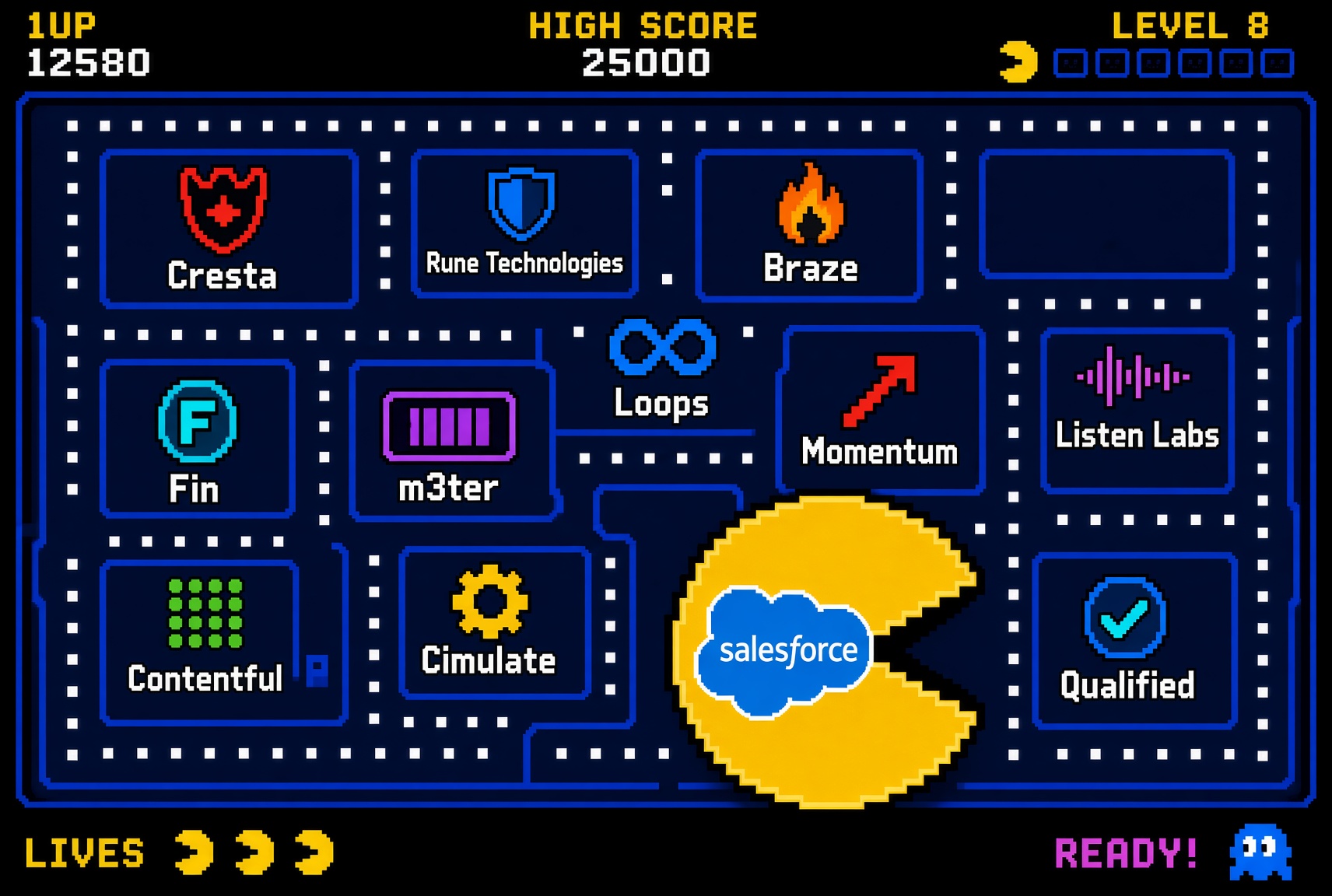
Venture capitalists funded hundreds of small AI startups betting on the AI boom, and for a while the exit paths looked limited. IPOs stayed scarce, and raising deeper capital was hard. Fast forward to the beginning of November 2026, and the exits have arrived. Within one week, Salesforce announced it was buying Cresta, Dialpad agreed to combine with Ada, and Five9 agreed to acquire Level AI. The consolidation wave is no longer theoretical.
Salesforce has been, no pun intended, a force of nature on acquisitions in 2026. It has roughly $15 billion committed to marketing and customer-experience-related deals, a large share of them AI-native or AI-heavy. That figure combines prices Salesforce has disclosed with prices the press has reported. The more contact-center-focused pieces (Fin and the pending Cresta deal) account for about $6.3 billion of the total. (See Table 1.)
What this means for customer service
What does this mean for customer service specifically? Customer experience spans the whole journey, but marketers and contact-center leaders solve different problems with different data and interfaces. I still don’t see CRM and CCaaS collapsing into one system at most large enterprises. The contact center does, however, hold a rich stream of customer issues, intent, and outcomes. Salesforce clearly wants more of that data and more control over the interaction layer. In 2026, the company put heavy emphasis on Contact Center as a Service through both product work and acquisitions.
During the year, Salesforce pitched Agentforce Contact Center as a native, unified platform that brings voice (including its own telephony), digital channels, CRM data, and AI agents together. Like other players in the space, it focused on context that could survive handoffs and on expanding the types of conversations tied to the customer record. Building on the March 2026 U.S. and Canada launch, it previewed, and later delivered, an October rollout to more than 30 European countries, with Australia, New Zealand, and further markets to follow. That expansion moves Salesforce from CRM companion or overlay toward contending for the core contact-center platform decision itself. But as with all vendors, everything works great if you bring all your data into vendor X’s island. The world is simply more complex than this.
On the AI agent side, the company showed Casey, an out-of-the-box Help Agent that can handle common issues across voice, chat, WhatsApp, and other channels with relatively fast setup. At Dreamforce, It also leaned on Fin, the customer-service AI agent it acquired and closed in September, to support resolutions across chat, email, WhatsApp, SMS, voice, and Slack. Fin brings proprietary models tuned for support and an existing customer base. The new tools aim to improve visibility over mixed human-and-AI teams. The message was connected, faster service with fewer visible handoffs.
At Dreamsforce, Salesforce talked about how it will offer forecasting, scheduling, adherence monitoring, and supervisor visibility across human and AI work. It also said its new Service Cloud editions bundle Contact Center and Workforce Engagement Management.
Cresta, which The Information reported Salesforce is buying for about $2.7 billion, is meant to deepen the voice layer once the deal closes (expected early 2027). It offers end-to-end voice agents, plus conversation intelligence and real-time coaching for human reps still on the line. So Salesforce is also pitching real-time guidance and dynamic plans for human agents as customer interactions evolve. Cresta’s clients include large enterprises such as Marriott, Comcast, and Alaska Airlines. Salesforce has said Cresta will continue to support the other telephony and CCaaS platforms its customers use today. I am skeptical that the promise lasts long. Once Salesforce owns the technology and is actively competing for the platform decision, the commercial incentive for rival CCaaS vendors to keep investing in deep interoperability declines. Customers should treat multi-platform continuity as temporary.
These acquisitions also bring real enterprise customers, not just technology. Fin arrived with more than 30,000 companies. Braze, while in the marketing sector, brought customers including Canva, Dairy Queen, and Equinox. Cresta, as noted above, has large recognizable accounts. Mature organizations had already found enough value to buy and deploy these tools. But I’ll admit, it’s hard to gauge the size and scope of those deployments and outcomes are still difficult to pin down. Agentic AI in the contact center is early. Resolution-rate claims exist, definitions vary by vendor, and some customers report productivity or containment gains. Right now, logos are easier to collect than durable, measured business results.
The market around Salesforce
For years, Salesforce worked alongside CCaaS vendors. Vendors like Amazon Connect, Genesys, Five9, and others all built integrations with Service Cloud. With Agentforce Contact Center, Salesforce now competes with those same partners for the core platform decision. As companies like to expand TAM, Salesforce’s change in posture was expected.
Genesys is the most interesting case. Salesforce and ServiceNow together invested $1.5 billion in the company in 2025. That stake does not make Genesys a captive, but it means both companies keep a way to connect with Genesys technology, which remains very strong in the contact center. In fact, Genesys shipped updates to its joint Salesforce product in October. This demonstrates Salesforce can still work with at least one of the leading CCaaS providers even as it competes with it.
The same pressure applies to the AI companies other vendors have bought. NiCE (Cognigy), Dialpad (Ada), Five9 (Level AI), and Salesforce (Cresta) have all acquired AI agent or conversation-intelligence companies that were selling across other vendors’ platforms, and most vendors say cross-platform support will continue. While NiCE Cognigy is currently still offering integrations, I do not expect any of the companies partnerships to be durable over time. As the fight for the platform decision heats up, today’s integration assurances are best read as transition-period statements.
The strongest independents, so far, are staying independent. Sierra raised $950 million in May at a reported valuation above $15 billion, and Decagon raised $250 million in January at $4.5 billion. Valuations like those are likely a big reason they haven’t been taken out. Very few buyers can pay that price, and both have the capital to keep going on their own.
Salesforce’s own position adds context to why it’s intensified its acquisitions. Its stock was down roughly 28 percent for the year, even as Agentforce ARR grew from about $800 million at the end of its fiscal fourth quarter (January 2026) to a reported $1.5 billion in June. Investors are worried that AI agents threaten seat-based software. Against that backdrop, the buying spree reads more defensive than offensive. Salesforce is buying AI-native technology, customers, and data streams that could otherwise be used to compete with it.
My take on the pros, cons, and risks
Salesforce already reaches marketing, sales, and service stakeholders inside many accounts. It’s continuing to expand its solutions to maintain and grow its position as a strategic partner. With the industry replatforming around agentic AI, buying proven technology and customer bases is a logical way to expand footprint and accelerate time-to-market. The combination of CCaaS, WFM, Casey (an Agentforce Help agent), Fin, and (soon) Cresta lets an enterprise evaluate Salesforce’s own solutions and (at least for the next year) integrate with their existing deployed contact center and telephony technology.
The risks
The biggest concern remains integration, as always. Salesforce’s history with large acquisitions is mixed. This year’s onslaught of eleven acquisitions (see Table 1) creates significant execution risk. Salesforce will be absorbing multiple AI-native teams, roadmaps, and customer bases at once. Product cohesion, roadmap clarity, and talent retention are high risks. Casey, Fin, custom Agentforce agents, and Cresta’s voice stack will need clear positioning and technical integration, or customers will face overlapping options and internal complexity. NiCE’s acquisition of Cognigy at least signaled a clearer intent to make the acquired technology a foundation rather than one more bolt-on. Salesforce’s approach so far looks more like a portfolio.
A second risk is the erosion of multi-vendor freedom. Cresta today works across multiple telephony partners, and those relationships are unlikely to stay equally deep once Salesforce is both owner and competitor. As noted above, the same dynamic applies to the other acquired AI layers in this market.
A third risk is that no one knows yet how this market will charge. Salesforce is currently selling Casey with resolution-based pricing. Many large buyers still prefer predictable spending. Meanwhile, the industry is still trying to settle on the right mix of outcome, consumption, and seat pricing. Companies should specify what qualifies as a billable resolution, how repeat contacts and escalations count, and which telephony or AI usage charges sit outside the quoted rate. It’s a brave new world in pricing.
Salesforce is now competing aggressively to be your CRM, sales, and contact-center/service platform of choice using AI. That is a bigger lift than simply adding AI agents. Whether the Pac-Man strategy produces a coherent, high-performing platform or a collection of capable but incompletely integrated pieces will be the real test over the next 18 to 24 months.
PS: Bonus points if you still remember Pac-Man. Double bonus if you’ve already started asking what the agent pricing and contract language looks like for 2027.
| Company | Announced | What it does |
|---|---|---|
| Cresta | Nov. 2, 2026 | Contact center AI with voice agents that handle calls, real-time coaching for human agents, and conversation analytics. (salesforce.com) |
| Rune Technologies | Oct. 29, 2026 | Military logistics software that forecasts supply needs and helps teams allocate resources in areas with limited connectivity. (hklaw.com) |
| Braze | Oct. 20, 2026 | Real-time customer engagement platform that personalizes messaging across mobile apps, websites, email, SMS, and WhatsApp. (sec.gov) |
| Loops | Oct. 12, 2026 | AI analytics platform that monitors business metrics, flags anomalies, and explains what drove changes. (salesforce.com) |
| Listen Labs | Sept. 29, 2026 | AI-powered customer research platform that designs studies, interviews customers, and synthesizes feedback. (salesforce.com) |
| Fin (formerly Intercom) | June 15, 2026 | AI customer service agents that resolve support requests across chat, email, messaging, and phone. (investor.salesforce.com) |
| m3ter | June 8, 2026 | Tracks product usage and applies pricing rules so companies can bill customers based on consumption. (salesforce.com) |
| Contentful | June 1, 2026 | Content management platform that lets companies create and reuse content across websites, apps, and other digital channels. (salesforce.com) |
| Momentum | Feb. 18, 2026 | Captures insights from sales calls and meetings and turns them into data that revenue teams can use in their workflows. (salesforce.com) |
| Cimulate | Feb. 10, 2026 | AI-powered e-commerce search and product discovery that uses shopper intent to surface relevant products. (salesforce.com) |
| Qualified | Dec. 17, 2025 | AI marketing agents that engage website visitors, qualify leads, and nurture prospective buyers. (salesforce.com) |
Leave a Reply