Author: maribellopez

  • From Chatbots To Digital Workers: Why NiCE’s AI Focuses On Execution

    From Chatbots To Digital Workers: Why NiCE’s AI Focuses On Execution

    NiCE is betting that AI agents that complete tasks—not just conversations—will separate winners from pretenders in the enterprise AI race

    The artificial intelligence hype cycle has reached peak saturation, with technology vendors scrambling to slap “AI-powered” labels on everything from refrigerator recipe suggestions to chatbots that rely on simple keyword matching. Yet, for all the breathless marketing rhetoric, most business leaders are still waiting for AI that simplifies operations and improves data analysis.
    NiCE, a customer experience platform provider, is making a calculated bet that the next phase of enterprise AI won’t be about making chatbots sound more human. The next wave of business outcomes will leverage AI agents that can navigate complex business processes from start to finish with minimal human intervention. 

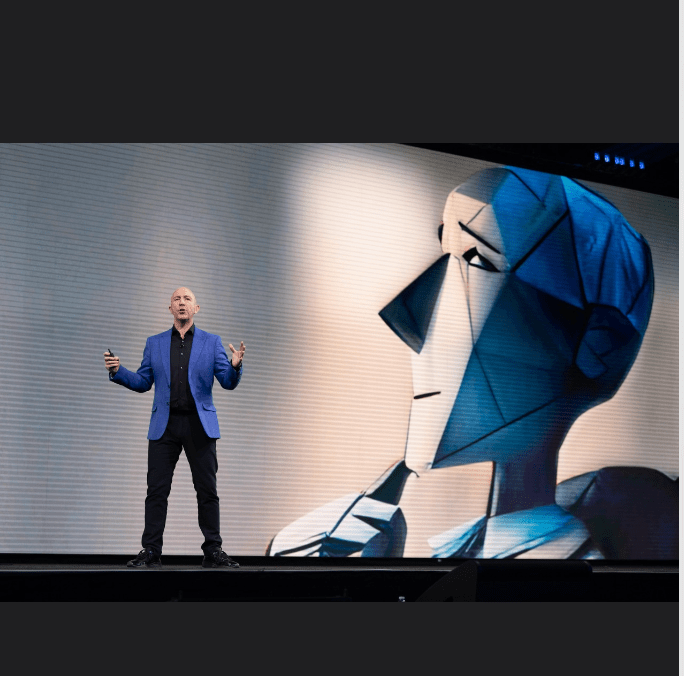
    NiCE’s CEO, Scott Russell said, “Optimizing knowledge is not just critical for AI to truly thrive in your environment, but it’s also the key for transforming service from reactive to proactive, identifying opportunities to solve issues and predict future needs.” NiCE’s recent product launches and strategic moves reveal a move toward enhanced automation and agentic AI.

    From AI Data Access to Intelligent Action

    The first wave of enterprise AI focused primarily on making data more accessible through conversational interfaces—essentially putting a chat layer on top of existing applications and knowledge repositories. 

    While this represented significant progress in democratizing data access, it only scratched the surface of AI’s potential business value. Organizations could ask questions and get answers, but the burden of reasoning through complex decisions and taking action remained entirely on human operators.

    Going forward, technology vendors, such as NiCE, will use AI to deliver solutions that can reason through multifaceted problems and take semi or fully autonomous action. This evolution from conversational AI to agentic AI represents the difference between AI that informs and AI that performs. Agentic AI enhances a company’s ability to analyze context, weigh multiple variables, make informed decisions based on key business performance indicators, and execute actions across interconnected systems.

    Traditional conversational AI helps a customer service representative find relevant information. Still, agentic AI can help a representative evaluate a customer’s complete history more easily, assess risk factors, determine appropriate responses based on business rules, and automatically trigger the necessary workflows to resolve issues end-to-end. “There’s a big difference between AI that talks and AI that gets things done,” explains Barry Cooper, President of NiCE’s CX Division. “While others are building agents that mimic conversations, we’re building agents that fulfill customer needs—end to end.” 

    This distinction becomes crucial when examining NiCE’s CXone Mpower Agents. Traditional AI chatbots had limited access to data, offered scripted responses, and were confined to specific areas of the business, such as front-office or back-office operations. NiCE’s AI agent platform aim to break through these constraints by operating across the entire enterprise ecosystem—from initial customer contact through mid-office approvals to back-end fulfillment systems. Admittedly, Agentic AI is the AI buzzword of 2025, but early, well-scoped use cases show promise. 

    Speeding Up Time to AI Agent Creation

    Technology companies are increasingly working to streamline AI deployment as traditional approaches require extensive technical resources, custom development, and lengthy implementation cycles. NiCE’s model simplifies AI agent creation while maintaining enterprise-grade sophistication through what they call vibe coding, allowing business users to tailor each agent’s personality and communication style without requiring technical expertise.

    While the concept of vibe coding remains ill-defined, and its merits are hotly debated within the enterprise software community, there is a broad consensus around the underlying goal of making AI agents easier to code and deploy. The specific term matters less than the fundamental shift toward empowering business users to create and customize AI functionality without requiring deep technical expertise.

    Breaking Down Data and Function Silos With Strategic Partnerships

    In a rapidly evolving tech landscape, no single vendor can deliver everything an enterprise needs to succeed with AI, cloud, data, and digital transformation. Today, companies are no longer looking for isolated solutions—they need interconnected ecosystems. That’s why strategic partnerships are essential. By working together, enterprise technology vendors can bridge data and function silos, improving workflows and accelerating innovation. Just as importantly, these alliances help enterprises extract greater value from existing technology investments by ensuring that new capabilities work in concert with the tools already in place. Over the past several months, NiCE has expanded its partnership with Amazon Web Services (AWS) and added ServiceNow and Snowflake to the mix.

    NICE and AWS Tackle AI Integration at Enterprise Scale

    At Interactions 2025, NiCE announced an expanded collaboration with AWS, bringing together NiCE’s domain expertise and rich interaction data with AWS’s cloud infrastructure and generative AI services, including Amazon Bedrock, Amazon Q, and the Amazon Nova family of large language models. The partnership addresses some of the most pressing challenges facing enterprise AI deployments: fragmented workflows, disconnected data, and inconsistent global performance. 

    The partnership focuses on three core pillars. First, content-aware automation ensures that AI-generated responses are highly relevant and context-specific. Using the Amazon Q Index, Mpower Agents are equipped with up-to-date business content—from product documentation to policy details and case histories—enabling them to respond accurately and confidently in real time.

    Second, the integration delivers enterprise-wide orchestration by bridging front, middle, and back-office operations. NiCE’s CXone Mpower Orchestrator automates workflows across functional teams, while Amazon Q Business extends this reach into a broader set of enterprise applications—eliminating silos and streamlining complex processes.

    Additionally, global scalability is made possible through AWS’s robust cloud infrastructure. With low-latency performance and high availability across regions, multinational organizations can deploy and scale AI-driven customer service experiences quickly and consistently around the world. NiCE’s partnership strategy also extends beyond AWS to include other critical enterprise platforms, such as ServiceNow and Snowflake. 

    NiCE and ServiceNow Partner to Automate the Full Customer Journey

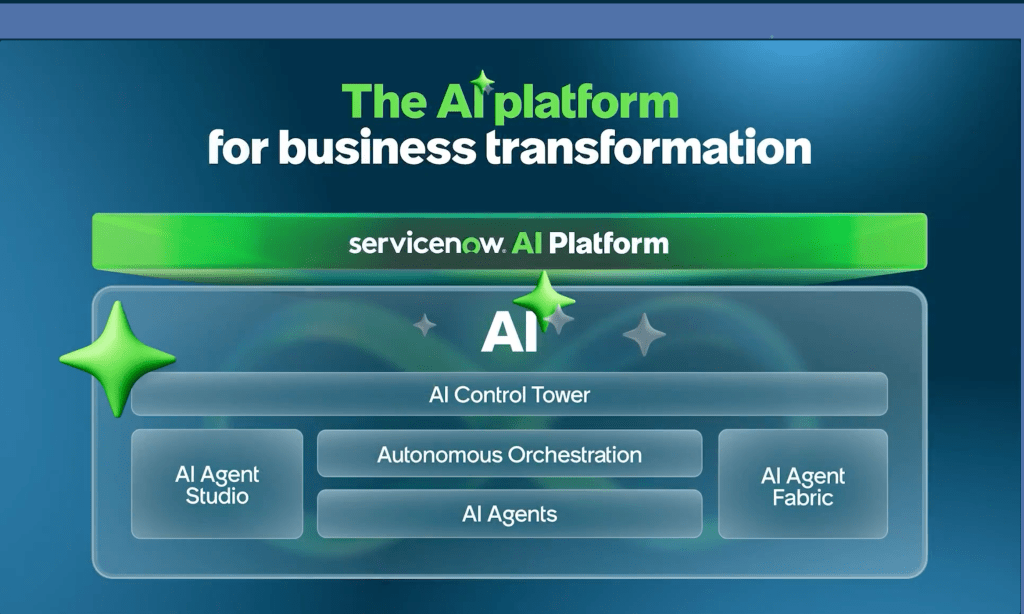
    NiCE’s latest partnership with ServiceNow aims to eliminate long-standing service gaps by tightly integrating real-time customer engagement with enterprise workflow automation. Announced at ServiceNow’s Knowledge 2025 event, the collaboration integrates NiCE’s customer service platform with ServiceNow’s AI and Customer Service Management (CSM) tools to streamline operations across the entire organization, from the front office to the back.

    The goal: fully automated customer service fulfillment. The combined solution routes inquiries based on sentiment, intent, and service-level agreements (SLAs)—bridging siloed departments to accelerate resolution times and enhance both customer and employee experiences. Role-based AI copilots assist agents and back-office teams with real-time insights and next-best actions, while continuous optimization tools flag issues and launch workflows automatically.

    These relationships provide access to complementary technologies and customer bases, allowing NiCE to integrate with the broader enterprise software ecosystem that companies rely on for operations, data management, and workflow automation.

    NICE and Snowflake Partner to Turn Customer Interaction Data Into Enterprise Intelligence

    NiCE’s strategic collaboration with Snowflake aims to unlock the full value of customer interaction data by making it accessible, secure, and actionable across the enterprise. By integrating Snowflake’s AI Data Cloud with CXone Mpower, NICE can improve data sharing, breaking down silos that have traditionally limited the impact of customer insights. Snowflake serves as the backbone of the CXone Mpower data lake, centralizing interaction data and enriching it with information from other enterprise systems. This unified data foundation allows organizations to automate key processes—from billing to claims handling—while powering AI-driven analytics, dashboards, and decision-making. The result: faster fulfillment, greater accuracy, and a deeper, organization-wide understanding of the customer experience.

    The Strategic Imperative of Brand Evolution in an AI Era

    Apparently, 2025 is the year of the brand refresh. The technology industry has witnessed updates from Five9, Google’s G, Hitachi HPE, and Qualcomm’s introduction of Dragonwing, alongside NiCE’s own transformation. Every brand refresh has its own story to tell, but NiCE’s new logo and marketing campaign represent more than a desire for fresh typography and color schemes.

    The rebrand indicates the company’s strategic desire to expand its AI vision beyond the contact center to encompass its broader portfolio of finance and security solutions. The company describes the rebrand as positioning “NICE to empower brands to deliver AI-powered experiences that are proactive, human-centered and intuitive—whether connecting with customers, protecting communities or combatting financial crime.”

    NiCE’s solution involves partnering with actress Kristen Bell, who serves as the face of the company’s “NiCE World” brand campaign. The initiative positions Bell as the “NiCEst Person in the World,” NiCE said the campaign “builds on NiCE’s reimagined brand, championing a future where AI isn’t just intelligent – it’s connected, intuitive and working behind the scenes to make life better.

    Key Takeaways

    The enterprise AI market remains in flux, with new entrants and existing players continually repositioning themselves. NiCE’s focus on domain expertise, integration depth, strategic partnerships, and automation suggests a company that understands both the technical and implementation requirements necessary for large-scale AI adoption.

    As enterprises increasingly demand AI that delivers results, NiCE’s bet on fulfillment-focused automation may prove prescient. Of course, there’s still the matter of  cost and return on investment. Most companies struggle to understand and plan for the true product and operational costs of AI. Organizations need to work with their technology vendors to deploy well-scoped use case that deliver measurable return on investment, fast. The question isn’t whether AI will transform customer experience—it’s which companies will build AI that completes the transformation rather than just talking about it.


  • How Best Buy Uses AI to Transform Customer Experience

    How Best Buy Uses AI to Transform Customer Experience

    The electronics retailer’s methodical approach to artificial intelligence in customer experience offers lessons for companies rushing to deploy the latest tools

    Best Buy Co. faced a daunting challenge that would sound familiar to many large corporations: multiple different software applications were needed to run its contact centers, creating a maze of complexity for customer service agents and frustrating experiences for shoppers seeking help. “When I came into this space, we had 93 applications that were needed to run our contact centers,” Daniels revealed. This fragmentation created what she describes as “incredibly sticky and muddy” experiences for both agents and customers.

    Rather than simply layering AI on top of this fragmented system, the Minneapolis-based retailer took a step back. The company’s approach—starting with customer outcomes rather than flashy AI capabilities—has yielded rapid results and provides a roadmap for other businesses grappling with how to effectively deploy AI technology.

    “AI is not the goal. It is one solution and often needs to be incorporated with many others to bring an actual experience to life,” said Ashley Daniels, Best Buy’s vice president of product management, in a recent interview with Lopez Research

    Beyond the Hype AI Hype in Customer Experience

    Best Buy’s disciplined approach stands in stark contrast to the AI frenzy that has gripped corporate America since the debut of ChatGPT. While many companies have rushed to implement artificial intelligence tools, often with mixed results, Best Buy has focused on solving specific business problems.

    Three Pillars of Its Customer Experience AI Implementation

    Best Buy’s AI strategy focuses on three core areas, each designed to enhance different aspects of the customer journey:

    1. Customer Self-Service Empowerment

    The company launched a gen AI-powered virtual assistant that enables customers to independently handle complex tasks, such as troubleshooting product issues, rescheduling deliveries, and managing subscriptions. Best Buy didn’t just launch a simple chatbot—it’s an intelligent system that can understand context and provide meaningful solutions across web, mobile app, and phone channels.

    2. Customer Service Agent Augmentation

    Best Buy has also created AI solutions that provide advanced assistance to customer care agents. The system provides real-time conversation assessment, sentiment detection, and contextual recommendations, enabling agents to focus on building personal connections with customers. As the company notes, these tools “are designed to help reduce the mental workload for agents, allowing them to better focus on personally connecting with the Best Buy customer.”

    3. Front Line Employee Support

    Putting AI assistive tools in the hands of  front line workers can fundamentally change the customer experience. Companies like Wendy’s are experiencing the benefits of this strategy today and Best Buy story highlights a similar trend. Beyond customer-facing applications, Best Buy is developing AI assistants for front-line employees. These tools provide easier access to company resources and product guides, enabling store associates to serve customers more efficiently and confidently. 

    Additionally, Best Buy commits to transparency, always informing customers when they’re interacting with AI rather than humans. However, the company strives to make those interactions feel natural and helpful.

    The strategy appears to be working. The company deployed AI-powered conversation summarization in its contact centers in just six to eight weeks—a timeline that surprised even internal teams. But Daniels cautions that not every AI project moves that quickly. The retailer’s experience suggests that successful AI deployment requires managing expectations. While some capabilities can be implemented quickly, others take time to develop properly.

    Best Buy created a vision for its AI-powered customer service a year before the technology was fully ready to support it. “The technology is catching up to our vision,” Daniels said. “When you give the technology a chance to catch up to your vision, it makes it less painful.”

    The Role of Strategic Partnerships in Customer Experience

    Best Buy’s AI initiative relies on partnerships with Google Cloud and consulting firm Accenture—a three-way arrangement that divides responsibilities strategically. Google provides the underlying AI technology and rapid innovation. The company’s partnership with Google Cloud wasn’t just about adopting new AI capabilities—it was about fundamental architectural consolidation. Despite serving similar conversational functions, Best Buy recognized that their chatbot and IVR (Interactive Voice Response) systems were built by separate teams using different solutions. This insight led to a unified approach where AI could power consistent experiences across all customer touchpoints.

    Accenture brings implementation and regional experience from working with multiple companies. Meanwhile, Best Buy maintains control over customer experience decisions and business strategy.

    Daniels emphasizes that partnership doesn’t mean abdication of responsibility: “Just because you have partners does not mean that you get to step back and take your hands off the wheel… we’re the only people that can make decisions about the experiences we want for our customers.”

    Advice for Companies

    The retailer’s experience highlights a crucial lesson that many AI enthusiasts overlook: the underlying business infrastructure matters as much as the artificial intelligence solutions.

    Daniels compares the process to remodeling a house. If your foundation isn’t solid, your windows leak, your walls will have cracks, and you’re not going to achieve the outcomes that you want. For Best Buy, the foundation includes clean data, updated software interfaces that enable different systems to communicate, and a deep understanding of how the business operates.

    “People think that when AI shows up to save the day, we no longer need domain experts,” Daniels said. “In my opinion, it’s the exact opposite.” She likens training AI systems to managing a new teenage employee who needs guidance from experienced mentors to be effective.

    For businesses considering their own AI initiatives, Best Buy’s leaders offer two key recommendations. First, define clear outcomes before selecting technology. “Be thoughtful about what outcome it is that you want to drive,” Daniels said. Second, invest in foundational capabilities, including data quality, modernizing APIs, system integration, and employee expertise. Without these elements, even sophisticated AI tools are likely to disappoint.

    While there is considerable hype surrounding the creation of fully autonomous workloads with agentic AI, today’s AI success stories treat the technology as a tool to enhance human capabilities rather than replace them entirely. 

    Best Buy has taken this approach, and other companies, such as Cisco, have also shared how AI will assist their employees in delivering faster, better customer experiences. Best Buy’s measured approach suggests that sustainable success with AI technology comes from being thoughtful. 

  • Cisco’s Winning AI Formula: Real CX Problems, Practical Solutions

    Cisco’s Winning AI Formula: Real CX Problems, Practical Solutions

    Companies with the best customer experience focus on consistency, clarity, and a mindset of continual improvement. Most enterprise AI initiatives fail not because the technology doesn’t work but because companies chase broad or ill-defined use cases instead of addressing a real problem. For example, many organizations have built chatbots that wow in demos but frustrate users in practice.

    When Liz Centoni, Cisco’s Chief Customer Experience Officer, talks about solving “boring problems,” she’s not being modest—she’s highlighting a fundamental truth about artificial intelligence that most companies miss. While the tech world obsesses over flashy AI demos and theoretical capabilities, Cisco quietly built practical and measurable AI use cases that make it easier for its enterprise customers to use and troubleshoot their Cisco environments.   

    “We’re solving the most boring problems that are instrumental to our customers’ operational environments—problems everybody’s been circling around for years,” Centoni explained during an industry analyst breakout at the Cisco Live conference in San Diego. What are examples of these “boring” problems? Configuration errors that cause 25% of all support cases. Network professionals spending up to 50% of their time on manual tasks and minimizing security breaches caused by human error.

    The results speak volumes: Cisco has achieved a 22-25% decrease in low-severity support cases and a 10% reduction in high-severity cases year-over-year. Additionally, its AI-powered renewal process has reduced the time its customer success teams spend on data gathering from 40% to under 5%, freeing them to focus on actual customer relationships.

    By addressing the low-hanging fruit of basic support issues, Cisco can focus its support teams’ time on more complex problems while also enhancing its sales process.

    The Three Pillars of AI-Driven Customer Experience

    During her Cisco Live keynote, Centoni shared that Cisco’s customer experience strategy centers on three core areas that any company can adapt to its customer experience challenges:

    1. Resiliency: Preventing Problems Before They Occur With AI

    The most tangible impact comes from what Cisco calls “services as code”—integrating AI-powered testing into deployment pipelines to catch configuration errors before they cause outages. “We can envision a future where we go from configuration chaos to configuration confidence,” Centoni explained.

    This isn’t just about finding defects. The system proactively validates configurations against established best practices and operational requirements specific to each customer’s environment. One customer who adopted this approach summarized the value: “Security, resiliency, consistency—you delivered all three.”

    The broader lesson: AI’s value often lies not in replacing human decision-making but in preventing the human errors that cause the most expensive problems.

    2. Simplicity: Creating Unified, Intelligent Interfaces

    Cisco recognized that customers were drowning in multiple interfaces and disconnected tools. Like many large technology vendors, Cisco aims to simplify the customer experience (CX) by offering a unified, AI-powered interface that provides a “hyper-personalized view into your entire Cisco environment,” as Centoni described it.

    This interface doesn’t just aggregate information—it understands context. It can identify which devices are approaching end-of-support, suggest remediation scripts for security vulnerabilities, and even generate compliance reports tailored to specific regulatory requirements.

    The key insight: AI’s real power in simplification comes not from hiding complexity but from making complex information actionable and relevant to each user’s specific context.

    3. Time to Value: Personalizing the Journey to Success

    Personalization isn’t a new concept, but it’s proven elusive in both consumer and B2B sales. Cisco has created what they call an “adoption agent” that digitalizes customer intent and creates personalized onboarding journeys. Rather than providing a standard set of features, the system aligns adoption with each customer’s specific goals and key performance indicators (KPIs).

    “We’re digitizing the customer’s intent, the KPIs, the outcomes, and then we’re helping them adopt the features that tie up to that intent, not just a whole standard set of features,” Centoni explained.

    Breaking down data siloes was a key theme of most technology vendor’s presentations in this spring’s technology conference circuit. Cisco also showcased how AI could help the company connect and analyze data across various sources. This strategy represents a shift from product-centric to outcome-centric customer success enabled by AI’s ability to process and connect disparate data sources. 

    The Role of Agentic AI: From Tools to Teammates

    In 2025, a technology conference can’t be complete without sharing a vision for Agentic AI. Cisco was no exception. While there is still some debate over the definitions of Agentic AI, most technology companies define it as a system of AI agents “designed to act autonomously, making decisions and taking actions to achieve goals with limited human oversight. Unlike generative AI, which focuses on creating content, agentic AI focuses on doing by executing tasks and solving problems. It perceives its environment, reasons about it, and acts upon it, often without direct human intervention.” Agentic AI concept is both empowering and terrifying to organizations that want to reap the productivity of agents but need to minimize the risk of fully autonomous workflows.

    During the analyst conference at Cisco Live, Centoni shared a balanced approach to moving into Agentic AI. She said, “We want our teams to think about it as augmentation,” Centoni emphasized. “I would love to be in a space where instead of asking for an intern to help them do their job, everyone in my team could spin up an agent to be able to help them with tasks.”

    Agentic AI agents can operate like capable colleagues, understanding their context, making informed decisions, and coordinating multiple tasks to achieve a goal. Carlos Pereira, Cisco’s Fellow and Chief Architect for Customer Experience, explained the distinction: “The way we look at it is the way we have been using traditional AI as a tool. The way we expect to use agentic AI is where it becomes a teammate.”

    This shift from tool to teammate enables what the technology industry refers to as “ambient agents”—AI systems that operate in the background, triggered by events rather than direct commands. As Harrison Chase, CEO of LangChain (a key partner for Cisco in building these systems), described during the Cisco Live keynote: “We define ambient agents as agents that are triggered by events, run in the background, but they’re not completely autonomous.”

    The power of this approach becomes clear in practice. Instead of a customer reporting a network issue and waiting for a human to diagnose it, Cisco’s ambient agents can detect the problem in real-time, analyze historical data and best practices, and provide personalized recommendations—all before the customer even knows there’s an issue.

    While Cisco’s efficiency gains are impressive, the real return on investment extends beyond traditional metrics. Centoni noted that customer satisfaction consistently improves when solutions are found through AI-enabled methods. AI will also change the nature of work itself at Cisco. “Reducing cognitive load and friction enables my teams to get more creative in how we solve our customers’ problems,” Centoni observed. “They can use that (extra) time for learning. They can use that time to balance work and life.”

    Agentic AI offers significant potential business impact, where AI not only enhances existing processes but also enables entirely new ways of creating value. When routine tasks are automated, human workers can focus on the complex, creative problem-solving that drives real competitive advantage.

    AI Lessons for Every Company

    Cisco also offers practical lessons for any organization looking to transform customer experience with AI:

    Start with Pain Points, Not Possibilities

    Rather than asking, “What can AI do for us?” Cisco asked, “What problems do our customers and employees face every day?” This question led Cisco to focus on configuration errors, manual tasks, and data silos—initial use cases that may seem unglamorous but can deliver high impact rapidly.

    Design for Augmentation, Not Replacement

    “We are thinking about autonomous in terms of tasks that augment what our teams do,” Centoni emphasized. This approach reduces resistance, maintains quality control, and often delivers better results than fully automated systems. Over time, there will be opportunities to have more autonomous systems; however, Cisco’s strategy offers a more pragmatic approach to minimizing risk today. 

    Embrace Continuous Learning

    Unlike traditional software that follows a “build it, ship it, maintain it” cycle, AI systems require continuous improvement. “It’s build it, improve the accuracy of it… it’s continuous learning,” Centoni noted. Businesses need to design processes for ongoing feedback and refinement.

    Prioritize Trust and Transparency

    With customer relationships at stake, Cisco maintains human oversight at critical decision points. “The decision is never up to the agent, per se. The decision is up to the human at the end of the day,” Centoni explained. The balance between AI capability and human control builds trust with both employees and customers.

    Think Beyond Efficiency

    While cost savings matter, the real value lies in enabling new capabilities. Cisco’s agents don’t just handle support cases faster—they can predict and prevent issues that would never have been caught manually.

    The Future of AI in Customer Experience

    Cisco’s vision extends beyond current capabilities to what Centoni calls “intelligent anticipation”—systems that understand customer environments so deeply that they can resolve problems before customers are even aware of them.

    “Our goal, whether it’s a customer who spends a few thousand dollars or a customer who spends a few billion dollars with us: we want them to feel like they’re our only customer because we know their environment. We know them so well, sometimes even better than they do themselves,” Centoni explained.

    The vision of hyper-personalized, predictive customer experience represents the true promise of AI in business—not replacing human relationships but making them more meaningful by removing friction and adding intelligence to every interaction.

  • AI in Retail: Best Buy’s Journey from 93 Apps to One Solution

    Description: In this episode from Google Cloud Next 2025, we dive deep into Best Buy's AI transformation with Ashley Daniels, VP of Product Management. Discover how one of America's largest retailers approached AI implementation strategically, moving from 93 contact center applications to a unified solution.

    Ashley shares the real story behind Best Buy's AI journey – the quick wins, unexpected challenges, and why your foundation matters more than the technology itself. From gift finder tools to revolutionizing customer care, learn practical strategies for implementing AI that actually drives business outcomes.

    Key insights covered:

    • Why treating AI as a “tool in the toolbox” leads to better results
    • The importance of starting with customer experience, not technology
    • How to build strategic partnerships for AI implementation
    • Why domain expertise becomes more critical in an AI world
    • Real timeline: Getting AI summarization live in 6-8 weeks

    Whether you're in retail, customer service, or leading digital transformation initiatives, this conversation offers actionable insights for your AI strategy.

    Hosted by Maribel Lopez, founder and principal analyst at Lopez Research who interviewed Ashley Daniels, the VP of Product Management at Best Buy.

    You can follow Ashley here  https://www.linkedin.com/in/ashley-daniels1219/ and Maribel here https://www.linkedin.com/in/maribellopez/

  • 58. The AI Advantage With Liz Centoni: How Cisco is Making Customer Experience Hyper-Personal

    Guest Profile

    Liz Centoni brings over 25 years of experience at Cisco where she currently leads a team of 20,000+ people dedicated to helping customers maximize the value of their technology investments. She also serves on the boards of Mercedes-Benz and Workday.


    Episode Highlights


    Cisco's Unique Position in the AI Landscape

    • Liz outlines Cisco's three-pillar approach to AI:
      1. Investment in back-end AI networks with hyperscalers
      2. Enterprise deployment of secure AI use cases
      3. Meeting increased capacity requirements for both private and public front-end cloud networks
    • Recent partnership with NVIDIA to accelerate AI adoption and simplify building AI-ready data centers


    Transforming Customer Experience

    • Vision for customer experience: personalized, proactive, and predictive
    • Goal: Make every customer “feel like they are our only customer”
    • Leveraging data across tech stacks to break down silos and deliver proactive experiences
    • Using AI to reduce cognitive load and workplace friction for employees


    AI Renewals Agent: A Case Study in Predictive AI

    • Jointly developed with Mistral AI and announced in February 2025
    • Consolidates data from 50+ signals and sources (both structured and unstructured)
    • Provides real-time sentiment analysis by incorporating customer support data
    • Expected to reduce time spent on renewal proposals from 40% to less than 5%


    The Future of Agentic AI

    • Moving from AI as a tool to AI as a teammate
    • Current focus on assisting and augmenting tasks, not replacing roles
    • Human oversight remains critical for complex customer networks
    • Evolution from reactive to proactive customer care


    Impact on Jobs and Work

    • Expectation that everyone needs baseline AI skills
    • Historical pattern of rebalancing versus complete replacement
    • Focus on using AI to eliminate busy work and reduce cognitive load
    • Importance of emotional intelligence and empathy in areas where AI still falls short


    Closing Thoughts

    Liz's definition of success: “Customers walk up and say, 'You really know me better than I know myself'… and they feel they can't live without three things: Cisco's security, Cisco's networking portfolio, and Cisco services.”

  • Microsoft Build 2025: Bridging the Gap Between AI POCs and Agentic AI Success

    Microsoft Build 2025: Bridging the Gap Between AI POCs and Agentic AI Success

    The AI Acceleration Challenge

    The AI market has rapidly evolved from early chatbot failures to a landscape of simplified access to information driven by generative AI, with agentic AI coming soon. Yet, most organizations are still struggling to move beyond proof-of-concept projects to production deployments that deliver measurable business value. Over 80% of firms interviewed by Lopez Research report significant technical skills shortages and challenges with change management when deploying AI systems. The landscape has also become increasingly complex, with thousands of AI models and multiple approaches to designing, deploying, and managing AI solutions.

    Before enterprises had even fully embraced conversational interfaces within various SaaS solutions, the technology industry rapidly moved toward creating agentic AI products. Instead of AI that assists people, the industry has pushed toward systems that can operate autonomously, reason through complex problems, and take action without always requiring human guidance. While agentic systems represent the future of AI, the inherent risks in autonomous systems terrify all but the most fearless companies.

    Amplified Risks in an Autonomous Agentic AI World

    AI systems face significant reliability challenges, including unpredictable outputs, “hallucinations” where they generate false information, and brittleness when encountering unfamiliar scenarios. These systems can also experience model drift as underlying data patterns change over time, leading to degraded performance without obvious warning signs. From a security perspective, AI systems remain vulnerable to sophisticated attacks, including adversarial inputs designed to manipulate outputs, data poisoning that corrupts training datasets, and inference attacks that can extract sensitive information from trained models.

    These challenges become exponentially more serious with agentic AI. Reliability issues that may cause minor inconveniences when a human is in the loop will become critical safety concerns when agents can act autonomously. An agentic AI experiencing model drift or brittleness could make consequential decisions affecting business operations, financial transactions, or even physical systems without human oversight. Security vulnerabilities become particularly dangerous, as adversarial attacks can manipulate agents into taking harmful actions, while data poisoning can corrupt not only outputs but entire chains of autonomous decision-making.

    Companies Flock To Strategic Vendors For AI Platforms

    The AI sprawl of startup vendors and highly specialized solutions only creates increased anxiety. Today, most business leaders are looking to a handful of strategic technology vendors to offer more comprehensive systems for designing, securing, maintaining, and governing AI that supports many but not all of the AI functions. It’s crucial that these strategic vendors also provide ecosystem-friendly platforms that can connect with other third-party technology vendors when necessary.

    Microsoft Responds with Advances in Agentic AI 

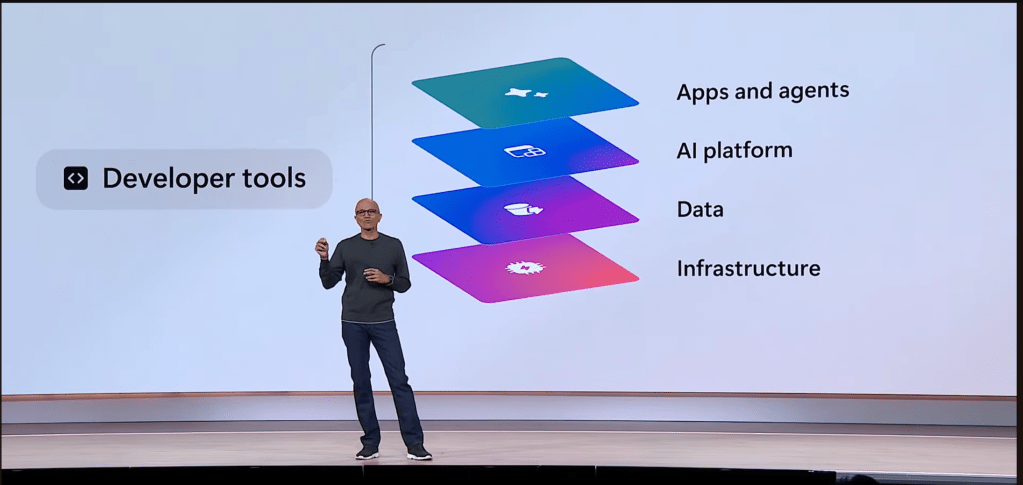
    At Microsoft’s Build 2025 conference, CEO Satya Nadella advanced the company’s vision for an “open, agentic web.” Microsoft’s announcements encompass over 50 new AI tools and platforms, focusing on agentic AI capabilities that promise to transform how organizations develop software, conduct research, and manage business processes. 

    Microsoft calls its Microsoft 365 Copilot “the UI for AI,” providing a place where people and teams interact with agents in the flow of work. However, since last year’s Build conference, the company has moved well beyond Microsoft Copilot as a conversational interface to also offering a more comprehensive platform for designing and using agents. This is in addition to providing its own AI models and special-purpose AI hardware. The latest Microsoft Build announcements showcase several key updates that demonstrate Microsoft’s commitment to addressing enterprise concerns about the deployment of autonomous AI while maximizing its transformative potential.

    1. Evolving Software Development

    Microsoft Build has always focused on tools for software development. The evolution of GitHub Copilot from code suggestion to an autonomous coding agent represents a significant shift in software development lifecycle management. The new agent handles end-to-end programming tasks, including bug fixes, feature implementation, and code refactoring. Embedded directly into GitHub, the agent activates when developers assign a GitHub issue to Copilot or prompt it in VS Code, spinning up secure and fully customizable development environments powered by GitHub Actions.

    The autonomous handling of routine coding tasks allows development teams to focus on architecture and innovation, effectively multiplying the strategic impact of existing technical staff. Beyond productivity gains, the system ensures consistent application of best practices across entire codebases, reducing quality variations that often plague large development organizations. Perhaps most significantly for enterprise operations, the platform reduces dependency on individual developer expertise, creating more resilient and maintainable systems where institutional knowledge embedded in the AI agent ensures continuity when personnel changes occur.

    The advances in GitHub Copilot address one of the most persistent challenges facing technical leaders: the growing gap between the demands of software development and the available talent. At Build, Microsoft shared that Ramp, a spend management platform, saves approximately 30,000 hours of manual work per month by utilizing GitHub Copilot. Cathay Pacific, Hong Kong’s largest airline, similarly leveraged GitHub Copilot to save developer time and increase productivity across their development teams.

    2. Delivering Choice and Interoperability

    Microsoft’s Azure AI Foundry Agent Service represents the cornerstone of enterprise agentic AI deployment. Now generally available, the platform provides enterprise-grade infrastructure for production AI agent deployments, integrating Semantic Kernel and AutoGen into a unified SDK while supporting Agent-to-Agent (A2) communication and the Model Context Protocol (MCP). The support for A2A and MCP means it will be easier for companies to create Agentic AI systems where agents can connect and collaborate across various applications and data sources. 

    Microsoft’s commitment to the Model Context Protocol across its entire platform stack addresses a critical enterprise concern: avoiding AI vendor lock-in while enabling sophisticated integrations. MCP integration with Windows will provide a standardized framework for AI agents to connect with native Windows applications, allowing seamless agent-based interactions. The support for the A2A protocol, an open standard, also enables Microsoft to integrate with other major technology companies, including Google (the originator of the protocol), Atlassian, Box, Cohere, Intuit, LangChain, MongoDB, PayPal, Salesforce, SAP, ServiceNow, UKG, and many others.

    Organizations will also gain model flexibility with access to over 11,000 models through a Hugging Face integration in addition to the existing 1,900 models in the Microsoft catalog. These capabilities enable organizations to integrate best-of-breed AI models regardless of vendor and optimize costs by selecting the right model for the right workload. 

    3. Advanced Workflow Automation

    The introduction of multi-agent systems enables sophisticated workflow automation where specialized agents collaborate to handle complex business processes within the Microsoft ecosystem and across applications. This multi-agent orchestration transforms organizational thinking about business process automation, shifting from rigid, predetermined workflows to intelligent systems that adapt and collaborate in real time.

    Cross-platform integrations demonstrate the versatility of this capability. Adobe’s marketing agent, integrated with Microsoft 365 Copilot, enables marketers to access audience analysis without needing to switch applications. ServiceNow AI agents work with Microsoft 365 Copilot for service management. SAP integration through SAP Joule enables the creation of custom AI agents for SAP workloads using Azure AI services while also allowing SAP users to access data within Microsoft 365 applications.

    Financial operations benefit similarly, with compliance agents working alongside analysis agents to produce automated reporting that maintains accuracy while reducing manual oversight requirements. Supply chain management becomes more responsive as demand forecasting agents coordinate directly with inventory management agents, creating dynamic, self-optimizing systems that respond to market changes in real time.

    4. Observability for Agentic Systems

    For technology leaders grappling with the complexities of AI deployment, this platform addresses several fundamental concerns that have historically hindered the success of AI initiatives. In addition to supporting open protocols for agent communication and governed access to multiple types of AI, it also offers built-in observability. Observability provides real-time metrics for performance, quality, cost, and safety, giving executives the visibility needed to manage AI operations with confidence. 

    Rather than deploying AI as a black box, organizations can now monitor and optimize their AI investments with the same rigor applied to traditional enterprise systems. The platform’s integrated compliance controls help prevent “agent sprawl,” which many organizations fear as AI adoption accelerates, enabling centralized oversight while increasing accessibility through a centralized agent store.

    AI Can Deliver Impact

    Real-world implementations demonstrate measurable impact. Accenture has leveraged Azure AI Foundry for AI and agent-led business process transformations, achieving a 30% increase in efficiency and a 50% reduction in AI application development time. Carvana developed an agent that analyzes customer interactions, resulting in a 40% reduction in inbound sales calls. The Indiana Pacers created an in-arena real-time captioning system with error rates reduced to just 1 percent. 

    Early implementations highlight the potential of agentic AI in mission-critical environments. Stanford Medicine’s Healthcare Agent Orchestrator, built on Azure AI Foundry, transforms cancer care delivery across approximately 4,000 tumor board meetings per year. The system consolidates fragmented information from multiple sources, integrates patient history with radiology data, medical literature, and clinical trials, and generates comprehensive reports for clinicians, thereby reducing the time spent on manual information gathering. Deployed into Microsoft Teams with a foundation in specific clinical notes, the solution enhances patient decision-making by making it more efficient, faster, and potentially more accurate while enabling the sharing of advanced medical AI capabilities with community hospitals to democratize these capabilities. 

    The NFL’s implementation demonstrates the impact of agentic AI on data-driven decision-making. Azure AI Foundry revolutionized scouting operations by combining previously scattered data systems, enabling teams to ask specific player questions and receive immediate comparative analysis, complete data filtering in seconds rather than hours, access detailed player information in real-time during evaluations, and perform instant queries like “give me the fastest 40 times of a defensive lineman.” This transformation gave NFL teams significant competitive advantages in player evaluation by fundamentally changing how they process and analyze scouting data.

    Build Your Foundation Wisely

    For technology leaders, the strategic imperative is clear: organizations that successfully implement agentic AI will gain substantial competitive advantages in efficiency, innovation speed, and operational capability. The key to success lies not in the technology itself but in thoughtful implementation that addresses governance, security, and change management challenges while maximizing the transformative potential of autonomous AI systems. While organizations should proceed with caution, the latest offerings announced by Microsoft and others signal that the technology market is providing more mature offerings to mitigate risks, suggesting that the foundation for safe, effective agentic AI deployment is rapidly solidifying.

  • SAP Modernization Gains Momentum: Customer Success Stories From Sapphire

    SAP Modernization Gains Momentum: Customer Success Stories From Sapphire

    For nearly two decades, Lopez Research has tracked SAP customers’ struggles when transitioning to standardized, cloud-based solutions. The reality of enterprise IT deployments is undeniable: SAP powers critical business operations—from finance and human resources to sales, marketing, and supply chain management—making any transition extraordinarily complex.

    Lopez Research has consistently heard these concerns from organizations across industries. However, we’re witnessing a significant shift as customers finally embrace modernization. Two key factors drive the modernization momentum: substantially improved SAP offerings and an urgent desire to capitalize on artificial intelligence capabilities that require modern infrastructure.

    Migrating business software from on-premises to cloud environments is like changing a car’s tires while driving at full speed. This challenge gets amplified by years of customizations that make simple drop-in replacements to modern cloud offerings impossible. The path to a new business suite is inevitably costly, complex, and time-consuming.

    Simplifying Business with SAP

    At Sapphire 2025, SAP’s message was unmistakable: they’re committed to simplifying how customers engage with their products—whether through faster, more cost-effective modernization of existing solutions, embracing AI innovations, or building solutions with partners. This comprehensive transformation has been years in the making.

    On day one, Christian Klein introduced a new transition guidance tool to accelerate migrations with fewer resources. SAP is streamlining AI deployment by embedding intelligence directly into its products. The company expects to deliver more than 400 embedded AI scenarios by year-end, with Joule functioning as a CoPilot interface across the entire suite. Multi-agent frameworks are this year’s dominant theme, and SAP has embraced agentic AI capabilities. A key objective is providing tools that reduce custom application and AI development costs throughout the entire lifecycle. SAP is enhancing customer experience through several key initiatives:

    • Line-of-business specific solution packages tailored to different buying centers (finance, HR, supply chain, sales, procurement, services)
    • Simplified commercial terms and contracts
    • Out-of-the-box AI packages with managed integration
    • Pre-packaged, SAP-managed industry-specific content
    • Inclusion of SAP Build to extend applications while maintaining a clean core

    With these changes, SAP aims to create solutions that deliver a “best of suite as a service” approach, significantly reducing complexity and implementation costs for companies adopting SAP’s business suite.

    At Sapphire 2025, SAP also announced new partnerships with AWS and Perplexity.ai. The Perplexity answer engine is being embedded directly into SAP Joule. It allows companies to integrate accurate, trusted, real-time answers on public web data with their SAP data for enhanced decision-making. The AWS collaboration establishes a dedicated AI co-innovation program and fund to support the development and deployment of generative AI applications on the SAP Business Technology Platform for cloud ERP workloads.

    SAP Responds to Customer Challenges

    On day two of SAP’s Sapphire conference, Thomas Saueressig acknowledged these customer challenges and highlighted the company’s progress over the past year. At last year’s Sapphire, SAP introduced its simplified engagement model, the RISE with SAP offering, and an integrated tool chain to streamline transformation processes. This year, Saueressig revealed that “customers using the RISE with SAP methodology and the integrated tool chain saved up to 30% of the cost for their transformations.”

    The RISE with SAP offering helps businesses transition their SAP ERP systems from on-premises to the cloud. Rather than a new standalone product, it’s a bundled package of software, platform, infrastructure, and services, marketed as “Business Transformation as a Service.” The RISE with SAP methodology encompasses SAP S/4HANA Cloud and the SAP Business Suite, enabling customers to progress from fit-to-standard to fit-to-suite implementations.

    SAP also offers GROW with SAP, a program tailored for small to medium-sized businesses seeking rapid cloud ERP adoption. It delivers a comprehensive package of solutions, best practices, adoption services, community access, and learning resources for smooth cloud implementation. The company now supports 8,500 RISE with SAP customers and manages over 146,000 systems with an impressive five-nines (99.999%) availability service level agreement.

    While companies recognize data as their strategic asset, unlocking its value has remained challenging. In February 2025, SAP announced the SAP Business Data Cloud (BDC)—a next-generation, fully managed Software-as-a-Service platform that unifies, governs, and analyzes business data across SAP and third-party sources. This solution represents the evolution of SAP’s data and analytics offerings, integrating capabilities from SAP BW, SAP Datasphere, SAP Analytics Cloud, and new AI features enabled through a strategic partnership with Databricks.

    Real-World Customer Success Stories

    The critical question remains: Will SAP’s efforts yield meaningful results? This year’s Sapphire showcased customers sharing their modernization journeys and the value they’re creating through SAP solutions and artificial intelligence.

    Mercedes-Benz: Navigating Complex Transformation

    Mercedes-Benz decided to adopt RISE with SAP in 2024. Katrin Lehmann, CIO of Mercedes-Benz Group, explained, “I took on that role just a year ago, and the first thing you do is assess what you have. I have over 10,000 applications in the system landscape, and 1,200 of those are SAP applications. Most of them (SAP apps) are still on ECC. How did we tackle that topic? We bought LeanIX.”

    SAP’s LeanIX software provides comprehensive visibility into an organization’s entire software estate—whether purchased, planned, or custom-built. By offering detailed insights into the current IT landscape and all interdependencies, SAP LeanIX helps companies plan and navigate both technical and business aspects of ERP transformation.

    Lehmann continued, “We implemented LeanIX and sorted the systems by importance. We used the time methodology, transform, invest, migrate, eliminate, to plan where we need to go. We took the most important systems, and we’re migrating those to RISE right now.”

    She emphasized that “Moving to RISE also means that we can leverage innovation, and AI is very important to us. But, AI is not new to us at all.” Mercedes-Benz engineers have been using GitHub Copilot for several years throughout their supply chain and value chain. The company has developed its own internal ChatGPT called MRS GPT, which is used across finance, HR, and manufacturing plants. When quality issues arise, workers can use natural language to ask MRS GPT for resolution assistance. The company is now looking to incorporate Joule and other SAP AI capabilities.

    Metal Services: Transformation During Crisis

    Jeff Suellentrop, CITO of Metal Services LLC, shared how his company grew too quickly and needed to reinvent its business during bankruptcy, which followed rapid growth. “We wanted to reimagine how we do business. We selected GROW with SAP, and an all-best practice implementation to replace every system in the entire company. Now there are other subsystems, but we got rid of the paper and pencil. And not only do we use the best practices for simplification, but also to level up. The (SAP) best practices were better than many existing processes. It was a few huge lifts, and we went live within eight months of initiating that process.”

    He added, “We’ve built out our full data model, which is one of the big unlocks (of value). We have the ability with a standardized, out-of-the-box core product to deploy to multiple sites, and then we can continuously innovate on top of that. We use SAP maintenance to maintain all our equipment, and we’ve returned millions and millions of dollars back into the business. Our profitability and utilization are up. We have some other AI models as well, and we’ve just scratched the surface.”

    Mars: Multi-Business Unit Strategy

    Large multinational companies face unique challenges when designing systems that can’t follow a one-size-fits-all approach. Will Beery, Global CIO of Mars Snacking, outlined the company’s digital strategy to create an architecture that is “global, standardized, scalable, and has the ability to make it easier to plug in acquisitions.”

    “We’re using the public cloud to house True Fruit, Nature’s Bakery, and now KIND. For my retail business, we’ve deployed a retail-specific RISE instance that will run M&M stores but also be fit-for-purpose (solution) for Hotel Chocolat. For Mars Wrigley, we’re developing a more customized, complex template for the rest of Mars Incorporated. The three-tier model allows us the agility to support smaller businesses like KIND. It allows us interoperability across all businesses, to drive scale and efficiency where it makes sense. It’s also going to enable a massive integration if we were to acquire a sizable snacking business in the future. SAP and RISE are a massive partner, helping us do that fast and at a lower total cost of ownership.”

    Praveen Moturu, Global Vice President – Digital Platforms at Mars Information Services, elaborated, “We took a model-driven approach from our business capabilities, business processes, data, applications, and technology, and put those models in the SAP Business Suite. It has helped us to build a cleaner platform for the future, which is resilient, and that’s one of the key cornerstones of our transformation.”

    Starting with what SAP calls a “clean core” is challenging but potentially rewarding. Moturu explained, “The productivity from the business suite is enormous for us. We started with leveraging the automation that’s already available in the (SAP) Business Suite to reduce manual interactions, human errors, and give our associates time back. Real-time data and embedded analytics helped us to drive productivity and make accurate and timely decisions that help us to drive quality. And last, but not least, the AI components that the business we introduced with Joule have increased productivity across the company. We have deployed it in our public and private cloud, and it helped us onboard new users, change management, and learning.”

    NBCUniversal: From Project to Platform Mindset

    How you start the transformation journey will shape how resilient and flexible your company becomes as market dynamics change. Abhinav Gupta, SVP of Enterprise Product at NBCUniversal, shared how his company approached transformation and offered advice for business leaders.

    “The fundamental premise of our strategy is to consolidate disparate technology platforms supporting similar processes onto a common technology platform with a standardized set of processes. It sounds easy, right? This is hard to do because this is not about the technology. It requires driving a significant mindset shift within the company. The way I like to verbalize this mindset shift is this concept of moving from a project mindset to a product or platform mindset.”

    Gupta explained how NBCUniversal structured its governance to drive this mindset shift: “One of the ways we are driving this mindset shift within NBC Universal is in the way that we have structured our governance model. The steering committee for our finance transformation effort has representation across the entire breadth of the company. We have the four CFOs who represent each of the four divisions. We have our chief accounting officer, our corporate Financial Planning and Analysis leader, our global CIO, our CTO, and our head of AI on the steering committee as well. We also have representation from EY, our primary Systems Integrator in this effort, and SAP.”

    He praised SAP’s collaborative approach, noting that SAP “brought its top product and engineering folks that have collaborated with our teams, and collectively, we have overcome some significant problem statements.”

    Despite the successes, NBCUniversal acknowledged the ongoing challenges of transformation. Gupta emphasized, “In spite of the incredible wins that I’ve shared with all of you today, we still have a long way ahead of us. The one key takeaway for the audience is this. It’s important to bake in incremental wins across your long transformation journeys. This is helpful to keep your organization and people energized, which is crucial to your success.”

    Expanding Success Stories

    Saueressig highlighted additional customer achievements, including PHP’s creation of $500 million in value using Signavio for business process transformation, enabling the company to reinvent its shared service center model. SAP Signavio is a comprehensive suite for business process transformation that helps organizations design, analyze, improve, manage, and monitor process changes.

    Nestlé saved over 5 million hours using solutions like SAP’s WalkMe—a digital adoption platform providing in-app guidance, automation, and analytics—to drive enablement and digital adoption for 270,000 people across more than 200 applications. First Abu Dhabi Bank achieved a 25% reduction in application count.

    Jan Gilg, Chief Revenue Officer for SAP Americas and SAP Business Suite, and Member of the SAP Extended Board, emphasized, “An integrated, harmonized enterprise foundation is the key, and that’s the reimagined SAP Business Suite. It is data-driven, AI-powered, and can democratize access to business AI. I’m convinced that this will then truly unlock the next wave of productivity, and the time is now.”

    Lopez Research Perspective

    Lopez Research believes we’re witnessing a critical inflection point in enterprise software modernization. After years of hesitation, SAP customers are accelerating their transformation journeys, driven by more flexible migration options and the compelling business case for AI-powered operations. While the path remains challenging, the potential benefits in operational efficiency, data-driven decision making, and competitive differentiation are becoming too significant to ignore.

    SAP customers have long viewed their relationship with the software provider as a partnership rather than a typical vendor arrangement. They expect SAP to innovate on their behalf but adopt these innovations cautiously, recognizing the potential business disruption of hasty implementation. This balanced approach to modernization—combining thoughtful planning with strategic ambition—appears to be gaining traction as organizations seek the agility needed to thrive in increasingly digital markets.

  • Dell AI Factory Expands with 40+ Enhancements for Enterprise AI Deployment

    Dell AI Factory Expands with 40+ Enhancements for Enterprise AI Deployment

    Dell Technologies unveiled a significant expansion of its AI Dell Factory platform at its annual Dell Technologies World conference today, announcing over 40 product enhancements designed to help enterprises deploy artificial intelligence workloads more efficiently across both on-premises environments and cloud systems.

    The Dell AI Factory is not a physical manufacturing facility but a comprehensive framework combining advanced infrastructure, validated solutions, services, and an open ecosystem to help businesses harness the full potential of artificial intelligence across diverse environments—from data centers and cloud to edge locations and AI PCs.

    The company has attracted over 3,000 AI Factory customers since launching the platform last year. In an earlier call with industry analysts, Dell shared research stating that 79% of production AI workloads are running outside of public cloud environments—a trend driven by cost, security, and data governance concerns. During the keynote, Michael Dell provided more color on the value of Dell’s AI factory concept. He said, “The Dell AI factory is up to 60% more cost effective than the public cloud, and recent studies indicate that about three-fourths of AI initiatives are meeting or exceeding expectations. That means organizations are driving ROI and productivity gains from 20% to 40% in some cases. 

    Making AI Easier to Deploy

    Organizations need the freedom to run AI workloads wherever makes the most sense for their business, without sacrificing performance or control. While IT leaders embraced the public cloud for their initial AI services, many organizations are now looking for a more nuanced approach where the company can control over their most critical AI assets while maintaining the flexibility to use cloud resources when appropriate. Over 80 percent of the companies Lopez Research interviewed said they struggled to find the budget and technical talent to deploy AI. These AI deployment challenges have only increased as more AI models and AI infrastructure services have been launched.

    Silicon Diversity and Customer Choice

    A central theme of Dell’s AI Factory message is how Dell makes AI easier to deploy while delivering choice. Dell is offering customers choice through silicon diversity in its designs, but also with ISV models. The company announced it has added Intel to its AI Factory portfolio with Intel Gaudi 3 AI accelerators and Intel Xeon processors, with a strong focus on inferencing workloads.

    Dell also announced its fourth update to the Dell AI Platform with AMD, rolling out two new PowerEdge servers—the XE9785 and the XE9785L—equipped with the latest AMD Instinct MI350 series GPUs. The Dell AI Factory with NVIDIA combines Dell’s infrastructure with NVIDIA’s AI software and GPU technologies to deliver end-to-end solutions that can reduce setup time by up to 86% compared to traditional approaches. The company also continues to strengthen its partnership with NVIDIA, announcing products leveraging NVIDIA’s Blackwell family and other updates launched at NVIDIA GTC. As of today, Dell supports choice by delivering AI solutions with all of the primary GPU and AI accelerator infrastructure providers.

    Client-Side AI Advancements

    At the edge of the AI Factory ecosystem, Dell announced enhancements to the Dell Pro Max in a mobile form factor, leveraging Qualcomm’s AI 100 discrete NPUs designed for AI engineers and data scientists who need fast inferencing capabilities. With up to 288 TOPs at 16-bit floating point precision, these devices can power up to a 70-billion parameter model, delivering 7x the inferencing speed and 4x the accuracy over a 40 TOPs NPU. Dell says the Pro Max Plus line can run a 109-billion-parameter AI model.

    The Pro Max and Plus launches follow Dell’s previous announcement of AI PCs featuring Dell Pro Max with GB 10 and GB 300 processors powered by NVIDIA’s Grace Blackwell architecture. Overall, Dell has simplified its PC portfolio but made it easier for customers to choose the right system for their workloads by providing the latest chips from AMD, Intel, Nvidia, and Qualcomm.

    On-Premise AI Deployment Gains Ecosystem Momentum

    Following the theme of choice, organizations need the flexibility to run AI workloads on-premises and in the cloud. Dell is making significant strides in enabling on-premise AI deployments with major software partners. The company announced it is the first provider to bring Cohere capabilities on-premises, combining Cohere’s generative AI models with Dell’s secure, scalable infrastructure for turnkey enterprise solutions.

    Similar partnerships with Mistral and Glean were also announced, with Dell facilitating their first on-premise deployments. Additionally, Dell is supporting Google’s Gemini on-premises with Google Distributed Cloud.

    To simplify model deployment, Dell now offers customers the ability to choose models on Hugging Face and deploy them in an automated fashion using containers and scripts. Enterprises increasingly recognize that while public cloud AI has its place, a hybrid AI infrastructure approach could deliver better economics and security for production workloads.

    The imperative for scalable yet efficient AI infrastructure at the edge is a growing need. As Michael Dell said during his Dell Technologies World keynote, “Over 75% of enterprise data will soon be created and processed at the edge, and AI will follow that data; it’s not the other way around. The future of AI will be decentralized, low latency, and hyper-efficient.”

    Dell’s ability to offer robust hybrid and fully on-premises solutions for AI is proving to be a significant advantage as companies increasingly seek on-premises support and even potentially air-gapped solutions for their most sensitive AI workloads. Key industries adopting the Dell AI Factory include finance, retail, energy, and healthcare providers.

    Scaling AI Requires a Focus on Energy Efficiency 

    Simplifying AI also requires product innovations that deliver cost-effective, energy-efficient technology. As AI workloads drive unprecedented power consumption, Dell has prioritized energy efficiency in its latest offerings. The company introduced the Dell PowerCool Enclosed Rear Door Heat Exchanger (eRDHx) with Dell Integrated Rack Controller (IRC). This new cooling solution captures nearly 100% of the heat coming from GPU-intensive workloads. This innovation lowers cooling energy requirements for a rack by 60%, allowing customers to deploy 16% more racks with the same power infrastructure.

    Dell’s new systems are rated to operate at 32 to 37 degrees Celsius, supporting significantly warmer temperatures than traditional air-cooled or water-chilled systems, further reducing power consumption for cooling. The PowerEdge XE9785L now offers Dell liquid cooling for flexible power management. Even if a company isn’t aiming for a specific sustainability goal, every organization wants to improve energy utilization. 

    Early Adopter Use Cases Highlight AI’s Opportunity

    With over 200 product enhancements to its AI Factory in just one year, Dell Technologies is positioning itself as a central player in the rapidly evolving enterprise AI infrastructure market. It offers the breadth of solutions and expertise organizations require to successfully implement production-grade AI systems in a secure and scalable fashion. However, none of this technology matters if enterprises can’t find a way to create business value by adopting it. Fortunately, examples from the first wave of enterprise early adopters highlight ways AI can deliver meaningful returns in productivity and customer experience. Let’s look at two use cases presented at Dell Tech World. 

    The Power of LLMs in Finance at JPMorgan Chase

    JPMorgan Chase took the stage to make AI real from a customer’s perspective. The financial firm uses Dell’s compute hardware, software-defined storage, client, and peripheral solutions. Larry Feinsmith, the Managing Director and Head of Global Tech Strategy, Innovation & Partnerships at JPMorgan Chase, said, “We have a hybrid, multi-cloud, multi-provider strategy. Our private cloud is an incredibly strategic asset for us. We still have many applications and data on-premises for resiliency, latency, and a variety of other benefits.” 

    Feinsmith also spoke of the company’s Large Language Model (LLM) strategy. He said, “Our strategy is to use a constellation of models, both foundational and open, which requires a tremendous amount of compute in our data centers, in the public cloud, and, of course, at the edge. The one constant thing, whether you’re training models, fine-tuning models, or finding a great use case that has large-scale inferencing, is that they all will drive compute. We think Dell is incredibly well positioned to help JPMorgan Chase and other companies in their AI journey.”

    Feinsmith noted that using AI isn’t new for JPMorgan Chase. For over a decade, JPMorgan Chase has leveraged various types of AI, such as machine learning models for fraud detection, personalization, and marketing operations. The company uses what Feinsmith called its LLM suite, which over 200,000 people at JPMorgan Chase use today. The generative AI application is used for QA summarization and content generation using JPMorgan Chase’s data in a highly secure way. Next, it has used the LLM suite architecture to build applications for its financial advisors, contact center agents, and any employee interacting with its clients. Its third use case highlighted changes in the software development area. JPMorgan Chase rolled out code generation AI capabilities to over 40,000 engineers. It has achieved as much as 20% productivity in the code creation and expects to leverage AI throughout the software development life cycle. Going forward, the financial firm expects to use AI agents and reasoning models to execute complex business processes end-to-end.

    Seemantini Godbole, EVP and Chief Digital and Information Officer at Lowe's, shared insights on designing the strategy for AI

    How AI Makes It Easier For Employees to Serve Customers at Lowe’s

    Lowe’s Home Improvement Stores provided another example of how companies are leveraging Dell Technology and AI to transform the customer and employee experience. Seemantini Godbole, EVP and Chief Digital and Information Officer at Lowe’s, shared insights on designing the strategy for AI when she said, “How should we deploy AI? We wanted to do impactful and meaningful things. We did not want to die a death of 1000 pilots, and we organized our efforts across how we sell, how we shop, and how we work. How we sell was for our associates. How we shop is for our customers, and how we work is for our headquarters employees. For whatever reason, most companies have begun with their workforce in the headquarters. We said, No, we are going to put AI in the hands of 300,000 associates.” For example, she described a generative AI companion app for store associates. “Every store associate now has on his or her zebra device a ChatGPT-like experience for home improvement.”, said Godbole. Lowe’s is also deploying computer vision algorithms at the edge to understand issues such as whether a customer in a particular aisle is waiting for help. The system will then send notifications to the associates in that department. Customers can also ask various home improvement questions, such as what paint finish to use in a bathroom, at Lowes.com/AI.

    Designing A World Where AI Delivers Human Opportunity

    Michael Dell said, “We are entering the age of ubiquitous intelligence, where AI becomes as essential as electricity, with AI, you can distill years of experience into instant insights, speeding up decisions and uncovering patterns in massive data. But it’s not here to replace humans. AI is a collaborator that frees your teams to do what they do best, to innovate, to imagine, and to solve the world’s toughest problems.” 

    While there are many AI deployment challenges ahead, the customer examples shared at Dell Technologies World provide a glimpse into a world where AI benefits both customers and employees. The challenge now is to do this sustainably and ethically at scale.  

  • Google Cloud’s Vertex And Models Advance Enterprise AI Agent Adoption

    Google Cloud’s Vertex And Models Advance Enterprise AI Agent Adoption

    New Reasoning Models and AI Agent Capabilities Promise To Transform Business Applications

    Enterprises need reliable platforms that combine powerful models with practical deployment capabilities. Google Cloud’s latest enhancements to Vertex AI and the Gemini model family offer businesses a comprehensive solution for building, deploying, and managing AI applications with unprecedented speed and efficiency. Vertex AI is Google Cloud’s platform to orchestrate the three pillars of production AI: models, data, and AI agents.

    Google Cloud has significantly enhanced its Vertex AI platform with new capabilities centered around reasoning models and agent ecosystems, improving the ability for enterprises to build and deploy artificial intelligence applications. The Vertex AI platform now supports over 200 models besides Google’s. The cloud provider’s latest Gemini 2.5 models represent a fundamental shift from simple response generation to what Google calls “reasoning models” – AI systems that demonstrate transparent step-by-step thinking before producing outputs. Reasoning models can work through complex analyses across multiple information sources and make nuanced decisions based on enterprise data and

    Google offers two complementary models targeting different business needs. Gemini 2.5 Pro, designed for complex problem-solving with a one-million token context window, enables sophisticated analysis of extensive documents and codebases. Meanwhile, Gemini 2.5 Flash offers optimized performance for high-volume, cost-sensitive applications where efficiency at scale is paramount.

    Organizations have faced insurmountable barriers to developing trust in AI outputs without understanding how AI arrives at conclusions. The first step in this process was listing the sources AI used in responses. Still, reasoning models enhance this by demonstrating their thought process, marking a critical advancement for enterprises requiring explainable AI for compliance and governance requirements.

    The availability of a combination of solutions that offer cost, performance, and transparency is a step in the right direction for supporting the wide range of enterprise AI requirements. Early adopters report compelling results. Moody’s claims Google’s Solution provided over 95% accuracy and an 80% reduction in processing time for complex financial document analysis. Box has implemented AI extract agents for unstructured data processing across procurement and reporting workflows, demonstrating practical applications in information management. But it takes more than AI models to build robust strategies.

    Bolstering AI Agent Capabilities With New Tools

    The number one agentic AI concern enterprise buyers have expressed to Lopez Research is fear that agents will make and implement the wrong decision. Many organizations shared concern that AI orchestration solutions are half-baked, and there’s fear that agents won’t operate properly because the data and work streams required to complete a task span multiple applications and services. To solve this, companies are looking for robust AI orchestration to coordinate and manage various AI systems, models, or components to work together seamlessly in solving complex tasks. Finally, it’s not as easy as you click a button and deploy an army of agents. Companies need tools that help them more easily build and deploy custom and out-of-the-box agents faster.

    New Solutions Aim to Overcome Enterprise AI Deployment Concerns

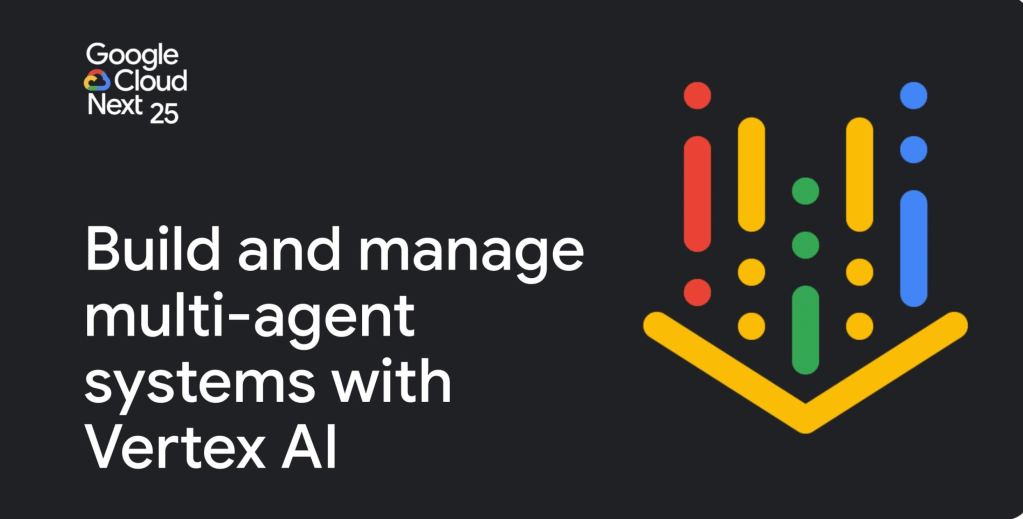
    To address these concerns, Google announced a wave of new multiagent ecosystem capabilities in its Vertex AI that allow multiple AI systems to work together to accomplish complex tasks. The company introduced several components to enable this approach, including the Agent Development Kit (ADK), the Agent2Agent protocol, Agent Engine, and updates to Agentspace.

    Minimizing the Data Collaboration Problem with the Agent2Agent Protocol

    Most vendors claim they can provide fully autonomous AI agents. Still, most buyers prefer to deploy these agents semi-autonomously to reduce concerns about process failures or inaccuracies. To address the enterprise buyer issue of data access and execution across various applications, Google introduced the Agent2Agent protocol, an open standard for enabling communication between agents built on different frameworks and vendors. Google launched the protocol with the support of over 50 industry partners, including Salesforce, ServiceNow, and UiPath. The Agent2Agent initiative addresses one of the most significant barriers to enterprise AI adoption: painful integration challenges to create interoperability across disparate systems.

    Making it Easier for Developers of All Skill Levels to Build AI

    Meanwhile, the Agent Development Kit (ADK), agent engine, and other advances in the Vertex AI platform help bootstrap the development of agents. Agent Development Kit, an open-source framework, allows developers to build sophisticated agents with approximately 100 lines of code –dramatically reducing development complexity. It also offers pre-built samples through Agent Garden to further accelerate development. ADK offers compatibility with over 200 models from providers like Anthropic, Meta, and Mistral AI.

    The companion Agent Engine provides a fully managed runtime for deployment, eliminating the traditional challenges such as rebuilding the agent to move from prototype to production. Agent engine also provides evaluation tools to measure and improve agent quality.

    Security and data integration capabilities round out the platform, with configurable content filters, identity controls, and Google Cloud’s Virtual Private Cloud (VPC) service controls providing multi-layered protection. Equally valuable is the platform’s ability to connect agents to enterprise data through various methods, including standard protocols and direct API integration.

    Improving Access to AI Agents

    Once a company can design, manage, and secure agents, the biggest obstacle to success is getting agents ubiquitously adopted within the enterprise. Agentspace aims to help employees find, publish, and consume agents. Agentspace, launched in December 2024, allows employees (and agents) to find information from across their organization, synthesize and understand it with Gemini’s multimodal intelligence, and act on it with AI agents. Enterprises can discover and adopt agents quickly and easily with Agent Gallery and create agents with Google’s no-code Agent Designer. Firms can also deploy Google-built agents, such as its new Deep Research and Idea Generation agents, to help employees generate and validate business ideas and synthesize dense information.

    At the conference, Google announced that Agentspace is integrated with Chrome Enterprise, letting employees leverage Agentspace’s unified search capabilities from the Chrome search box. Bringing Agentspace directly into Chrome will help employees easily and securely find information, including data and resources, right within their existing workflows.

    Perhaps what was most surprising was to learn that actual businesses are deploying agents today. Client quotes during the keynote and on Google Cloud’s website demonstrated that business impact is already evident across diverse industries. For example, Revionics has implemented a multiagent system for optimizing retail pricing, while Renault Group developed agents to strategically place EV charging infrastructure using geographical analysis. Gordon Food Service is using Agentspace to change how it accesses enterprise knowledge with searches grounded in its data across Google Workspace and other sources like ServiceNow. These early examples demonstrate the potential for complex automation of previously human-intensive analytical workflows.

    The Key takeaway: AI Agents Will Happen

    The strategy provides elements for sophisticated developers, novice designers, and employees who must find and use agents to improve their workflow. The availability of models, connectors, and out-of-the-box agents will help eliminate painful trade-offs between model capability, enterprise integration, and production readiness. The result isn’t merely faster development but significantly more reliable agents prepared for mission-critical enterprise workflows.

    As reasoning models and multi-agent systems evolve from experimental concepts to production realities, organizations should evaluate not only the capabilities of individual models but also the broader infrastructure required for responsible enterprise deployment. The key consideration for executives evaluating AI investments isn’t individual technical capabilities but rather the breadth of the portfolio and ecosystem to accelerate time-to-value while maintaining governance requirements. Google’s latest enhancements to Vertex AI and AI agent tooling suggest a maturing approach focused on practical enterprise adoption rather than merely advancing technical benchmarks.

  • Hello World!

    Welcome to WordPress! This is your first post. Edit or delete it to take the first step in your blogging journey.

  • AI Agents in Action: ServiceNow’s Knowledge 2025 Vision for Enterprise Workflow Transformation

    AI Agents in Action: ServiceNow’s Knowledge 2025 Vision for Enterprise Workflow Transformation

    The AI industry evolved from Generative AI to the Agentic AI era at a breakneck pace. Are AI Agents fact or fiction? The reality is somewhere in between, and buyers remain skeptical. As technology leaders race to implement artificial intelligence across the enterprise, many organizations are experiencing a paradox. Despite increasing investments in AI technology, the maturity of enterprise AI adoption has declined nine points year over year, according to ServiceNow’s latest AI maturity index survey.

    Additionally, Lopez Research data shows that companies struggle to show meaningful business outcomes from early AI proof of concepts, leading to fewer than anticipated AI projects moving from pilot into production. The use cases shared at ServiceNow’s Knowledge 2025 conference revealed a crucial insight: there’s still tremendous business upside available in automating existing processes. However, organizations need effective orchestration, governance, and data quality to unlock the promise of these sophisticated AI tools without creating complexity.

    Orchestration: Moving Beyond Isolated AI Tools

    Agentic AI is the buzzword of 2025. Technology vendors, like ServiceNow, are racing to showcase maturing AI offerings that will deliver on the promise of automated work. ServiceNow used its Knowledge 2025 conference to showcase its vision for orchestrated, agentic AI, which are autonomous AI entities that can reason, plan, and take action independently across systems and departments.

    “What they are is a new digital workforce,” explained John Sigler, EVP of ServiceNow’s AI platform, during the keynote presentation. “And ServiceNow is in a great spot to provide the management of that new workforce with the AI Control Tower, where you can manage, govern, secure, onboard, and offboard, and update all your AI agents.”

    ServiceNow’s focus on orchestration and governance addresses a critical gap Lopez Research has identified in the enterprise AI landscape. While many vendors have spent 2024 defining what agents are and how to create them, few have tackled the orchestration and governance challenges that would allow organizations to confidently deploy these agents autonomously across the various data and software silos. Even with fully baked technology, the potential brand, business, and compliance risk associated with automated workflows provides a significant roadblock to delivering production Agentic AI systems today.

    Sigler showed how the AI Control Tower enables organizations to manage, govern, and secure their AI agents, provide visibility into agent actions, and monitor outcomes. The demo showcased how an employee can drill down into individual agents to see the tasks they perform and the benefits they deliver.

    Orica has already realized these benefits in their IT Service Desk, boosting deflection rates from 18% to 94% and doubling the number of fully resolved cases without human intervention—a testament to the power of automation and agents.

    Reimagining Processes, Not Just Automating Them

    Unlike previous automation waves that often simply accelerated existing workflows, the next wave of agentic AI innovation will emphasize improving processes rather than automating them. The evolution beyond robotic process automation (RPA) was evident in how ServiceNow positions its AI agents.

    In a software demonstration, Joe Davis, EVP of Engineering for Platform and AI, showed how a contract renewal issue typically involving multiple departments and taking days or weeks to complete can be compressed into minutes using autonomous agents working across systems. The key shift here is shepherding a process across what were previously disparate data and application silos. 

    Demo view of multi-agent orchestration of ServiceNow and third-party agents.  Source: ServiceNow

    Chris Taylor, Group CDIO at Stellantis, reinforced this approach: “What we see is an incredible momentum building. We’ve passed the initial fear factor, and people are starting to use it, adopt it, and create tangible value. It’s less of a threat, more of a way to enhance their productivity and enhance their job satisfaction.”

    Stellantis has redesigned its processes around these capabilities, with Taylor noting, “In Europe, 85% of our cars are scheduled and loaded onto transporters using AI. It’s faster. We connect to the customer needs, and we get higher quality.”

    Using Stellantis as an example, ServiceNow showcased a demo of a supply chain specialist alerted by an AI agent that detected a 25% increase in battery cell costs that could impact production. The agent recommended an alternate approved supplier and conducted a comprehensive analysis to ensure the new supplier could deliver the correct product requirements. This integration utilized ServiceNow’s Workflow Data Fabric to bring together data from internal and external systems, enabling the specialist to resolve a major supply chain issue.

    When network transactions began dropping at a Jeep plant, AI agents diagnosed the problem by analyzing the scale of the issue, identifying that it was isolated to network services, and recommending rolling back a change to a Kubernetes container. After approval, the agents executed the rollback, confirmed network performance stabilization, and created a knowledge base article documenting the fix, preventing disruption to car production.

    The demo highlighted more than just automation of existing processes, but a fundamentally better way to detect, diagnose, and resolve network issues, with AI agents working proactively rather than reactively.

    Data Quality: The Foundation for Effective AI

    A fundamental challenge for implementing effective AI remains data access and quality. During the keynote, ServiceNow referenced a Gartner statistic stating that 60% of AI projects will be abandoned by 2026 due to a lack of AI-ready data.

    Gaurav Rewari, SVP and GM of Data and Analytics at ServiceNow, who presented on data strategy, underscored this point: “Here’s the uncomfortable truth. AI agents like the ones you just saw are only as powerful as your data.” This acknowledgment that “the journey to an agentic AI heaven goes through a data hell” represents a significant AI implementation challenge that Lopez Research sees in designing effective AI: data readiness. It’s 2025, and we still struggle with the “Garbage In: Garbage Out” problem.  

    To address this, ServiceNow unveiled its strategy for AI-ready data, which includes:

    1. RaptorDB: A new database offering designed to handle billions of complex transactions supporting operational and analytical workloads in real-time.
    2. Workflow Data Fabric: ServiceNow’s data integration and semantic layer that connects structured and unstructured data across the enterprise.
    3. Workflow Data Network: An ecosystem of 100+ integrations with data platforms including Snowflake, Teradata, AWS, Cloudera, Databricks, Google Cloud, Microsoft, and Oracle.
    4. Data Catalog and Governance: The announced acquisition of data.world to manage, harmonize, and govern data at scale.

    It’s good to see a set of AI platform offerings that focus on data quality instead of just the mechanics of how agents work. Canada Life has already leveraged these data capabilities with their AI-powered catalog builder and Now Assist for Creator to automate self-service management, reducing catalog creation development time by 200%—showing how data-driven AI can transform specific business processes.

    Simplifying Agent Creation

    The low-code/no-code movement isn’t new. Still, we’re seeing a new round of innovation as we move into the AI era/ ServiceNow is making agent creation accessible to business users through AI Agent Studio, allowing non-technical users to create and deploy agents that can transform business processes. By putting these tools in the hands of those who genuinely understand the business, ServiceNow enables organizations to reinvent inefficient processes to be more intelligent and dynamic. To improve return on investment, Lopez Research sees enterprise buyers landing and refining a few specific AI use cases before expanding these tools across the organization.

    “It’s important for everyone to be able to build these AI agents,” said Sigler, before Joe Davis demonstrated creating a research and development agent in about a minute. “You can see it’s low code. You provide instructions using natural language, and you give the agent access to a set of tools.”

    Lloyds Bank has taken advantage of this approach, transforming HR and workplace services with Now Assist and GenAI virtual agents, automatically deflecting up to 90% of HR-related cases and saving teams over 4,000 workdays—demonstrating how business-led AI initiatives can drive significant operational improvements.

    The conference also highlighted how AI agents can transform customer experience processes. Terence Chesire VP, CRM and Industry Workflows at ServiceNow stated during the keynote, “in customer service, you need more than just great omni-channel intake, you need to also orchestrate and automate the hard part, which is resolution and fulfillment, whether it’s a dispute in banking, ordering a telco service, or processing a warranty claim in manufacturing.” This approach to end-to-end process transformation, rather than simple task automation, represents a significant evolution in how organizations approach AI implementation.

    Workforce Transformation: Connecting Front Office to Front Line

    The true power of agentic AI extends beyond process automation to fundamentally transforming how the workforce operates. As CEO of UKG, Jennifer Morgan highlighted at Knowledge 2025, “About 80% of the workforce is made up of frontline, field hourly employees,” yet “only 23% of frontline employees feel that they have access to the technology and the insight that they need.”

    There’s a significant opportunity for AI agents to bridge the gap between the front office and the frontline workers who are the face of the organization to customers. By creating what UKG describes as “a single point of interaction,” organizations can connect field employees back to enterprise systems and data.

    AstraZeneca offers a compelling example of this transformation in action. By revolutionizing their onboarding process with ServiceNow, they’ve streamlined the integration of 20,000 new employees annually, saving over 90,000 hours through optimized workflows. As Cindy Hoots, Chief Digital Officer and CIO, AstraZeneca, explained: “We’ve been able to take processes that used to take 20 minutes, 30 minutes, and now get them to the point that we can do that in just mere seconds.”

    This workforce transformation extends to scientific operations as well. In AstraZeneca’s laboratory environments, AI agents are helping lab managers monitor equipment, automatically detect issues through image recognition, determine warranty status, and even place supply orders based on sensor data. What previously required manual inventory checks and paperwork now happens autonomously, giving valuable time to researchers focused on life-saving discoveries.

    The Missing Link: Governance by Design

    AI Governance shouldn’t be an afterthought designed to remediate compliance issues. AI governance should start as a framework of policies, guidelines, and oversight mechanisms that guide the development, deployment, and use of artificial intelligence to ensure safety, fairness, and transparency. AI governance should be part of developing, deploying, and modifying AI models, systems, and agents. 

    ServiceNow emphasized governance as a foundational element of its AI strategy. The AI Control Tower provides a central hub for managing, monitoring, and governing AI agents across the enterprise.

    This approach embeds governance into the design phase rather than treating it as an afterthought, allowing organizations to deploy autonomous agents more confidently. Yet, organizations must maintain a critical eye by continuously monitoring agents and processes. The system provides visibility into how agents are used across departments, what LLMs they use, and the specific tasks and benefits each agent provides. As AI agents become more autonomous and more widely deployed, this governance capability will be crucial for ensuring security, compliance, and alignment with business objectives. 

    Governance matters because real business value requires the right people and agents to have the correct permissions to manage and use data. In one demonstration, ServiceNow showcased how AI agents could help sales representatives prepare for doctor meetings by aggregating insights from various systems, generating presentation materials, and even remembering the doctor’s lunch preferences. When these AI capabilities extend to patient services, they can orchestrate complex multi-organization workflows, such as automatically generating insurance justification forms and rebate cards while protecting the patient’s data.

    Strategic Partnerships: Accelerating the AI Journey

    The conference highlighted ServiceNow’s partnership approach as crucial to its AI strategy. The company showcased collaborations with data and cloud providers like AWS, Cloudera, IBM, Snowflake, and Teradata, and strategic technology partnerships with Microsoft and NVIDIA.

    These partnerships reveal that the AI capabilities showcased at Knowledge 2025 aren’t overnight developments. The first Knowledge 2025 keynote included a discussion between ServiceNow CEO Bill McDermott and NVIDIA CEO Jensen Huang, who noted they had been working together for six years to reach this point in AI development.

    This historical context is important—it reminds us that we’ve reached a tipping point where we’re seeing the fruits of many years of research and development. The seemingly sudden explosion of AI capabilities is the culmination of sustained investment and strategic collaboration.

    Orchestrating Tomorrow: The New Business Operating System

    If done well, AI agents are not mere automation tools but transformative elements that can reimagine how work gets done across the enterprise. ServiceNow has addressed several key challenges that have limited the impact of AI initiatives by creating enhancements to orchestration, data quality, processes, and governance. 

    As enterprises navigate this transition, the shift from isolated AI tools to orchestrated AI agents working across departments represents a fundamental change in how work gets done, transforming tasks that once took days into processes completed in minutes, and turning the promise of AI from a technology buzzword into tangible business results.

    The future of work isn’t just about automating what we do today—it’s about reimagining what’s possible when AI agents can work autonomously and collaboratively across systems, data sources, and departments. It’s about creating what Lopez Research calls Right-time Experiences that deliver the correct information to the right person or thing at the right time. The shift from what we discussed in the 2014 Right-time Experiences book is that those “things” are intelligent connected devices and AI agents working with humans to complete workflows round-the-clock. ServiceNow’s customer use cases and product demonstration suggest this future is well on its way to becoming a reality.

  • Securing AI: Strategies for Success with Cisco’s CPO Jeetu Patel

    Summary
    In this conversation, Maribel Lopez and Jeetu Patel discuss the transformative potential of AI in business, the challenges organizations face in adopting AI, and the importance of security in AI applications. They explore the need for visibility, validation, and guardrails in securing AI, the rise of specialized AI models, and the future of AI agents in automating workflows. Patel emphasizes Cisco's commitment to innovation and the urgency for companies to embrace AI to remain relevant in a rapidly evolving landscape.

    Takeaways

    • AI is transforming business strategies across industries.
    • CEOs are optimistic about AI but feel unprepared.
    • Security practitioners face significant staffing shortages.
    • AI can both complicate and simplify security challenges.
    • Organizations must secure AI models and use AI for defense.
    • Visibility, validation, and guardrails are essential for AI security.
    • Specialized AI models can be more effective and cost-efficient.
    • AI agents will enhance productivity and workflow automation.
    • Cisco is innovating rapidly and operating like a startup.
    • Companies must embrace AI to thrive in the future.

    Chapters

    00:00
    The Exciting Intersection of AI and Business

    02:47
    Challenges in AI Adoption and Security

    06:34
    Securing AI: Visibility, Validation, and Guardrails

    12:47
    The Rise of Specialized AI Models

    18:00
    The Future of AI Agents and Automation

    25:31
    Cisco's Transformation and Innovation

    31:10
    Embracing AI: A Call to Action

    Follow us at: 

    Jeetu Patel  https://www.linkedin.com/in/jeetupatel/

    Maribel Lopez https://www.linkedin.com/in/maribellopez/

  • From Concept to Value: The AI Journey With Tredence CEO Shub Bhowmick

    In this episode, Maribel speaks with  Shub Bhowmick, the CEO and Co-founder of Tredence on how its using AI internally and externally. Bhowmick also provides advice on what's important for enterprise buyers looking to leverage AI. 

    Takeaways

    • The shift from proof of concept to proof of value is crucial for businesses.
    • AI is enabling organizations to achieve more with fewer resources.
    • Agentic solutions are becoming increasingly relevant in various industries.
    • Internal innovations at Treatance are focused on developing interconnected AI agents.
    • Organizations must prepare for a future where they need to do more with less.
    • Crawl, walk, and run is a practical approach to AI implementation.
    • Creating a robust monitoring and operations foundation is essential.
    • Small language models can be more effective and cost-efficient than larger models.
    • AI can significantly enhance productivity and creativity in the workplace.
    • Health and personal well-being are important considerations in a fast-paced professional environment.

    Sound Bites

    • “Proof of value is the new proof of concept.”
    • “AI is enabling you to do more with less.”
    • “Agents are like smart interns, very analytical.”
    • “The speed of AI is moving much faster.”
    • “AI can 10x your productivity.”
    • “Crawl, walk, and run with AI implementation.”
    • “Small language models are the new thing.”

    Chapters

    00:00
    Introduction to Treatance and AI Trends

    07:28
    Emerging Use Cases in AI

    11:46
    Real-World Applications of AI in Business

    18:33
    Internal Innovations at Treatance

    30:33
    Advice for Organizations on AI Implementation

  • Transforming Networking with AI: Insights from Extreme Networks’ Markus Nispel

    Summary

    In this conversation, Maribel Lopez speaks with Markus Nispel about the integration of AI in networking solutions, particularly at Extreme Networks. They discuss the evolution of AI capabilities, the importance of data governance, and the role of AI in enhancing operational efficiency and security. Markus emphasizes the need for trust in AI systems and the potential of agentic AI to transform networking operations. The discussion also touches on the challenges of skill development and the future of AI in the industry. 

    Extreme Networks, trusted by tens of thousands of customers globally, delivers AI-native cloud networking solutions that seamlessly connect people, applications, data, and devices.

    Info on Extreme Networks Platform One: https://www.extremenetworks.com/platform-one and an explainer video https://vimeo.com/1036922077/58472f1411?ts=0&share=copy. 

    Takeaways 

    • AI has been integrated into networking solutions for measurable business value. 
    • Data quality is crucial for effective AI implementation. 
    • Generative AI can significantly reduce the time for knowledge acquisition. 
    • Agentic AI combines various capabilities for enhanced networking solutions. 
    • Trust and transparency are essential for AI adoption in enterprises. 
    • AI can optimize security policy configurations and reduce attack surfaces.
    • The orchestration of agents is vital for achieving automation in networking.
    • AI's role in skill development is critical for new employees.
    • The future of AI in networking will involve more autonomous systems. 
    • Continuous feedback loops enhance trust in AI systems. 

    Sound Bites

    • “AI allows for a consistent support experience.”
    • “Data governance is critical for AI systems.”
    • “The orchestration of agents is key to automation.”
    • “Trust is essential for AI adoption in enterprises.”
    • “The future is dynamic with AI advancements.” 

    Chapters 

    00:00 Introduction to AI in Networking

    03:40 Evolution of AI Integration in Networking Solutions

    06:54 Understanding AI's Unique Positioning in Networking

    10:18 AI's Role in Skill Development and Knowledge Acquisition

    13:02 Defining Agentic AI and Its Current Capabilities

    16:54 The Importance of Orchestration in AI Systems

    19:45 Addressing Trust and Resistance in AI Adoption

    23:19 Demonstrating ROI from AI Implementations

    25:29 Future of AI: The Rise of Agentic Systems 

  • Key Trends AI in Marketing and Communications

    Artificial intelligence, once only accessible to highly technical individuals, has evolved from an obscure to mainstream use across consumers and businesses. AI promises to deliver practical tools that will transform how marketing and communications professionals operate. Drawing insights from a recent conversation with Tim Marklein, CEO of Big Valley Marketing, alongside the latest industry developments, this article explores how AI is reshaping marketing and communications—and what business leaders need to know to navigate this transformation effectively.

    The Current State of AI Adoption in Marketing

    Despite widespread discussion about AI revolutionizing marketing, the reality is more nuanced. As Marklein points out, “depending on what survey you look at, you’ll hear AI is changing everything in marketing communications and others where people will say they’re not using it really at all.” The truth lies somewhere in between—many organizations are still testing rather than fully integrating AI into their workflows. While AI tools have become increasingly accessible, many marketing departments are in an experimental phase, selectively applying AI to specific tasks rather than implementing comprehensive AI strategies.

    Three Key Areas Where AI Is Gaining Traction

    According to Marklein, marketing teams are finding value in areas such as search alternatives, pattern analysis and writing assistance. This assessment aligns with Lopez Research’s industry observations.

    It’s clear that LLMs have become a powerful alternative to traditional search engines, enabling business professionals to quickly gather information about trends, topics, and industry developments. Tools like Perplexity and others are enabling marketers to ask conversational questions and receive synthesized answers instead of sifting through pages of search results. Of course, marketers must still place a critical eye on search findings and review the source links.

    One of AI’s strongest applications is identifying patterns across large datasets. Marketing teams are using AI to analyze audience behaviors, summarize interviews, extract themes from reports, and understand what industry analysts, journalists, and customers are saying. Identifying patterns supports market research and content planning efforts but also provides the opportunity to boost top line revenue by discovering trends that lead to new product offerings.

    AI excels at helping transform content from one format to another—such as simplifying technical content, converting long-form content into shorter pieces, and adapting messaging for different channels. Leading marketing teams will leverage AI to scale their content production while maintaining consistency and brand voice.

    How do you differentiate in an AI Era?

    Perhaps the most crucial insight from industry leaders is where AI falls short: generating original thinking and authentic brand positioning. As Marklein emphasizes, “There’s going to be a premium on original thinking,” particularly in the B2B context where customers seek a company’s unique perspective based on their expertise and frontline experience.

    While everyone is talking about reasoning models and AI becoming more human-like, it’s important to note that today’s AI can and should augment human creativity rather than replace it. The most effective marketing strategies will leverage AI for efficiency while preserving human ingenuity for differentiation. Personally, I’m pleased and relieved to hear other individuals discuss that there’s still room for humans in content creation.

    AI and Workflow Integration: The Key to Value

    A recurring theme in both the podcast and recent industry developments is the importance of integrating AI into existing workflows. Standalone AI tools provide limited value; the real potential emerges when AI is embedded within the tools marketers already use daily.

    However, as Marklein notes, this creates a new challenge: “The AI tools that we would like to use aren’t the ones that are necessarily integrated into the workflow.” Organizations are still navigating this disconnect, often using different AI tools for different use cases while waiting for more seamless integration solutions.

    Metrics and Measurement: Evolution, Not Revolution

    When it comes to metrics, AI isn’t necessarily changing what marketing teams measure, but rather how they measure it. Traditional marketing objectives and KPIs remain relevant—what’s changing is the ability to analyze data more efficiently and extract insights more effectively.

    As Marklein explains, AI probably won’t “tell you anything new about how you should measure brand growth, equity, and value,” but it can help marketers track and instrument these measurements more effectively, especially when connected to existing data streams.

    Navigating Authenticity and Ethics

    Trust remains a significant concern in AI adoption. During the podcast, Marklein highlighted research showing that while disclosure about AI use is often recommended, “80% of people don’t trust AI. So disclosing that you’re using AI actually makes people trust it less in the short term”.

    To develop trusted AI, organizations needed to take both a broader and more nuanced approach that focuses on emphasizing appropriate use of AI rather than just responsible use. Additionally, organizations must be transparent about who is using AI and why they’re using it. AI governance needs to be part of the marketing strategy at the outset.

    As AI capabilities continue to evolve, the organizations that thrive will be those that strategically balance automation with authentic human insight, using technology to amplify their unique voice rather than replace it.

    You can review Big Valley Marketing’s research on AI disclosure and transparency here. If you found this article useful, please share it on your social channels and subscribe to my channels. Subscribe to my YouTube channel here: https://www.youtube.com/@AIwithMaribelLopez and my podcast here: https://bit.ly/3R0Etal.

  • Google Cloud’s Ironwood TPU Forges Better Enterprise AI

    Artificial intelligence infrastructure has emerged as the critical battleground for cloud computing dominance. At this year’s Google Cloud Next conference, the company demonstrated its intensified commitment to AI infrastructure, unveiling strategic investments, such as the Ironwood Tensor Processing Units (TPUs), designed to transform enterprise AI deployment across industries.


    “We’re investing in the full stack of AI innovation,” stated Sundar Pichai, CEO of Google and Alphabet, who outlined plans to allocate $75 billion in capital expenditure toward this vision. This substantial commitment reflects the scale of investment required to maintain competitive positioning in the rapidly evolving AI infrastructure market. Innovating in AI requires courage and deep pockets.

    Google Cloud articulated a full stack strategy focused on developing AI-optimized infrastructure spanning three integrated layers: purpose-built hardware, foundation models, and tooling for building and orchestrating multi-agent systems. During the keynote presentation, Google Cloud introduced the Ironwood TPU its seventh-generation Tensor Processing Units (TPUs), representing a significant advancement in AI computational architecture.

    Optimizing Infrastructure for AI With TPUs

    Cloud Computing infrastructure started as a method of replacing and optimizing on-premise data centers. Today, cloud computing providers are adding specific infrastructure to support new computing requirements introduced with supporting AI. TPUs are specialized processors developed by Google specifically to accelerate AI and machine learning workloads—with particular optimization for deep learning operations. TPUs deliver superior performance-per-dollar compared to general-purpose GPUs or CPUs across numerous machine learning use cases, resulting in reduced infrastructure costs or increased computational capability within existing budget constraints.

    Ironwood TPUs represent a cornerstone component of Google Cloud’s AI Hypercomputer architecture, which integrates optimized hardware and software components for high-demand AI workloads. The AI Hypercomputer platform constitutes a supercomputing system that combines performance-optimized silicon, open software frameworks, machine learning libraries, and flexible consumption models designed to enhance efficiency throughout the AI lifecycle—from training and tuning to inference and serving.

    According to Google’s technical specifications, these specialized AI processors deliver computational performance that’s 3,600 times more powerful and 29 times more energy efficient than the original TPUs launched in 2013. Ironwood also demonstrates a 4-5x performance improvement across multiple operational functions compared to the previous version 6 Trillium TPU architecture.

    Ironwood implements advanced liquid cooling systems and proprietary high-bandwidth Inter-Chip Interconnect (ICI) technology to create scalable computational units called “pods” that integrate up to 9,216 chips. At maximum pod configuration, Ironwood delivers 24 times the computational capacity of El Capitan, currently ranked as the world’s largest supercomputer.


    To maximize this infrastructure’s utility, Google Cloud has developed Pathways, a machine learning runtime created by Google DeepMind that enables efficient distributed computing across multiple TPU chips. Pathways on Google Cloud simplifies scaling beyond individual Ironwood Pods, allowing for the orchestration of hundreds of thousands of Ironwood chips for next-generation AI computational requirements. Google uses Pathways internally to train advanced models such as Gemini and now extends these same distributed computation capabilities to Google Cloud customers.

    Marrying Business Impact With Economics

    While the industry has witnessed a proliferation of smaller, specialized AI models, significant AI chip innovation remains essential to deliver the performance requirements for supporting advanced reasoning and multimodal models.

    According to Amin Vahdat, VP/GM of ML, Systems & Cloud AI at Google Cloud, “Ironwood is designed to gracefully manage the complex computation and communication demands of ‘thinking models,’ which encompass Large Language Models (LLMs), Mixture of Experts (MoEs) and advanced reasoning tasks.” This architecture addresses the market requirement for modular, scalable systems that deliver improved performance and accuracy while optimizing both cost efficiency and energy utilization.


    For enterprises implementing large-scale AI initiatives, Google’s hardware advancements translate to quantifiable benefits across three dimensions:

    1. Economic Efficiency. Google’s specialized hardware substantially increases computational density per dollar, reducing the total cost of ownership for AI infrastructure. Organizations can deploy increasingly sophisticated AI models without corresponding linear increases in computing expenditures.
    2. Sustainability Metrics. As AI model complexity increases (across systems like Gemini, ChatGPT, and advanced image generators), the underlying computational infrastructure generates significantly more heat and power consumption. Liquid cooling technology, implemented in Ironwood, delivers substantially higher thermal efficiency compared to conventional air cooling, enabling chips to operate at higher frequencies without thermal throttling. This innovation addresses power consumption—a critical consideration for both cloud providers and enterprise buyers with sustainability commitments. The enhanced performance-per-watt metrics of these TPUs help organizations address environmental impact concerns while scaling their AI capabilities.
    3. Time-to-Market Acceleration. The exponential increase in processing capacity means that AI model training and inference workflows—previously requiring weeks or months of computation—can now be completed in days or hours. This compression of development timelines enables organizations to iterate more rapidly and operationalize AI solutions with significantly reduced deployment cycles.

    Why TPUs Matters to Enterprise Buyers

    Organizations are over the phase of interesting AI proof of concept trials that never make it to production-grade systems. 2025 is the year that organizations expect to deploy use cases with quantifiable business value while laying the foundation for what’s next. Google Cloud’s enhanced AI infrastructure enables practical enterprise applications today while supporting previously constrained by computational economics or performance limitations. Consider the impact of AI today and tomorrow in:

    • Financial Services Analytics. During the Google Cloud Next keynote, Deutsche Bank shared how it uses technology from Google Cloud to power an AI-powered research agent named DB Lumina for faster data analysis. Many banking and investment firms are investigating how to use enhanced AI infrastructure to process market data streams, detect complex pattern anomalies in real-time, and enable more responsive trading strategies and comprehensive risk management frameworks.
    • Customer Experience Transformation. Retail and service organizations can implement sophisticated recommendation engines and multimodal conversational AI systems that process customer interactions with minimal latency while incorporating rich contextual understanding. For example, Verizon uses Google Cloud’s Customer Engagement Suite to enhance its customer service for over 115 million connections with AI-powered tools, like the Personal Research Assistant which accurately answers 95% of questions, helping agents provide faster, more accurate, and personalized support. The next era focuses on cracking the code for personalization, advanced marketing assets, and empathetic conversational AI.
    • Computational Medicine. Today, healthcare organizations use AI to improve patient experiences with data gathering and summarization features. For example, Seattle Children’s Hospital used Google Cloud’s generative AI to create Pathway Assistant, an AI-powered agent that improves clinicians’ access to complex information and the latest evidence-based best practices needed to treat patients. As we advance, healthcare institutions can leverage advances in AI infrastructure to accelerate the analysis of complex imaging datasets, genomic sequences, and patient records, potentially enhancing diagnostic accuracy and treatment protocol optimization.

    Get Comfortable With Change

    As competition intensifies among cloud infrastructure providers, Google’s substantial investment in AI represents a strategic assessment that enterprise computing will increasingly prioritize AI-driven workloads—and that organizations will select platforms offering the optimal combination of performance, cost efficiency, and energy sustainability.


    The only constant in the AI market will be change. Business leaders must be comfortable with continuously adapting strategies to leverage AI advancements. For CIOs and technology leaders developing their AI implementation roadmaps, Google Cloud’s hardware innovations, such as the Ironwood TPU, present technical and economic justifications to reevaluate their infrastructure strategy as AI becomes increasingly central to operational excellence and competitive differentiation.

  • The Platform Play: Zoho’s Enterprise Evolution and AI Integration Strategy

    In the category of better late than never, we found the missing recording file with Vijay. Enjoy!


    Show Notes:

    In this episode of “AI with Maribel Lopez,” host Maribel Lopez sits down with Vijay Sundaram, Chief Strategy Officer at Zoho, at Zoho Day 25 in Austin, Texas. They discuss Zoho's strategic evolution and approach to AI.


    Key Highlights:

    • Zoho's Market Evolution: Vijay explains how Zoho has expanded from primarily serving small and medium businesses to increasingly being adopted by larger enterprise customers worldwide. This evolution has happened naturally as their products became more sophisticated and larger customers discovered them.
    • Enterprise Adaptation Challenges: To serve enterprise customers, Zoho had to make changes in three areas:
      1. Technology (their strength as a product-driven company)
      2. Operations (building expertise in account management, solutions consulting, etc.)
      3. Transitioning from an inbound to outbound business model
    • AI Implementation Strategy: Vijay clarifies that while generative AI has recently captured public attention, Zoho has been implementing various AI technologies (machine learning, NLP, video recognition) for over a decade. Much of this AI has been “headless” – working behind the scenes in applications rather than through conversational interfaces.
    • Three Levels of AI: Zoho approaches AI implementation through:
      1. Contextual AI within business applications
      2. Interactive AI for specific purposes
      3. Expert-level insights that enable non-experts to gain valuable business intelligence
    • Platform Approach: By integrating applications and creating a comprehensive platform, Zoho can leverage data across domains (finance, sales, HR, operations) to provide more valuable AI-driven insights.
    • AI Market Shift: Vijay predicts that AI differentiation will increasingly move from foundational models to the application layer, where companies like Zoho can add value through their access to business data across domains.
    • Privacy and Security: Zoho maintains a strong stance on privacy (no trackers on their websites) and has built a “trust layer” into their platform to ensure proper data access controls for AI interactions.
  • Why Small AI Models Matter: The Business Case for Enterprise AI Efficiency

    In the rapidly evolving landscape of artificial intelligence, business leaders face a critical decision: which AI models will deliver the most value to their organization? While much attention has focused on massive models with billions of parameters, there’s a compelling case for considering smaller, more specialized AI models. Lopez Research interviewed Kate Soule, Director of Technical Product Management for IBM’s Granite products, to learn more about these smaller models.

    IBM Granite represents a family of open AI models specifically designed for transparency, data governance, and practical business applications. IBM’s third-generation of Granite models (3.2) offer reasoning capabilities and multimodal models that offers vision and has been optimized for document understanding.

    Big News: Small Models Will Make Enterprise AI More Efficient and Effective. Image Source: Adobe Stock

    Why Size Matters (and Why Smaller Models Can Be Better)

    Soule says, “Everything gets more difficult as the model gets larger.” This challenge manifests in several business-critical ways:

    • Higher operational costs. Larger models require more computing resources and energy, directly increasing operational expenses.
    • Increased latency. Bigger models take longer to generate responses, potentially degrading customer experience.
    • Need for powerful hardware. If using larger models in the cloud or on-premises, these models demand more powerful and expensive GPU infrastructure.
    • Limited customization. Adapting massive models to your business needs requires substantial computing resources and expertise.

    The Small Model Efficiency Advantage

    IBM’s approach with their Granite models focuses on efficiency through purpose-built smaller models. At just 2 to 8 billion parameters (compared to the largest industry models, such as Llama 3.1 from Meta, exceeding 400 billion parameters), these models deliver several key advantages, including::

    1. Cost-effectiveness. Lower computational requirements translate directly to reduced operational costs.
    2. Customization potential. Smaller models are more manageable and less expensive to fine-tune for specific business tasks.
    3. Deployment flexibility. Some models are small enough to run locally on standard hardware, such as an AI PC, eliminating cloud dependency.
    4. Faster response times. Reduced model size means quicker inference and better user experiences.

    Whether it’s Small Models or Large Models, Companies Need a “Fit-for-Purpose” Approach

    Rather than seeking a single “model to rule them all,” business and IT leaders are working together to assemble a portfolio of AI solutions that incorporate foundational LLMs with specialized AI models to support different business needs. As Soule notes, “To get value and to be able to deploy AI cost-effectively… you need to consider having fit-for-purpose models.”

    Fit-for-purpose AI model selection allows businesses to optimize performance and cost based on the specific requirements of each use case. A larger model may be the best solution for high-value, complex tasks. For routine operations, a smaller specialized model often delivers comparable results at a fraction of the cost.

    Soule shared that IBM’s Granite models embody this philosophy with their modular design. Instead of trying to create a single massive model for all tasks, IBM has developed distinct models for different enterprise functions. For example, IBM’s Granite solutions offer the models for use cases such as coding, time-series forecasting, security and language models for designed for agentic workflows, RAG etc.

    Despite their efficient design, IBM shared that Granite models don’t sacrifice performance for cost. According to IBM’s benchmarks, Granite outperforms comparable models across various enterprise tasks, achieving high scores on Hugging Face’s RAGBench Leaderboard. This targeted approach ensures organizations can select the right tools for specific business challenges without unnecessary computational overhead.

    Multimodal Models: Expanding AI’s Capabilities

    Multimodal AI models can simultaneously process and interpret multiple types of data inputs—such as text, images, audio, and video. Unlike unimodal models that work with only one data type (typically text), multimodal models can understand the relationships between different forms of information, similar to how humans process the world through multiple senses:

    IIBM’s Granite 3.2 vision models offer a practical application of multimodal capabilities in an enterprise context. Rather than focusing on image generation (creating pictures from text prompts), these models specialize in image understanding—extracting valuable information from visual content. At just 2 billion parameters, these specialized vision models can:

    • Extract data from documents, even poorly scanned PDFs
    • Analyze charts and graphs to answer specific business questions
    • Process dashboard screenshots to provide insights on performance metrics
    • Interpret receipts and other visual business documents

    Making Strategic AI Decisions: The Performance-Cost Matrix

    As AI technology evolves, organizations must balance cost, accuracy, and safety for model use. Soule shared at least four guidelines for evaluating what models to use within the enterprise, including:

    1. Right-sizing your models: Match model capabilities to business requirements rather than defaulting to the largest available.
    2. Design model selection criteria with transparency and governance in mind: Understand how models were trained and whether they align with your governance requirements.
    3. Systems-based security: Implement guardrails and safety protocols beyond relying solely on the model’s built-in safeguards.
    4. Customization needs: Assess how much adaptation a model will require for your specific use cases.

    For example, Soule discussed how different models may offer various levels of transparency and governance. One distinguishing feature of IBM Granite models is that IBM publishes detailed information about their training datasets and methodologies, allowing enterprises to understand what’s “under the hood” of these models. The Granite ecosystem includes risk and harm detection capabilities, transparency tools, and IP protection. Model transparency allows IBM to provide indemnification for Granite models, offering businesses additional protection when deploying these AI solutions.

    The Shift is Underway

    The “bigger is better” paradigm is giving way to a more nuanced approach to enterprise AI. Business leaders can achieve comparable performance by strategically implementing smaller, specialized models for appropriate use cases while significantly reducing costs and complexity. IBM’s Granite models are one example of this approach. We’ve also seen the large foundation model providers, such as Open.AI and Meta, support smaller models. 

    Looking ahead, we’re moving toward more flexible AI deployment models where businesses can dynamically allocate resources based on task importance. This could mean using models of various sizes for different tasks or enabling features like “reasoning” when demands such as accuracy justify the additional cost and latency. As AI becomes further integrated into business operations, this efficiency-focused approach will be increasingly critical for sustainable AI adoption and competitive advantage.

    You can subscribe to our video channel here and our podcast here.

  • Harnessing AI: The Balance of Privacy and Innovation with Wipro’s Ivana Bartoletti

    Summary

    In this conversation, Maribel Lopez speaks with Ivana Bartoletti, the Global Privacy Chief Officer at Wipro, about the intersection of AI, privacy, and governance. They discuss the transformative impact of generative AI, the importance of embedding ethics in AI development, and the role of synthetic data in mitigating bias. Ivana also shares insights on the Audrey initiative aimed at promoting human rights in the digital age and highlights common mistakes in AI regulation. The conversation concludes with a positive outlook on the collaborative efforts to build fair and responsible AI.

    Takeaways

    • Public trust is essential to harness AI's benefits.
    • Generative AI is transforming how we live and work.
    • Privacy is a crucial collective good that must be respected.
    • Ethics in AI goes beyond compliance with laws.
    • AI should retain human agency and decision-making.
    • Bias in algorithms can perpetuate social inequalities.
    • Synthetic data can help mitigate bias but has limitations.
    • Transparency in data usage is vital for equity.
    • AI regulation should not be seen as opposing innovation.
    • Collaboration across sectors is key to responsible AI governance.

    You can follow Ivana here: https://www.linkedin.com/in/ivana-bartoletti-77b2b29/

    You can follow me here: 

    https://www.linkedin.com/in/maribellopez/

    https://www.youtube.com/@AIwithMaribelLopez

    https://x.com/MaribelLopez

  • AI Transforms Marketing: Beyond the Magic Button With Tim Marklein


    Episode Overview:

    Maribel Lopez speaks with Tim Marklein, CEO of Big Valley Marketing, about how AI is changing marketing and communications. The conversation explores the practical applications, limitations, and future of AI in the marketing landscape.


    Guest:

    Tim Marklein – CEO of Big Valley Marketing, an award-winning consulting firm that helps technology companies grow and win in various markets including software infrastructure, AI, cybersecurity, digital health, and supply chain.


    Key Topics Discussed:

    • Current state of AI adoption in marketing: Despite surveys showing varied adoption rates, most professionals are still “dabbling” with AI rather than fully integrating it into workflows
    • Three key areas where AI is proving valuable:
      • As a search alternative for market insights
      • For pattern analysis and audience research
      • For writing and editing assistance
    • The continued importance of original thinking: AI can't replace a company's unique point of view, especially in B2B contexts where buyers want to understand a company's beliefs and perspectives
    • Brand differentiation concerns: Discussion about whether widespread AI adoption might lead to homogenized marketing content and brand positioning
    • AI for audience targeting: How AI can help with audience research but cannot replace strategic decisions about which audiences to prioritize
    • Workflow integration challenges: The disconnect between the ideal AI tools and those integrated into existing workflows
    • AI and marketing metrics: How AI primarily makes it easier to capture existing metrics rather than creating new ones
    • Authenticity and ethics: The research showing that simply disclosing AI use doesn't build trust when 80% of people don't trust AI to begin with
    • Appropriate vs. responsible use: The importance of communicating who is using AI and why, not just how it's being used
    • Skills development for the AI era: The value of experimentation and curiosity over becoming a dedicated “prompt engineer”

    You can follow Tim Marklein, the Founder and CEO, Big Valley Marketing ( bigvalley.co) at LinkedIn: https://www.linkedin.com/in/tmarklein/ X: @tmarklein

    You can follow me at:

    https://www.linkedin.com/in/maribellopez/

    https://www.youtube.com/@AIwithMaribelLopez

    https://x.com/MaribelLopez

  • Cisco Attacks AI Cybersecurity Threats With New AI Defense

    Companies need security solutions that protect against AI cybersecurity threats

    Over the past several years, the security landscape rapidly evolved with the introduction of AI, specifically generative AI. AI spawned numerous new categories of AI cyber threats, such as data inference, transfer learning attacks and model inversion. Additional, AI-enhanced phishing attacks are driving increased breaches and data loss. Today, companies need specialized security solutions that protect AI systems and their components from various security threats (e.g., adversarial attacks) and vulnerabilities (e.g., data poisoning). These security products must protect the data, algorithms, models, and infrastructure involved in AI applications.


    What Cisco Announced
    Last week, Cisco unveiled its latest security innovation called Cisco AI Defense. The solution offers a new approach to targeting AI safety and security challenges. Let’s break down Cisco’s announcement, the AI-specific features of its latest offering, and the benefits it provides to security operations (SecOps) teams.

    Today, every security vendor worth evaluating offers new AI-enhanced products with features such as conversational AI assistants and streamlining alerts to help highlight relevant security threats. The Cisco AI Defense platform builds on Cisco’s existing Secure Access technology and incorporates new features designed specifically for the AI ecosystem. Specifically, AI Defense aims to address two core AI problems: 1) securing enterprise access to AI applications and 2) ensuring the safety and security of AI models and applications built by organizations.

    What are the AI-Specific Features of Cisco AI Defense

    Cisco’s security solutions leverage threat intelligence from over 50 billion daily events and integrates data from tools like Splunk and other third-party feeds. The data from these events helps detect AI-specific vulnerabilities and threats. However, the company also added more AI-specific features such as:

    See full article at: https://www.forbes.com/sites/maribellopez/2025/01/21/cisco-attacks-security-threats-with-new-ai-defense-offering/

    I no longer post the full article because there are websites that just scape my content and won’t even acknowledging me as the author.