Author: maribellopez

  • AI with Maribel Lopez: IBM Granite Models with Kate Soule

    Episode Summary

    In this episode, Maribel Lopez interviews Kate Soule, Director of Technical Product Management for IBM's Granite products. They discuss IBM's third-generation AI models, their focus on efficiency and enterprise readiness, and the latest advancements including vision capabilities and reasoning features.

    Guest

    Kate Soule – Director of Technical Product Management for IBM's Granite products

    Key Topics & Timestamps

    00:04 – Introduction

    • Maribel introduces the show and Kate Soule
    • Brief overview of IBM Granite as fit-for-purpose, open-source enterprise AI models

    00:48 – What is IBM Granite?

    • Designed as core building blocks for enterprises building with generative AI
    • Focus on efficiency with smaller model sizes
    • Monthly innovation updates to keep pace with rapidly evolving field

    02:19 – Understanding AI Reasoning

    • Explanation of reasoning capabilities in AI models
    • How allowing models to generate more text at inference time can improve performance
    • Cost/benefit tradeoffs of reasoning features

    03:13 – Enterprise AI Model Selection Criteria

    • Moving beyond “one model to rule them all” thinking
    • Importance of fit-for-purpose models
    • Why smaller models can be customized more easily
    • Trust and transparency considerations

    05:38 – AI Governance and Safety

    • How to evaluate models for governance requirements
    • Safety evaluations and benchmarks as table stakes
    • Systems-based approach to safety with guardrails
    • IBM's Granite Guardian and protection mechanisms

    08:55 – Benefits of Smaller Models

    • Why size matters: cost, latency, and customization advantages
    • Smaller models are easier to customize and require less computing power
    • IBM's transparent approach to training data

    10:13 – Future of AI Evaluation

    • Performance per cost becoming the key evaluation metric
    • The growing importance of flexibility in model selection
    • How the “efficient frontier” between cost and performance will differentiate providers

    12:41 – IBM's Vision Models

    • IBM's pragmatic enterprise focus for multimodal capabilities
    • Vision understanding (image in, text out) for practical business use cases
    • Specialization for documents, charts, and dashboards
    • Delivering powerful capabilities in only 2 billion parameters

    15:25 – Understanding Model Size Context

    • Evolution from millions to billions of parameters
    • Practical considerations of deploying different-sized models
    • Finding the right cost-benefit trade-off for specific use cases
  • 50: Analyst Commentary on AI and the Customer Experience At Zoho Day 2025

    This conversation explores the transformative impact of AI on business, particularly focusing on Zoho's evolution as it aims to enhance its enterprise offerings. The speakers discuss the importance of understanding customer data, the global dynamics of AI adoption, and Zoho's unique culture that fosters innovation. They also touch on the future of enterprise software and the integration of AI, emphasizing the need for a holistic view of customer engagement.

    Takeaways:

    • Massive interest in AI is changing markets and valuations.
    • Tools are only as effective as their application in serving customers.
    • Zoho is aggressively moving into the enterprise space with a focus on AI.
    • Integration of data is crucial for a comprehensive customer view.
    • The concept of customer 360 is often misunderstood.
    • Global market dynamics affect how AI is adopted in different regions.
    • Zoho's culture promotes innovation and responsiveness to customer needs.
    • AI will soon be an integral part of enterprise operations.
    • Not every enterprise is a fit for Zoho's offerings.
    • The future of enterprise software will be driven by AI and data integration.

    Chapters

    00:00
    The Rise of AI and Its Impact on Business

    01:59
    Zoho's Evolution and Enterprise Focus

    06:10
    Understanding Customer Data and Integration

    10:08
    Global Perspectives on AI and Market Dynamics

    13:54
    Zoho's Unique Culture and Approach to Innovation

    21:56
    Future of Enterprise Software and AI Integration 

  • 49: AI in Supply Chain: Transforming Industry Through Innovation

    In this episode, Maribel Lopez of Lopez Research interviews Kevin McInturff Chief Technology Officer of Logility. We explore the transformative impact of artificial intelligence on supply chain management and the key considerations for successful implementation. Our discussion covers critical insights for business leaders and practitioners navigating the AI landscape.

    Key Discussion Points

    Throughout our conversation, we delve into how artificial intelligence is fundamentally reshaping supply chain operations. The democratization of information through generative AI has opened new possibilities, though organizations continue to grapple with data integration challenges. We examine the critical balance between innovation and responsibility, particularly regarding ethics and data security in AI deployment.

    The discussion reveals how real-world applications of AI are enhancing decision-making processes across supply chain operations. We explore emerging AI technologies that are revolutionizing forecasting methods, while acknowledging the ongoing evolution of ROI measurement for AI investments. Building trust in AI systems emerges as a fundamental requirement for successful adoption.

    Our conversation emphasizes the importance of practical experimentation with AI solutions. Organizations must understand the interplay of different roles and technical languages in AI implementation. This approach allows companies to develop effective, tailored solutions while maintaining ethical considerations and data security.

    ## Episode Resources

    If you'd like to learn more about the topics discussed in this episode, follow me on social media at Youtube for the video version of this podcast and LinkedIN and X (Twitter) for AI research updates and insights.

    Kevin McInturff Expert Bio:
    Kevin McInturff, Chief Technology Officer of Logility, has 20+ years of experience in product and engineering roles. He spent his early career as an engineer on a plant floor working in industrial automation and plant information systems before moving into enterprise SaaS software. Under his leadership Logility has accelerated the pace of innovation and focused on delivering high quality product, a superior user experience and solutions that enable supply chain organizations to anticipate disruptions as opportunities to reap competitive advantages. He is passionate about understanding and meeting client needs with innovative solutions while building great engineering and product culture within his team.  

    Outside of his work with Logility he actively volunteers with the 501st Legion a non-profit who partners with other organizations to brighten the lives of the less fortunate and to bring awareness to positive causes on both a local and global scale. Kevin is a lifelong learner, an artist, and avid practitioner of the art of tsundoku.  

    He has earned a BS in Computer Science from the Georgia Institute of Technology, and a Masters of Science, Management of Technology from Georgia Tech Scheller College of Business. Kevin lives in Smyrna, Georgia with his wife and three daughters. 

  • Palo Alto Networks Simplifies Cybersecurity with Cortex Cloud

    Palo Alto Networks Simplifies Cybersecurity with Cortex Cloud

    With the average organization using dozens of cybersecurity tools, security and IT leaders are drowning in complexity and expense. According to Palo Alto Networks’ research, the average organization faces nearly 2 million security-related findings, making it impossible for security teams to prioritize and address all potential threats effectively.

    Adding to this complexity, cloud infrastructure changes rapidly, creating an ever-evolving risk landscape. The company’s research shows that 45% of cloud infrastructure risks change monthly. Meanwhile, adversaries are using AI to deliver more effective attacks more efficiently, cutting their time to data theft in half over recent months. While attackers may benefit from new AI capabilities, new AI-infused security solutions will also benefit defenders.

    Market research firms, such as Gartner and IDC, have predicted the convergence of cloud security and traditional security operations as a key trend that will minimize these challenges. For example, IDC’s “FutureScape: Worldwide Security and Trust 2024 Predictions” projected that by 2026, 60% of enterprises will consolidate their cloud security tools into unified platforms that integrate with security operations. Meanwhile, companies shared with Lopez Research that they are looking for AI-powered solutions to minimize alert fatigue and provide intelligent remediation recommendations based on correlating data across multiple products.

    Cortex Cloud Aims to Improve and Simplify Security

    Palo Alto Networks took this challenge head-on with the announcement of its Cortex Cloud platform. Cortex Cloud integrates and evolves its Prisma Cloud capabilities. This shift represents more than a simple rebranding for Palo Alto because it’s a fundamental re-architecture of the platform that aims to unify cloud security with security operations center (SOC) capabilities.

    This platform integration enables security teams to see the complete picture of their security landscape, from application code to cloud infrastructure to runtime environments. Cortex Cloud also integrates with third-party security tools and scanners to preserve existing security investments while benefiting from unified analytics and automation. Specifically, the Cortex Cloud platform offers four components that enable companies to:

    • Minimize application security vulnerabilities. Cortex Cloud identifies and prioritizes issues across the development pipeline with end-to-end context across code, runtime, cloud and third-party scanners. This part of the solution supports preventing issues in app development before they become production issues that attackers can target.
    • Create unified cloud posture visibility. Cortex Cloud builds on Prisma Cloud’s capabilities. It unifies visibility in one natively integrated platform, including cloud security posture management (CSPM), cloud infrastructure entitlement management (CIEM), data security posture management (DSPM), AI security posture management (AI-SPM), compliance and vulnerability management (CWP). It also supports AI-driven prioritization and automation-first remediation of multi-cloud risks.
    • Update Cloud runtime features to stop attacks in real-time. Cortex Cloud natively integrates the unified Cortex XDR agent, enriched with additional cloud data sources, to prevent threats with advanced analytics.
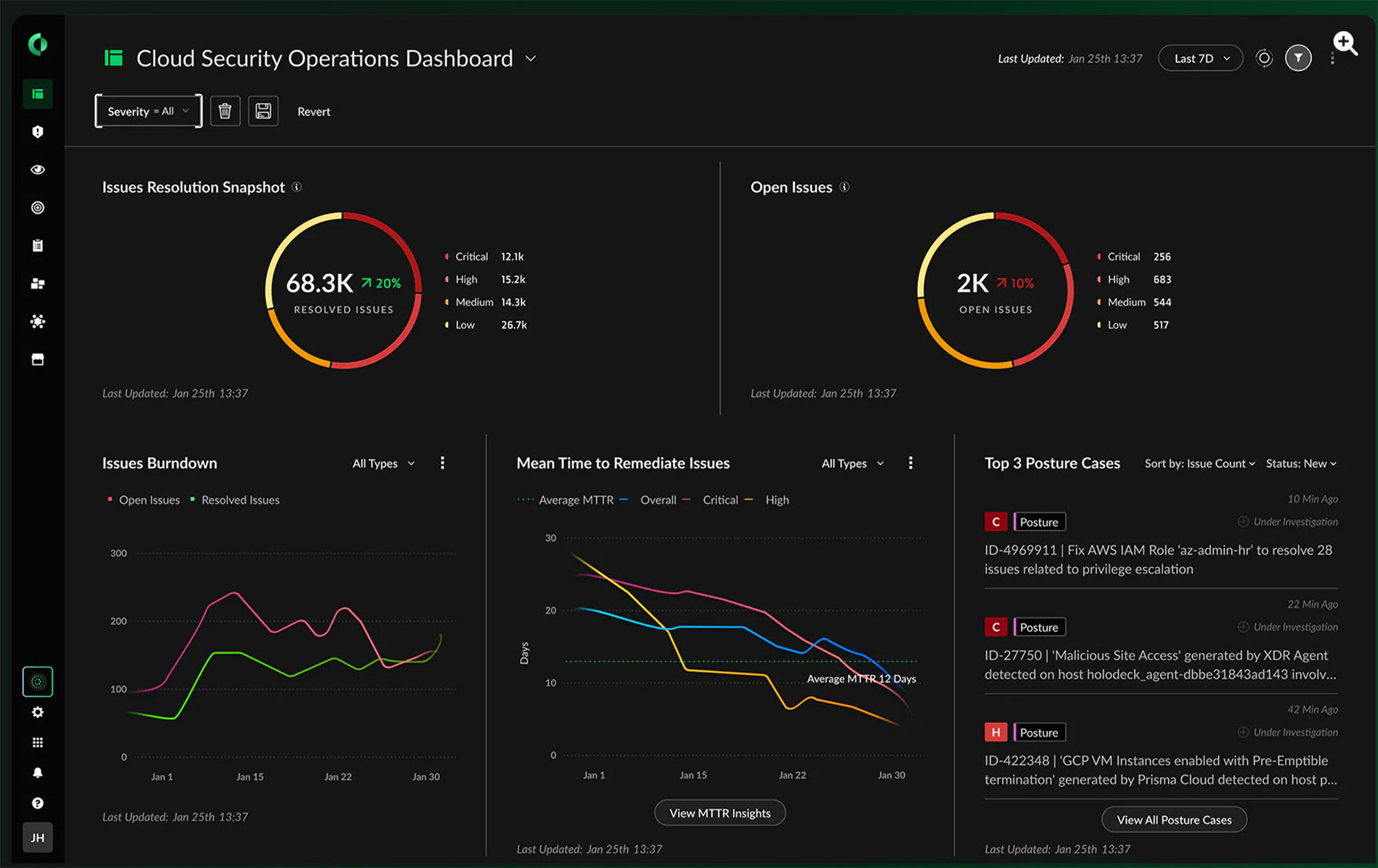
    • Deliver AI-driven SOC transformation. Cortex Cloud natively integrates cloud data, context and workflows within Cortex XSIAM to significantly reduce the mean time required to respond (MTTR) to modern threats with a single, unified Security Operations (SecOps) solution.

    How Does Cortex Cloud Benefit Buyers?

    The platform’s unified approach brings several practical benefits, such as unified dashboards and reporting across all security functions. At the heart of Cortex Cloud is its unified data plane, which integrates data from various sources, including cloud posture, runtime and application security. When security incidents occur, teams no longer need to manually coordinate between different departments and tools — all relevant information is available in one place, with unified reporting and consistent role-based access controls. However, Cortex Cloud goes beyond simply identifying security issues; it provides rich contextual information to help security teams understand the full scope and impact of security incidents.

    Cortex Cloud leverages advanced analytics and machine learning to prioritize alerts and security threat findings intelligently. The platform helps security teams focus on the most pressing issues that require immediate attention by considering factors such as threat intelligence, asset criticality and risk profiles. This AI-powered approach significantly reduces the time and effort needed to identify and address potential security breaches, enabling organizations to respond more effectively to evolving threats. This contextual awareness is particularly valuable in complex, multi-layered cloud environments where the relationships between different components can be challenging to discern.

    One of the other key benefits of Cortex Cloud is its automation capabilities. The platform can automatically remediate specific security issues, such as misconfigurations, without manual intervention. This feature reduces the workload on security teams and ensures that potential vulnerabilities are addressed promptly, minimizing the risk of exploitation. By automating routine tasks, Cortex Cloud empowers security professionals to focus on more strategic initiatives and proactive threat hunting.

    Meeting Customers Where They Are

    Palo Alto Networks’ move can potentially disrupt existing market prices by offering all multiple capabilities in a single package rather than requiring separate purchases for different controls. In one case, Palo Alto Networks demonstrated how its pricing would compare with that of one of its competitors using publicly available rates on the AWS Marketplace. In that scenario, the Cortex Cloud pricing was approximately 50% less than competitive solutions while providing more comprehensive coverage.

    But this doesn’t translate into a one-size-fits-all buying approach for customers. For existing Prisma Cloud customers, Palo Alto Networks offers flexible migration options, including like-for-like upgrades at no additional cost. The company emphasizes that adding the new Cloud Runtime Security or SOC capabilities is optional, and buyers can work with channel partners and their sales representatives to select what’s right for the organization.

    Accelerating the Industry Shift

    The announcement represents a significant shift in how enterprise security and cloud teams could achieve a more holistic security approach. Rather than treating cloud security as a separate domain, organizations can now manage it as part of their broader security operations strategy with shared intelligence, unified workflows and automated responses. For organizations struggling with alert fatigue and siloed security tools, Palo Alto Networks’ integrated approach could provide a more manageable and effective way to secure their cloud environments.

    There’s a significant opportunity for Palo Alto to gain a larger share of wallet as companies move from fragmented point solutions to more comprehensive security platforms such as Cortex Cloud. However, the platform transition also presents distinct challenges. Organizations that have recently invested in various security products will understandably be hesitant to abandon these investments before realizing their full value. Additionally, enterprises must carefully weigh the benefits of platform consolidation against the potential risks of becoming overly dependent on a single vendor’s ecosystem. Overall, the shift towards leveraging AI and creating platforms represents a leap forward in simplifying and improving an organization’s ability to prevent cybersecurity threats.

  • Wendy’s Serves Up Generative AI To Boost Its Customer Experience

    Wendy’s Serves Up Generative AI To Boost Its Customer Experience

    How generative AI changes the quick service restaurant industry

    Every industry, including the quick service restaurant (QSR) market, plans to transform its business with artificial intelligence (AI), especially generative AI. Several years ago, Wendy’s embarked on its AI journey, leveraging cloud computing services and generative AI to enhance employee and customer experiences. The drive-thru experience presents numerous challenges for QSR restaurants due to the complexities of menu options, limited-time offers, special requests, and ambient noise.

    Wendy’s chose to tackle the drive-thru experience with AI because 75 to 80 percent of Wendy’s customers choose the drive-thru as their preferred ordering channel. The company saw a tremendous opportunity to improve the customer experience by creating a seamless ordering experience using AI automation in the drive-thru.

    In an interview with Maribel Lopez of Lopez Research, Wendy’s CIO Matt Spessard shared how its AI program had advanced over the past year and shared advice for other leaders looking to tackle AI within their business. In 2024, Wendy’s announced an expansion of its partnership with Google Cloud, tapping into Google’s AI technology and resources to enhance its generative AI platform called Wendy’s FreshAI. Wendy’s Fresh AI aims to address challenges that traditional AI couldn’t solve, such as understanding casual conversations and handling the extensive customizations of Wendy’s menu. For example, the back-and-forth nature of conversations is an intensely complicated technical challenge for AI. It also added Spanish as a language option in 2024.

    Traditional rule-based AI chatbots weren’t the answer because they can’t easily support natural conversations’ diverse and dynamic nature. For example, Wendy’s realized there are over 200 billion combinations of words and options to order a Dave’s Double. Additionally, it can take years of development and tremendous work to maintain, modify, and expand capabilities within these more rigid rules-based solutions. Today, Wendy’s uses generative AI to interpret conversations, create responses, and adapt in real-time instead of following a narrow set of rules.

    While many AI discussions focus on job loss issues, Wendy’s shared that its AI efforts also benefit its employees. Wendy’s FreshAI works alongside restaurant teams, eliminating ordering issues while empowering crew members to focus on preparing and completing orders efficiently.

    How does Wendy’s measure AI success and return?

    Wendy’s takes a pragmatic view of what AI success means. Its efforts focus on delivering speed, accuracy, and consistency to customers. It measures these results with metrics such as how many orders were submitted without human intervention and the consistency of the customer experience at the drive-thru. What have been the results thus far? The percentage of orders successfully handled by Wendy’s FreshAI without restaurant team member intervention averaged 86%, and it expects the average to increase.

    One test site showed service times 22 seconds faster than the Columbus, Ohio market average. Wendy’s noted that other QSR companies define “accuracy” as any order started by the AI assistant and submitted to the point-of-sale system, including orders where a crew member joins the conversation to correct an inaccuracy. Wendy’s shared that if it uses that broader definition of accuracy, its FreshAI success rate reaches nearly 99%.

    What’s next for AI at Wendy’s

    Wendy’s FreshAI has moved from pilot to production. It is now available in nearly 100 restaurants across 17 states with Spanish language capabilities. There’s still tremendous upside to expanding the technology deployment as Wendy’s operates over 7,000 restaurants globally. Going forward, Wendy’s sees the Fresh AI assistant as a platform that will scale across various ordering channels, such as mobile apps, kiosks, and smart devices.

    Advice on tackling AI innovation?

    Wendy’s CIO Spessard said the company learned many lessons along the way. He provided the following key pieces of advice for organizations looking to adopt AI:

    1. Identify the right use case and technology. Wendy’s emphasizes that organizations need to think pragmatically about the use cases where AI can provide the most value and then select the appropriate AI technology (e.g., generative AI, traditional machine learning) to fit that specific need. AI is a broad spectrum of technologies, so the “right tool for the right job” approach is essential.
    2. Start with small-scale experiments. Spessard recommends that companies start with small-scale experiments within the organization, exposing employees to AI capabilities. This exposure helps organically grow the usage of AI as more use cases are identified. Spessard said Wendy’s had to resist the urge to deploy too widely and quickly. Iterating in the early stages of its AI deployment helped Wendy’s achieve its desired accuracy and consistency.
    3. Emphasize continuous improvement. Wendy’s stressed the importance of a feedback loop, continuous iteration, and a mindset of even 1% improvement every day. It regularly analyzes customer and employee feedback, allowing Wendy’s to refine aspects like tone, cadence, and phrasing in Wendy’s FreshAI. These refinements were critical to enhancing the AI assistant’s performance.
    4. Engage stakeholders early and often. Wendy’s found it very valuable to regularly perform demonstrations of the AI assistant’s capabilities and progress to key stakeholders like franchisees. These demos helped build trust and support for the initiative as stakeholders could see the improvements over time. Additionally, Wendy’s noted that the rapid democratization of AI technologies is making change management easier, as employees are already familiar with using AI in their personal lives, setting the expectation for it in the workplace as well.

    A key takeaway from the discussion was to ground AI innovation in iterative improvement, continuously engage employees and partners in the process, and cultivate a willingness to experiment and learn rather than trying to perfect the technology before deployment.

  • SAP Unveils Business Data Cloud and Strengthens Databricks Partnership

    SAP Unveils Business Data Cloud and Strengthens Databricks Partnership

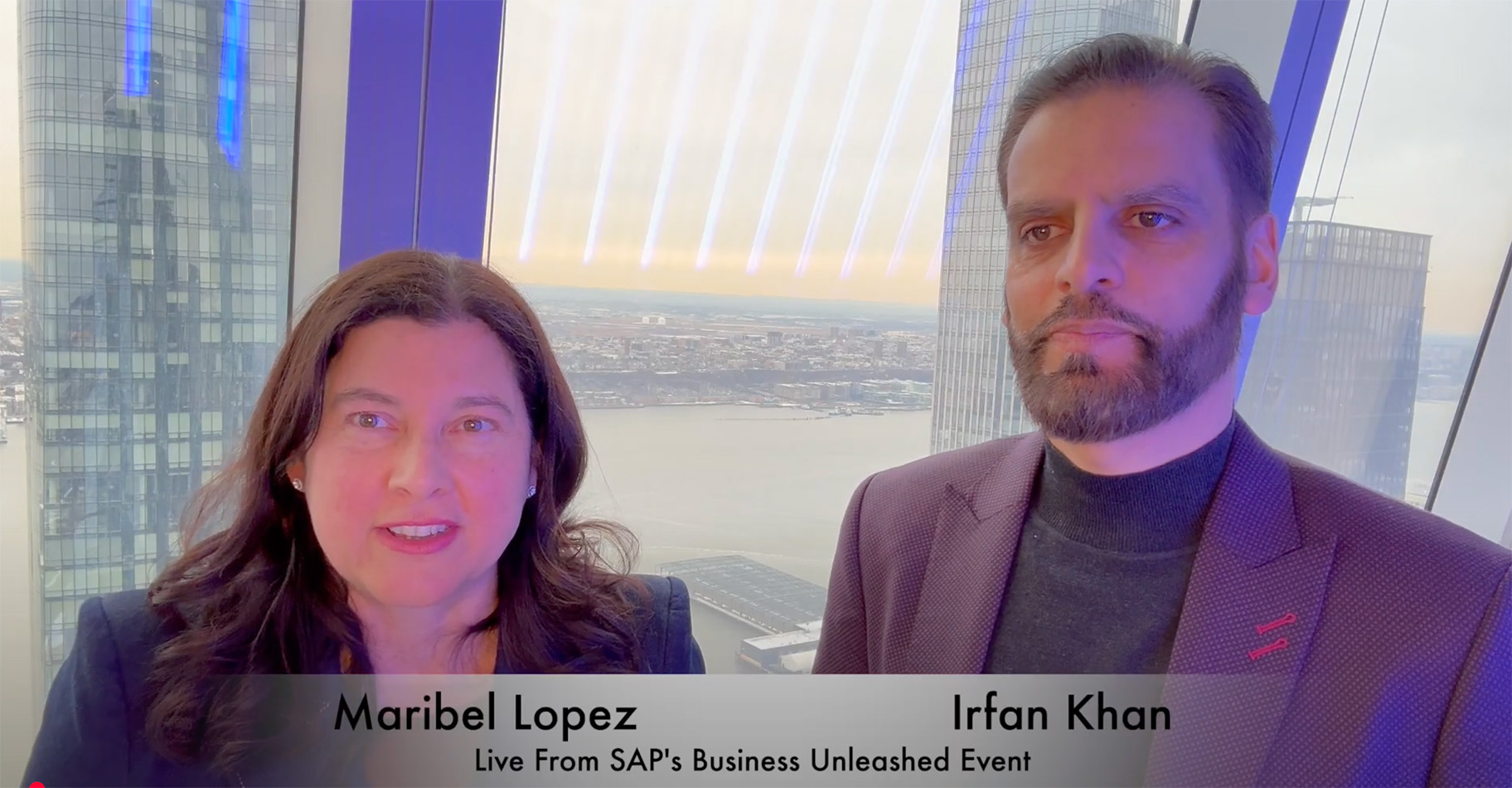
    Last week, SAP announced a major evolution in its enterprise data management platform with the launch of SAP Business Data Cloud. SAP Business Data Cloud represents a significant advancement in how enterprises can manage, analyze, and derive value from their data. As Irfan Khan, Chief Product Officer and President of Data and Analytics at SAP, explained in an interview with Maribel Lopez of Lopez Research: “Business data cloud takes all of SAP core business applications and shares the data in a zero copy fashion with whomever the consumer may be.”

    The Databricks Partnership

    One of the most significant aspects of this announcement is the deepened partnership with Databricks. The integration brings Databricks’ capabilities directly into SAP Business Data Cloud, creating a powerful combination for enterprises looking to leverage AI and machine learning. As Khan noted, “SAP Databricks now is part of the building materials of our business data cloud,” which he explains will radically improve time to market and value for customers.

    Addressing Key Industry Challenges

    The announcement comes at a crucial time, as organizations continue to struggle with data quality and integration. According to SAP’s global survey of 1,200 business and technology leaders, 55 percent cite poor data quality as their biggest challenge, with nearly half struggling to harmonize data across ecosystems.

    At the SAP analyst innovation summit, companies using the early preview of business data cloud shared under NDA their enthusiasm for the speed at which they could develop systems that leveraged a variety of business data and the insights that could be gained from turning this information into AI-led intelligence. Markus Hartmann, Corporate Vice President and Head of Business Technology at Henkel, echoed this perspective in the SAP blog when he stated: “SAP Business Data Cloud will help us unlock the value of our data and drive innovation across our business. Its semantically rich data products and deep Databricks integration will connect and enhance our existing data products, ensuring long-term adaptability.”

    Looking Ahead

    For organizations wondering where to begin, Khan offers clear guidance: start with Business Warehouse modernization. “Look no further than the most critical data that you have typically sit inside a BW (business warehouse) environment,” he advises, highlighting the opportunity to leverage existing data for AI and advanced analytics initiatives.

    The platform is designed with openness and customer choice in mind, featuring integrations with partners like Collibra, Confluent, and DataRobot, with more strategic partnerships on the horizon. This ecosystem approach, combined with the Databricks integration, positions SAP Business Data Cloud as a significant step forward in enterprise data management and AI enablement.

  • 48: How Amazon Web Services Quicksight and AI Enhance GoDaddy’s Business

    Maribel Lopez of Lopez Research hosted a podcast at AWS Reinvent, discussing QuickSight with ATracy Daugherty GM, QuickSight at Amazon Web Service and Travis Muhlestein, Chief Data and Analytics Officer at GoDaddy. QuickSight, a cloud-based BI tool, enables real-time data sharing and decision-making through dashboards, pixel-perfect reports, and Q for asking data questions. In the podcast, Muhlstein shares how QuickSight has transformed GoDaddy's approach from static dashboards to real-time, interactive data exploration and analysis, enabling more agile, data-driven decision-making across the organization.

    Follow the guests at:
    Maribel Lopez https://www.linkedin.com/in/maribellopez/

    Travis Muhlestein, Chief Data and Analytics Officer at GoDaddy https://www.linkedin.com/in/travis-muhlestein/

    Tracy Daugherty GM, QuickSight at Amazon Web Services https://www.linkedin.com/in/tracy-daugherty-28a1014/

  • 46: Wendy’s Serves Up AI to Enhance the Customer and Employee Experience

    Every industry, including the quick service restaurant (QSR) market, plans to transform its business with artificial intelligence (AI). Several years ago, Wendy's embarked on its AI journey, leveraging cloud services and generative AI to enhance employee and customer experiences. The drive-thru experience presents numerous challenges for QSR restaurants due to the complexities of menu options, limited-time offers, special requests, and ambient noise. 

    Wendy's chose to tackle the drive-thru experience with AI because 75 to 80 percent of Wendy's customers choose the drive-thru as their preferred ordering channel. The company saw a tremendous opportunity to improve the customer experience by creating a seamless ordering experience using AI automation in the drive-thru. 

    In an interview with Lopez Research, Wendy's CIO Matt Spessard shared how its AI program had advanced over the past year and shared advice for other leaders looking to tackle AI within their business.

  • 45: AWS Re:Invent Recap with Tim Crawford and Liz Miller

    At Amazon Re:Invent, Maribel Lopez met with several industry analysts to discuss their perspectives on what happened at one of the industry's premier cloud computing and AI trade shows.

    https://reinvent.awsevents.com/  

  • 43: Dell Technologies Chief AI Officer Shares Insight Delivering Successful AI Implementations

    Episode Summary:
    In this episode, Maribel Lopez speaks with Dell’s Chief Technology Officer and Chief AI Officer John Roese about Dell’s enterprise AI technologies from their development to their future. Roese explains how the initial magical thinking around artificial intelligence has shifted into a more practical approach that aims to maximize the benefits of each implementation. He also discusses the emerging trends and ideas that he is seeing in the AI space.

    Key Themes:
    Maribel and John start by delving into enterprise AI and AI markets in general. John explains the types of AI markets and how enterprise AI differs from other applications. The conversation then moves into the challenges of AI and the steps that Dell is taking to address them. 

    Next, John and Maribel reflect on the near-universal reactive approach that companies took to AI two years ago and how parts of that approach backfired or fizzled out. While this technology could have been approached better, its widespread use has provided companies with a real world understanding of LLMs and their applications. Now, companies take a more practical approach to AI while continuing to innovate. 

    The key innovation that Roese highlights is agentic architecture. This technology differs from previous generative AI applications because it can operate autonomously and is highly specialized. Individual “agents” can have job descriptions that they are trained for much like a human being, and they can interact with each other as a human team would. 

    For detailed show notes, navigate the episode using the time stamps below:

    [1:26] Maribel introduces the guest of the episode, John Roese. Roese is the CTO and Chief AI Officer at Dell Technologies. 

    [1:59] The AI market is not a singular market – there is a traditional market, a training market, and an enterprise market. The enterprise market is very pragmatic in its applications. 

    [4:10] Maribel asks about the challenges businesses see in enterprise adoption. Early discussions of new AI technology treated it like magic. Now that we have real world use cases and a better understanding of the technology, Dell is able to have grounded conversations about AI applications with real impacts. 

    [7:48] Roesch explains the challenges that Dell is facing with AI. One of the challenges was determining where to prioritize as a company. Another is the process by which you develop application ideas. Dell had this issue when bringing ideas that were not fully formed to their legal team. 

    [11:44] No one got AI perfectly right. Almost universally, companies reacted at the technical level before looking at business priorities. Roese encourages companies to move toward a more thoughtful approach to AI technology.

    [13:36] Dell learned that its goal was to add in the minimum sufficient AI structure to address the maximum use cases. In Dell’s case, half of their use cases were related to converting proprietary data into generative outcomes. Creating one model to handle all of these cases is the most efficient approach. 

    [15:05] Maribel asks Roese about the trends Dell is seeing in AI. Roese points to the emergence of agentic architecture. The idea behind agentic architecture is that they are autonomously performing agents with very specialized purposes. They can be combined much like a team of human beings. 

    Follow John Roese: https://www.linkedin.com/in/johnroese/ 

    Learn more about Dell’s AI solutions: https://www.dell.com/en-us/shop/scc/sc/artificial-intelligence 

    Follow Maribel Lopez on X/Twitter: https://x.com/maribellopez 

    Subscribe to Maribel Lopez on YouTube: https://www.youtube.com/c/MaribelLopezResearch 

    Follow Maribel Lopez on LinkedIn: https://linkedin.com/in/maribellopez/ 

  • 42: How Cloud Computing Provides Flexible Options to Design Your AI Strategy

    Episode Summary:
    In this episode, Maribel Lopez speaks with Google Cloud Product Manager Bobby Allen about the current benefits and future possibilities of artificial intelligence in the context of Google’s AI services. They explore the flexibility of Googles services that sets them apart, the environmental impacts of LLMs in comparison with their predecessor NLMs, and how companies can take a human approach to AI to make peoples lives better.

    Key Themes:
    Maribel and Bobby begin by discussing Google’s AI services. Allen explains the wide variety of AI services offered by Google, which fall into three main categories: building AI, building with AI, and using AI. Most organizations are currently interested in using AI, and they have seen tangible benefits from doing so.

    Bobby refers to these benefits as the “four I’s”: insight, increase, improvement, and innovation. Companies that adopt AI can see increases in productivity, gain insights into large documents through AI summarization, and more. Ai also has growing applications in compliance and query creation to analyze large datasets.

    Last, Maribel and Bobby discuss the future of AI. Bobby points to a human-first future with a focus on the impacts of AI applications, including sustainability and marginalization. He believes that AI should solve real problems and male peoples lives better.

    Follow Bobby Allen: https://www.linkedin.com/in/ballen-clt/

    Learn more about AWS: http://aws.amazon.com/

    Visit Maribel Lopez’s Website: https://www.lopezresearch.com/

    Follow Maribel Lopez on X/Twitter: https://x.com/maribellopez

    Subscribe to Maribel Lopez on YouTube: https://www.youtube.com/c/MaribelLopezResearch

    Follow Maribel Lopez on LinkedIn: https://linkedin.com/in/maribellopez/ 

  • 41: Using AI to Improve Healthcare Operations

    Episode Summary:
    In this episode, Maribel Lopez speaks with Qventus co-founder and CEO Mudit Garg. Mudit explains how automation can help patients receive efficient care and hospitals maximize their performance. Learn how Qventus is helping hospital systems cut down their “excess days,” why efficiency is essential to care, and Mudit’s predictions for the future of AI in healthcare.

    Key Themes:
    Maribel begins the episode by speaking with Mudit about how Qventus is changing the hospital system for the better. Mudit explains that AI can be extremely helpful for hospital coordination. There are many cases in healthcare where the patient and the hospital system are aligned in their goals, like booking a surgery for a patient, but administrative complexities make those goals difficult to accomplish. 

    Qventus bases its system on two crucial components – behavioral science and machine learning. Machine learning is a great tool for determining patterns for coordination and scheduling, but factoring human behavior is crucial to create a model that actually works. Mudit credits the success of Qventus to the combination of these factors. 

    Maribel and Mudit also discuss the future of artificial intelligence in hospitals. Many industries are adopting AI in a wide range of applications, but Mudit suggests that healthcare systems should focus in on perfecting technology that benefits both patients and hospitals. He also notes his interest in Ai’s potential for data siloing, which would cut down administrative work. 
     
    Follow Mudit Garg on LinkedIn: https://www.linkedin.com/in/gargmudit/ 

    Learn more about Qventus: https://qventus.com/ 

    Visit the 3Blue1Brown YouTube Channel: https://www.youtube.com/@3blue1brown 

    Visit Maribel Lopez’s Website: https://www.lopezresearch.com/ 

    Follow Maribel Lopez on X/Twitter: https://x.com/maribellopez 

    Subscribe to Maribel Lopez on YouTube: https://www.youtube.com/c/MaribelLopezResearch 

    Follow Maribel Lopez on LinkedIn: https://linkedin.com/in/maribellopez/ 

  • 40: AI in Healthcare with Five9’s Roni Jamesmeyer

    Episode Summary:
    In this episode, Maribel Lopez speaks with Roni Jamesmeyer about the changing role of AI in healthcare. Roni Jamesmeyer, the the Senior Healthcare Marketing Manager for Five9, has over twenty years of experience in IT sales, giving her an understanding of the complexity of healthcare delivery. She focuses on Five9's healthcare strategy to help health systems, payers, and life sciences move their contact centers to the cloud and close the gaps in patient communications. Maribel and Roni discuss technological advancements in AI, different uses of AI in healthcare, and Roni’s research findings.

    Key Themes:
    Maribel and Roni open the episode by discussing the healthcare industry’s past attempts to improve the patient experience and how its goals have shifted. Currently, Roni is seeing healthcare companies working toward an omnichannel experience for their customers – meaning that they can interact over many communication channels. 

    AI is helping the industry move forward. Intelligent Virtual Agents (IVAs) improve operations in four major ways: security, patient experience, revenue generation, and reduced administrative backend work. Different companies may focus more on some of these categories than others, but all four functions are extremely important to the healthcare industry. 

    Roni also discusses her AI research findings. She found that AI tuning is crucial to improvement, allowing models to pick up and retain information. As these models are used, they become more personalized and more intelligent and can take on more work as a result. She also found that AI agents open up phone lines, allowing previously missed calls to be answered. 

    Visit Maribel Lopez’s Website: https://www.lopezresearch.com/
     
    Follow Maribel Lopez on X/Twitter: https://x.com/maribellopez 

    Subscribe to Maribel Lopez on YouTube: https://www.youtube.com/c/MaribelLopezResearch 

    Follow Maribel Lopez on LinkedIn: https://www.linkedin.com/in/maribellopez/ 

    Learn More About Five9: https://www.five9.com/ 

    Download AI in Healthcare: How AI Drives Value for Five9 Customers: https://www.five9.com/resources/ebook/how-ai-drives-value-healthcare-customers#:~:text=Partners-,AI%20in%20Healthcare%3A%20How%20AI%20Drives%20Value%20For%20Five9%20Healthcare,customer%20surveys%2C%20and%20analyst%20insight. 

    Attend Roni’s Webinar with Exact Sciences: https://www.five9.com/registration/2024/exact-sciences-webinar 

    Follow Roni Jamesmeyer on LinkedIn: https://www.linkedin.com/in/roni-jamesmeyer-5733461/ 

  • 39: Laying the Foundation for AI with AWS’s Dr. Sherry Marcus

    Episode Summary:
    In this episode, Maribel Lopez discusses generative AI with Dr. Sherry Marcus, the Director of Generative AI Sciences at Amazon Web Services. Her insights into the artificial intelligence needs of businesses gives her a unique perspective on the future of generative AI. Learn about the concept of agents in AI, why customers are moving toward the use of multiple models, and the ways AI might evolve in the future.

    Key Themes:
    Maribel and Sherry begin their conversation by discussing Amazon Bedrock, which is Amazon’s AI building service. The technology allows AWS customers to create their own AI models by offering choices of foundational models that can be customized.

    Next, Sherry and Maribel discuss AI agents. In AI, Agents can retrieve real-time data to assist LLMs in providing information they cannot access in their training data. They also discuss how customers are currently using artificial intelligence, and why there is a shift away from specific modes and toward using multiple models for different use cases.

    Dr. Sherry Marcus also explains how customers have historically used RAG (Retrieval Augmented Generation) to answer questions, and how that technology is evolving. Last, she explains why companies are using synthetic data to train their models, her predictions for the future of AI, and her favorite primer on AI.

    Read What Is Chat GPT Doing… and Why Does It Work? by Stephen Wolfham: https://www.amazon.com/What-ChatGPT-Doing-Does-Work/dp/1579550819 

    Follow Dr. Sherry Marcus: https://www.linkedin.com/in/sherry-marcus-ph-d-4a4110/ 

    Learn more about AWS: http://aws.amazon.com/ 

    Visit Maribel Lopez’s Website: https://www.lopezresearch.com/ 

    Follow Maribel Lopez on X/Twitter: https://x.com/maribellopez 

    Subscribe to Maribel Lopez on YouTube: https://www.youtube.com/c/MaribelLopezResearch 

    Follow Maribel Lopez on LinkedIn: https://linkedin.com/in/maribellopez/ 

  • 38: How Musgrave is using AI in Retail to Improve Wireless Networking

    In this episode, I interview Kevin McCartan, Senior IT Delivery Engineer at Musgrave, about how he leverages AI (Open AI's ChatGPT and Juniper Mist AI) to streamline network operations.
    You can find a copy of the video here. https://www.youtube.com/watch?v=g1ZoMXn6c6M

    Case studies here
    Musgrave Stores Undergoes Transformation with AI-Native Network Enhancements
    https://www.juniper.net/us/en/the-fee…

    Three Steps on the AI Path to Retail Operational Zen
    https://blogs.juniper.net/en-us/ai-na…

  • 37: Responsible Ai and Governance with Credo AI

    Episode Summary: In this episode, Maribel Lopez discusses responsible AI governance with Credo AI’s Head of Product Susannah Shattuck. Susannah builds AI governance tools that help organizations design, develop, and deploy ethical AI at scale. She has been working in Machine Learning Operations and AI governance for the last five years; her passion for AI governance can be traced back to her days on the IBM Watson implementations team, where she saw firsthand all of the things that can go wrong during the ML development lifecycle. Maribel and Susannah discuss the difference between responsible AI strategy and AI governance, the EU AI Act, and how she helps teams build governance plans that work for them.

    Key Themes: Maribel and Susannah begin their conversation by discussing the risks of generative AI. Large language models have overlapping risks with older models such as algorithmic biases, but they also come with new risks such as hallucinations, privacy risks, and security risks.
    Many companies want to implement AI, but those same companies recognize that they are not prepared for its risks. Susannah helps teams create AI governance plans that protect against risks without holding them back. She notes that it is not possible or practical to eliminate all risks, and that part of building a good strategy is allowing for low-risk use cases.
    Later in the conversation, Maribel and Susannah dive into how Credo AI works with organizations to implement responsible governance. They also discuss the EU AI Act, which will shape AI governance in the years to come. Last, Susannah shares her predictions for the future of AI implementation and AI governance.

    Visit Maribel Lopez’s Website: https://www.lopezresearch.com/

    Follow Maribel Lopez on X/Twitter: https://x.com/maribellopez

    Subscribe to Maribel Lopez on YouTube: https://www.youtube.com/c/MaribelLopezResearch

    Follow Maribel Lopez on LinkedIn: https://linkedin.com/in/maribellopez/

    Follow Susannah’s LinkedIn: https://www.linkedin.com/in/susannah-shattuck/

    Follow Susannah’s Twitter: https://x.com/shshattuck?lang=en

    Credo AI LinkedIn: https://www.linkedin.com/company/credo-ai/

    Credo AI Twitter: https://x.com/credoai?lang=en

  • 36: Reclaiming the Customer Experience with Five9’s CTO Jonathan Rosenberg

    Episode Summary:
    In this episode, Maribel Lopez speaks with Five9’s CTO and Head of AI Jonathan Rosenberg on AI’s potential in the Customer Experience (CX) and Contact Center as a Service (CcaaS) space. Currently, customers are often unsatisfied with chatbot communication services at contact centers. However, AI’s increasing generative capabilities show potential for exciting future applications. 

    Key Themes:
    Maribel and Jonathan begin by discussing the current state of AI in CcaaS, and how many customers are unsatisfied with their experiences with automated calls. Contact centers have long attempted to automate aspects of the CX experience, first with DTMF and later with directed dialogue.

    Unlike these technologies, generative AI has seen widespread adoption. Consumer familiarity with artificial intelligence will lead to them understanding how to interact with generative AI over the phone. Jonathan and Maribel also discuss their predictions for how AI will impact jobs in at contact centers. Jonathan believes that jobs will change, but they will not disappear.

    Last, Jonathan defines open platforms and explains how their unique features allow for useful CX capabilities. The future of AI in CX depends on how quickly companies eliminate AI hallucinations. Once models overcome this obstacle, Jonathan predicts that AI will see wide adoption in the CX space.
    For detailed show notes, navigate using the time stamps below:

    Follow Jonathan Rosenberg on LinkedIn: https://www.linkedin.com/in/jonathanrosenberg1/

    Follow Jonathan Rosenberg on X/Twitter: https://x.com/jdrosen2 

    Read Jonathan Rosenberg’s articles in the Forbes Technology Council: https://www.forbes.com/councils/forbestechcouncil/people/jonathanrosenberg/ 

    Read the Broken Earth series: https://www.amazon.com/Broken-Earth-Trilogy-Season-Obelisk/dp/031652719X

  • 35: IBM Think 24: A Discussion on AI Governance with AWS and IBM

    Episode Summary: In this episode, recorded live at the IBM Think event in Boston, Maribel Lopez moderates a panel on AI governance with key figures from IBM and AWS. The discussion revolves around the current state and future of AI governance, the challenges and opportunities it presents, and the role of innovation and regulation in shaping responsible AI adoption.

    Speakers:

     Maribel Lopez, Lopez Research

     Karthik Bharathy from Amazon SageMaker

     Heather Gentile from IBM Watsonx.Governance

    Kush Varshney from IBM Research.

     Key themes:

    This  panel discussed the  necessity for organizations to manage data across hybrid multi-cloud environments while ensuring robust governance is discussed. Gentile highlighted the strategic importance of AI governance for organizations aiming to align AI adoption with their ethics, culture, and values.

    The panel discussed how companies are shifting from siloed AI projects to enterprise-wide governance frameworks driven by generative AI innovations as well as the need to closely follow changes in the regulatory landscape.  Bharathy discusses the collaboration between AWS and IBM Watson to integrate governance tools with AI and ML workflows. This integration aims to simplify risk management and regulatory compliance for customers using generative AI. Collaboration between AWS and IBM is seen  Varshney shared insights on ongoing research in AI governance, particularly in addressing issues like hallucination in generative AI and developing algorithms for regulatory compliance.

  • 34: 34. Exploring the Frontiers of AI Governance: A Chat with IBM’s Heather Gentile.

    This podcast was recorded as a LInkedIn Live on managing AI risk, governance, and explainability. We also talk about the EU AI Act's impact on the overarching global regulatory environment.

    Bio:
    Heather Gentile, Director of watsonx.governance Product Management, IBM Data and AI Software. (Learn more about Watson X here. https://www.ibm.com/watsonx)  

    Heather Gentile is Director of Product in IBM’s Data and AI software division. Heather focuses on opportunities to apply AI technologies to develop innovative solutions for IBM’s watsonx.governance and governance, risk and compliance portfolio. She works with organizations to enable responsible, transparent and explainable AI.  


    Heather has a passion for innovation and works with IBM’s technology and design teams to lead user experience workshops to solve for AI governance, risk and compliance challenges. Her experience expands across financial services, regulatory agencies, and other highly regulated industries. 


    Prior to joining IBM, Heather was responsible for overseeing the compliance analytics division of regulatory solutions at Wolters Kluwer. She received her undergraduate degree from Bryant University in Business Administration and her MBA from the University of Massachusetts.

    Social Links

    You can follow Heather at: https://www.linkedin.com/in/heathergentile/

    You can follow Maribel  at:
    X/Twitter: https://twitter.com/maribellopez
    LinkedIn: https://www.linkedin.com/in/maribellopez
    YouTube: https://www.youtube.com/c/MaribelLopezResearch