AI coding tools can now generate functional applications in minutes. Agentic AI can complete workflows across systems without human intervention. Investors are watching revenue growth slow and drawing conclusions.
Two arguments are driving this conversation. Both deserve attention. Neither supports the headline.
What’s happening isn’t extinction. It’s economic pressure and interface transformation. And enterprise buyers should be focused on very different questions.
The First Argument: AI Coding Tools Make SaaS Obsolete
Tools like Claude Code and Codex have changed the economics of software development. They compress timelines. They lower the skill floor. They make it plausible to build usable applications far faster than even two years ago.
That matters.
But here’s the part the narrative skips: enterprise development capacity is limited. The strategic question isn’t whether AI can build a CRM or ERP. It’s whether rebuilding commoditized infrastructure is the right use of the engineering capacity AI unlocks.
In most cases, it isn’t.
AI coding tools create leverage when they’re applied to differentiated workflows — the integration no marketplace covers, the process unique to how your business operates, the capability that reflects your competitive advantage.
Rebuilding Salesforce from scratch doesn’t create advantage. It recreates infrastructure.
And the total cost of ownership rarely shows up in the demo.
An AI-generated application still requires:
Hosting and monitoring
Security reviews
Compliance certifications (SOC 2, HIPAA, FedRAMP)
Identity and access management
Audit logging
Disaster recovery
Long-term ownership
SaaS vendors absorb these responsibilities at scale. Custom-built applications start at zero. Enterprises have seen this movie before. It was called shadow IT.
AI coding tools are an accelerant for custom development. They are not a procurement strategy for replacing mature systems of record.
The Second Argument: Agents Reduce the Need for SaaS Seats
This argument is more serious.
Agentic AI introduces automation at the workflow level. An agent can complete an expense report, resolve a service case, trigger procurement actions, or update a CRM pipeline without human intervention.
Today, agents sit on top of SaaS platforms. They read and write into systems of record.
They consume SaaS. They don’t replace it.
But here’s the real investor concern: if agents complete end-to-end workflows, how many human seats are displaced? And if pricing is per-seat, what happens to revenue?
That’s a legitimate question.
The pressure here is economic, not structural. Systems of record don’t disappear. Monetization models may evolve.
Vendors that rely entirely on per-seat pricing for task execution will feel compression. Vendors that move toward hybrid pricing — consumption, workflow-based, or outcome-linked — have a path forward.
The disruption is about revenue architecture.
It is not about eliminating the operational backbone of enterprise software.
Where SaaS Is Actually Vulnerable
Not all SaaS vendors are equally positioned.
Higher risk categories include:
Single-function tools with minimal integration depth
Applications without proprietary datasets
Products lacking compliance or regulatory infrastructure
Software that can be recreated easily with generative tools
If a product can be rebuilt with a prompt, defensibility becomes questionable.
Lower risk categories include:
Deep systems of record
Platforms with extensive integration ecosystems
Industry-specific regulatory workflows
Vendors with cross-customer benchmarking data
In these cases, AI often increases platform value rather than replacing it.
What Would Actually Have to Change for SaaS to Decline?
For SaaS to become structurally less relevant, several conditions would need to materialize:
AI-generated code becomes reliably maintainable at enterprise scale — not just generatable.
Compliance infrastructure becomes automated and commoditized.
Integration becomes dynamically AI-negotiated across counterparties.
Enterprise observability and governance wrap automatically around new AI applications.
Legal liability for AI-built systems becomes predictable and manageable for enterprises.
These conditions are evolving. They are not yet universal.
Until they are, the “SaaS is dead” narrative runs ahead of the evidence.
What Enterprise Buyers Should Do Instead
Rather than debating extinction, enterprise leaders should focus on allocation and evaluation.
First: Where should AI coding capacity be applied? Point it toward differentiated capability — not recreating commodity infrastructure.
Second: Which vendors are genuinely building for an agentic world? Evaluate them on:
Production-ready agentic functionality
Pricing flexibility beyond per-seat
Ability to convert historical data into operational intelligence
Avoid vendors that simply layer conversational interfaces onto legacy systems without meaningful workflow automation.
Demand proof of measurable business impact.
The Bottom Line
SaaS revenue models are under pressure. That pressure is real.
But pressure is not death.
The enterprise stack is shifting toward agent-driven interfaces and automation. Systems of record remain foundational. Compliance infrastructure still matters. Integration ecosystems still matter. Accountability still matters.
The question isn’t whether SaaS survives.
The question is which vendors adapt quickly enough to remain relevant — and which enterprises deploy AI capacity where it actually creates advantage.
That’s the strategic lens buyers should use.
A version of this Is SaaS Dead was also posted in my LinkedIn newsletter. You can subscribe to the AI Decoded newsletter here.
Episode Summary Agentic AI dominated industry conversation in 2025. But in 2026, enterprise leaders are asking a harder question: How do we deploy AI agents safely, accurately, and in production environments? In this episode, Maribel Lopez speaks with Peter Cousins, CTO of WorkFusion a UiPath company, about how AI agents evolved from RPA and intelligent automation into production-ready “digital workers.” The discussion focuses on regulated industries, where explainability, auditability, and risk controls matter as much as automation gains. Rather than hype, this conversation explores what it takes to operationalize AI agents: governance frameworks, confidence thresholds, human oversight, and model risk management.
The National Retail Federation Show highlighted that Agentic Commerce is the new buzzword for 2026. But before you rewrite your roadmap, let's talk reality. Julie Ask and Maribel Lopez are discussing:
What actually has to happen before agents can buy things for consumers Why 85% of retail is still offline (and what that means for AI commerce) The payments protocol wars: Google/Shopify vs. OpenAI/Stripe/PayPal Where to actually invest your AI budget in customer experience
Spoiler: The “auto-magic” future isn't here yet. But the opportunities in between? #AgenticAI #RetailInnovation #CommerceAI #NRF2026
Agentic AI is emerging as the next evolution of artificial intelligence in customer experience (CX), moving beyond chatbots to systems that can take real action on behalf of customers. In this episode of AI with Maribel Lopez, Maribel Lopez speaks with Jarrod Johnson, Chief Customer Officer at TaskUs, about how enterprises are actually deploying AI in customer experience today. The conversation covers real-world CX use cases, where AI delivers measurable ROI, why data and process design remain the biggest bottlenecks, and how organizations should manage risk, governance, and human handoffs as agentic AI scales. This episode is designed for enterprise leaders evaluating AI strategies for customer experience transformation.
Bio: Jarrod Johnson, Chief Customer Officer, TaskUs Jarrod Johnson is the Chief Customer Officer of TaskUs. He is responsible for TaskUs' go-to-market strategy and execution across all client-facing and market-facing functions. Jarrod leads the “Client Organization” at TaskUs, including client success, sales, product and service management, and TaskUs’ consulting function, which includes the Agentic AI Consulting Practice. Jarrod is responsible for all aspects of revenue management and growth for TaskUs. He brings over 20 years of experience in enterprise technology-enabled services and business management.
Show notes 00:00 – AI in Customer Experience (CX): What This Episode Covers
01:31 – What a Chief Customer Officer Does in AI-Driven Customer Experience
03:46 – Top Customer Experience (CX) Bottlenecks Blocking AI Adoption
05:56 – Chatbots vs. Agentic AI: What’s the Difference in Customer Experience?
09:31 – How to Start with Agentic AI in Customer Experience (Real ROI Use Cases)
12:46 – When AI Should Hand Off to Humans in Customer Experience
15:41 – AI in Customer Experience: Cost Reduction vs. Revenue Growth
18:21 – Voice AI in Customer Service: Why It Finally Works
22:01 – AI Guardrails, Safety, and Brand Risk in Customer Experience
26:31 – Measuring AI-Driven Customer Experience (CX Metrics That Matter)
29:46 – AI for Customer Experience: Market Fragmentation and Vendor Landscape
33:46 – Agentic AI Pitfalls to Avoid in Customer Experience Transformation
CES 2026 Quick Take: Physical AI, Ambient AI, and the Reality of Adoption
In this episode, Maribel Lopez, founder and principal analyst at Lopez Research, is joined by Julie Ask, founder of Ask Advisory, for a candid, unscripted conversation on what CES 2026 actually revealed about the state of AI.
Rather than focusing on flashy demos or speculative promises, Maribel and Julie examine where AI is delivering real value today—and where expectations are running ahead of reality.
Julie's bio
Julie is a prominent customer experience analyst, technology futurist, and digital product strategist who has advised hundreds of global brands on the impact emerging technologies (e.g., mobile, sensors, extended reality, networks, AI) can and will have on customer experiences. She actively works with enterprises and vendors to understand how technology and consumer trends will impact their business with a deep focus on customer engagement strategies.
For more than 25 years, her work has defined the evolution of consumer digital experiences and inspired brands to take action. Her combined background in engineering and business gives her a unique ability to help business leaders understand what is possible and leverage technology to drive business outcomes. She has appeared frequently on Bloomberg while her research has been cited by the Wall Street Journal, New York Times, Financial Times, and a breadth of marketing publications. She co-authored The Mobile Mind Shift book in 2014. She founded Julie Ask Advisory in 2024 to pursue her passion for helping business leaders understand the impact of AI on experiences.
Maribel Lopez reports live from AWS re:Invent 2025 in Las Vegas, unpacking why the AI experimentation phase is officially over. With statistics that say 95% of AI projects are failing and enterprise budgets tightening, 2026 demands production-quality AI—not more proof-of-concepts. This episode explores the critical shift from building agents to deploying them safely at scale.
Key Themes
The Reality Check (2025 Recap)
MIT study reveals 95% AI project failure rate
McKinsey and BCG document widespread implementation struggles
Board-level AI initiatives now demand real ROI, not just innovation theater
The POC gold rush is over—experimentation budgets are drying up
Agentic AI Grows Up The conversation has evolved from “can we build agents?” to “can we trust them in production?” Three critical roadblocks:
Security & Orchestration: How agents interact without creating vulnerabilities
Policy & Governance: Preventing rogue agents and establishing guardrails
Observability: Real-time monitoring to ensure agents perform as intended
AWS re:Invent 2025 Highlights
Agent Core Improvements
Enhanced policy frameworks defining agent boundaries and permissions
Human-in-the-loop controls for high-stakes decisions
Better cross-stack orchestration for multi-agent workflows
The Discoverability Problem
AWS Marketplace now features natural language search
Upload requirements documents instead of filling rigid forms
AI-suggested prompts help non-technical users navigate complex decisions
Smarter filtering for nuanced needs (performance vs. cost vs. compliance)
The Full-Stack Maturity
Recognition that AI “takes a village”—no single vendor owns the entire stack
Growing emphasis on open standards (A2A, MCP) for SaaS integration
Tools designed for all skill levels, not just data scientists
Key Takeaway
Enterprise AI in 2026 isn't about doing more—it's about doing it right. The winners will be organizations that prioritize governance, observability, and practical deployment over flashy demos.
Host: Maribel Lopez Recorded: AWS re:Invent, Las Vegas, December 2025 Follow-up: Stay tuned for next week's deep-dive episode with demos and vendor interviews
In this episode of AI with Maribel Lopez, Maribel sits down with Ian Bramson, Vice President of Global Industrial Cybersecurity at Black & Veatch, to explore the growing intersection between artificial intelligence and operational technology (OT) security.
From power grids and oil refineries to manufacturing plants, critical infrastructure systems are becoming increasingly connected—and therefore more vulnerable. Ian shares how Black & Veatch is helping industrial organizations rethink cybersecurity from the ground up, integrating protection early in the design and build process rather than bolting it on later.
Together, Maribel and Ian discuss the evolution of OT threats, the rise of AI in both defense and attack scenarios, and why cybersecurity must be seen as a core business function, not an afterthought.
🧩 Key Discussion Topics
1. The Evolution of Industrial Cybersecurity
Ian’s unconventional career path—from Coca-Cola to futurist consulting with Alvin Toffler to leading cybersecurity initiatives.
Why Black & Veatch launched its dedicated industrial cybersecurity practice and how it’s integrated across engineering, procurement, and construction (EPC).
2. IT vs. OT Cybersecurity: What’s the Difference?
IT focuses on data protection; OT focuses on physical safety and uptime.
The rising threat of cyber-physical attacks on power, water, and manufacturing systems.
How the increasing connectivity of devices—from pumps to sensors to AI controllers—creates new risks.
3. Foundational Security: Basics Still Matter
Start with asset inventory—knowing what you need to protect.
Identify vulnerabilities and train your “human layer.”
Build security in from day one instead of bolting it on later.
4. The Expanding Threat Landscape
Why ransomware is still relevant but no longer the only concern.
The growing risks of supply chain attacks, remote operations, and super dependencies (as seen in the CrowdStrike outage).
How attackers are weaponizing AI to accelerate attacks—and how defenders can use AI for faster detection and response.
5. AI and OT: A Double-Edged Sword
How AI is reshaping the attack surface for industrial systems.
Why every company is already “in the AI game,” whether they realize it or not.
The three layers of AI to consider: AI used in cybersecurity, AI inside your operations, and AI in the wild used by partners and adversaries.
6. The Biggest Misconceptions About OT Security
The “myth of the air gap”—why physical isolation no longer guarantees safety.
Common organizational blind spots: board confusion between IT and OT, fragmented responsibility, and lack of lifecycle thinking.
The need for Cyber Asset Lifecycle Management (CALM) to ensure long-term resilience.
7. Building a Resilient Future
Why early planning and a holistic approach are key to managing future risks.
The importance of embedding security, governance, and ethics into every new AI or industrial project.
About This Episode Daniel Ziv, Global VP of AI and Analytics at Verint, reveals why experienced executives are making their worst decisions in decades—and how AI analytics is rewriting the rules of business intelligence. Learn the two critical frameworks that separate AI winners from losers, and why the biggest risk isn't picking the wrong technology—it's doing nothing at all. Guest Bio Daniel Ziv leads AI and analytics product management and go-to-market strategy at Verint, where he helps global enterprises transform customer experience through data-driven decision-making. With two decades in the analytics space, Daniel has witnessed firsthand how AI is fundamentally changing what's possible in customer insights. Key Timestamps [00:00] – Why change is happening faster than ever before [03:04] – The Macro vs. Micro Analytics Framework explained [06:19] – Two flawed decision-making patterns destroying value [09:20] – Real ROI: $80M saved, $10M found in 48 hours [15:32] – Generative AI vs. Agentic AI: What's the difference? [21:03] – The hybrid cloud advantage (why on-prem isn't dead) [26:35] – Common misconceptions about Verint [28:49] – Daniel's advice for making AI decisions today [32:17] – Final thoughts: “Ride the dragon” Key Takeaways The Two Fatal Mistakes:
Gut-based decisions without data – Your experience is becoming less reliable as change accelerates Analysis paralysis – Waiting weeks for insights while competitors move in hours
The Macro-Micro Framework:
Macro Analytics: Understand patterns across ALL interactions (the 30,000-foot view) Micro Analytics: Apply insights to individual interactions in real-time Companies that excel at both create significant competitive advantage
Real Results:
Large telecom: $80M saved + 11% sales increase Typical deployment: $5-10M in insights found within 1-2 days UK financial services: $5M additional revenue from loan process improvements Energy supplier: $2M saved through increased agent capacity
Generative → Agentic Evolution:
Generative AI responds to prompts (you ask, it answers) Agentic AI breaks down goals and executes multi-step workflows autonomously Example: Genie Bot evolved from answering questions to analyzing, quantifying, and exporting results automatically
Action Items for Listeners
Audit your decision-making speed – Are you making gut calls or waiting too long for data? Identify one quick-win AI deployment – What could you turn on this week without changing infrastructure? Evaluate your analytics gaps – Do you have macro insights, micro operationalization, or both? Test before scaling – Start with 300 users, validate, then scale to 30,000 Connect with Daniel – Reach out on LinkedIn to discuss your specific use case
Connect With Daniel Ziv LinkedIn: https://www.linkedin.com/in/dziv1/ About the Host Maribel Lopez brings decades of technology industry analysis experience, helping business leaders cut through hype to understand what actually works in AI, cloud, and digital transformation. https://www.linkedin.com/in/maribellopez/ Subscribe & Follow If you found this conversation valuable, subscribe for more deep dives with AI leaders who are actually deploying this technology and seeing real business results.
Host Maribel Lopez sits down with Kerrie Jordan, the newly appointed Chief Marketing Officer at Epicor, to discuss the evolution of ERP systems and the transformative power of cognitive ERP in manufacturing, distribution, and supply chain industries.
Guest Bio and social links
Kerrie Jordan – Chief Marketing Officer, Epicor
Kerrie Jordan, Chief Marketing Officer at Epicor, leads the global go-to-market efforts, bringing together her deep product innovation and strategic marketing experience to drive brand growth and customer engagement across the make, move, and sell industry communities.
Maribel Lopez interviews Kathleen Peters, Experian's Chief Innovation Officer, about AI's evolution in fraud detection, the shift to generative and agentic AI, and balancing innovation with security in financial services.
Key Topics
AI Evolution at Experian
15-year AI journey: Using machine learning for fraud detection long before generative AI
Democratization shift: Public LLMs like ChatGPT and Claude made AI accessible beyond data scientists
Innovation labs: 15-year-old team of PhDs and researchers finding insights in vast datasets
Responsible AI Implementation
Risk Council: Cross-functional team ensuring responsible AI adoption
Security-first approach: Enterprise tools with guardrails protecting sensitive credit data
Custom AI stack: Proprietary systems maintaining data privacy while leveraging AI
Agentic AI Applications
EVA Experian Virtual Assistant (Consumer Assistant): Evolved from chatbot to personalized agent that can take actions like unlocking credit scores
Business Assistant: Democratizes data science, enabling rapid model development through natural language
Real-time capabilities: Shifted from batch to real-time fraud detection
AI-Powered Fraud Threats
Fraudster empowerment: Bad actors adopting AI faster than security measures
Deep fake risks: Sophisticated impersonation for identity theft and account takeover
Agent authentication: Challenge distinguishing legitimate vs. fraudulent AI agents
Industry urgency: Can't wait for regulation; must develop solutions proactively
Key Achievements
Fast, safe adoption: Chose innovation over waiting, with proper security guardrails
Product success: Launched consumer EVA and business AI assistants
Industry leadership: Staying ahead of evolving fraud landscape
Advice for Organizations
Establish Risk Council: Cross-functional leadership team for AI governance
Define values first: Determine organizational risk tolerance before technical implementation
Support curiosity safely: Enable experimentation within secure boundaries
Don't wait: Move quickly but responsibly – the technology won't slow down
Key Quote
“If you set up the infrastructure right, then you can let them hack away. You can let people be very curious.”
Kathleen Peters Chief Innovation Officer NA Fraud, Innovation & Commercialization
Kathleen Peters leads innovation and strategy for Experian’s Fraud and Identity business in North America, continuously exploring new ways to solve market challenges in identity, risk, and fraud detection. She and her team define business strategies and investment priorities while incubating new products, analyzing industry trends and leveraging the latest technologies to bring ideas to life. Kathleen joined Experian in 2013 to lead business development and global product management for Experian’s newest fraud products. She later served as the Head of the North America Fraud & Identity business, until being named Chief Innovation Officer for Decision Analytics in 2020. Kathleen has twice been named a “Top 100 Influencer in Identity” by One World Identity (now Liminal), an exclusive list that annually recognizes influencers and leaders from across the globe, showcasing a who’s who of people to know in the identity space.For nearly two decades, she has lived in
Kevin Dunbar joins Maribel Lopez to discuss how AI is revolutionizing commercial fleet management through Ford Pro Intelligence. With nearly two decades of experience at companies like Cisco and Palo Alto Networks, Kevin shares insights on how Ford's commercial division is processing over a billion data points daily to help fleet operators optimize operations, reduce costs, and improve safety.AI with Maribel Lopez: Transforming Fleet Management with Kevin Dunbar
Guest: Kevin Dunbar, General Manager of Ford Pro Intelligence Host: Maribel Lopez, Founder of the Data for Betterment Foundation and Lopez Research
Key Topics Covered
Ford Pro Intelligence Platform
Commercial division serving business and government customers
Comprehensive ecosystem from vehicle upfitting to fleet management
Data services, telematics software, and fleet controls
Updated from last earnings to 757,000 and 24% yoy growth. (vs. 675,000+ subscribers with 20% growth rate.)
Data at Scale
Processing over 1 billion connected vehicle data points daily
Sensor data ranging from tire pressure and GPS to seatbelt activity and driver behavior
Clean, structured data transformation into actionable insights
AI Applications in Action
Digital vehicle walkarounds replacing 20-minute manual processes
Predictive maintenance moving customers from reactive to proactive service
E-switch assist tool using machine learning for electrification decisions
Connected uptime system achieving 98% vehicle availability
Tangible Business Impact
10% reduction in insurance costs through safer driving coaching
20% improvement in driver safety metrics
25% reduction in speeding incidents
80% reduction in cost downtime
10-20% total cost of ownership reduction
Notable Quotes
“We want to make sure that their Ford vehicle works as hard for their business digitally as it does mechanically.” – Kevin Dunbar
“It's not just about having data. It's about having clean, structured data.” – Kevin Dunbar
For more episodes of “AI with Maribel Lopez,” visit Lopez Research and follow our latest insights on AI transformation across industries.
About Ford Pro and Ford Pro Intelligence
Ford Pro is helping commercial customers transform and expand their businesses with vehicles and services tailored to their needs. Ford Pro Intelligence is Ford’s comprehensive solution for fleet digitalization and operational efficiency, combining connected vehicle data, telematics tools, and smart management software under one platform
In this episode, Maribel Lopez sits down with David Singer, Global Vice President and Go-To-Market Strategy at Verint, to explore the rapid evolution from generative AI to agentic AI and how organizations can successfully implement AI solutions that deliver real business outcomes.
Key Topics Discussed
The Evolution from Generative to Agentic AI
Generative AI: Excellent at answering questions and synthesizing information from knowledge sources
Agentic AI: Takes the next step by actually executing actions autonomously, not just providing recommendations
The critical difference: autonomous decision-making versus rules-based automation
Building Trust in Autonomous AI Systems
Start with human-in-the-loop monitoring for training and validation
Gradually reduce oversight from constant monitoring to spot checks
Apply quality monitoring practices to AI agents similar to human agents
Consider AI agents as “silicon-based employees” requiring training, access controls, and performance management
Successful AI Implementation Strategies
Start with Clear Outcomes: Define specific business goals before selecting technology
Focus on solutions that deliver outcomes, not just impressive technology
Begin with well-understood processes that can be enhanced rather than completely reimagined
IVR Modernization: Convert top call flows to agentic conversational AI
Quality Management: Scale from monitoring 1-3% of calls to near 100% coverage
Vendor Selection Criteria
Proven outcomes at scale: Look for vendors with demonstrated success stories and customer references
Technology adaptability: Choose providers who can evolve with the rapidly changing AI landscape
Production readiness: “POCs are easy, production is hard” – prioritize vendors with production deployment experience
Change Management for AI Adoption
Deploy solutions that genuinely help employees first
Build internal champions through positive early experiences
Scale gradually to maintain trust and adoption
Key Insights
Employee Experience Drives Customer Experience: AI solutions that improve employee satisfaction often lead to better customer outcomes
Observability is Critical: Comprehensive monitoring and quality management become essential as AI systems gain autonomy
Outcomes Over Technology: Success comes from focusing on business results rather than being enamored with the latest AI capabilities
About the Guest
David Singer is the Global Vice President and Go-To-Market Strategy at Verint, where he focuses on delivering AI-powered outcomes for customer experience automation. Verint has been incorporating AI into their platform for over a decade, evolving from call recording and workforce management to comprehensive CX automation solutions.
In this episode from Cisco Live, Maribel Lopez sits down with two Cisco executives, Vijoy Pandey, SVP of Outshift at Cisco and Nathan Jokel, SVP of Corporate Strategy and Alliances at Cisco, to discuss how AI is fundamentally changing enterprise infrastructure over the next year. The conversation explores the evolution from deterministic to probabilistic computing, the emergence of agentic workflows, and practical advice for business leaders navigating the AI transformation.
Host: Maribel Lopez Guests:
Vijoy Pandey, SVP of Outshift at Cisco
Nathan Jokel, SVP of Corporate Strategy and Alliances at Cisco
Recorded at: Cisco Live
Episode Overview
In this episode from Cisco Live, Maribel Lopez sits down with two Cisco executives to discuss how AI is fundamentally changing enterprise infrastructure over the next year. The conversation explores the evolution from deterministic to probabilistic computing, the emergence of agentic workflows, and practical advice for business leaders navigating the AI transformation.
Key Topics Discussed
The Three Waves of AI Infrastructure Evolution
Wave 1: AI training in public cloud (mostly behind us)
Wave 2: AI inference moving to enterprise data centers for control, security, and economic reasons
Wave 3: AI moving to the edge with physical and embodied AI requiring new infrastructure for robots and devices
From Deterministic to Probabilistic Computing
Vijoy explains the fundamental shift happening in computing:
Traditional computing: deterministic, machine-speed but limited
Human intelligence: agentic but slow
New paradigm: AI agents with human-like behavior operating at machine speed and scale
The Internet of Agents
A collaboration platform where AI agents from different vendors can:
Get discovered and authenticated
Compose workflows together
Execute tasks collaboratively
Be evaluated for performance
Real-world example: Building a sales funnel portal using agentic interfaces from Salesforce, ServiceNow, Microsoft, and Cisco security – all working together without manual UI clicking.
AI and Energy Challenges
The Problem: By 2028, projected 63 gigawatt shortfall for new data center capacity
Solutions:
Invest in diverse energy sources (nuclear, renewables, battery storage)
Build data centers near power sources (e.g., Cisco's Middle East partnerships)
Develop more energy-efficient infrastructure
Focus on smaller, specialized models instead of racing for maximum parameters
Cisco's Specialized AI Models
Foundation SAC 8B: 8 billion parameter model specialized for security policy
Deep Network Model: Expert model trained on network configurations
Outshift: Cisco's Innovation Engine
Cisco's internal incubator tackling problems adjacent to core business in:
Space: Areas adjacent to networking, security, observability, collaboration
Time/Risk: Higher-risk ventures that can't enter at Cisco scale initiallyCurrent Big Hairy Audacious Goals (BHAGs):
Internet of Agents
Quantum Internet – building quantum networks for distributed quantum computing
NiCE is betting that AI agents that complete tasks—not just conversations—will separate winners from pretenders in the enterprise AI race
The artificial intelligence hype cycle has reached peak saturation, with technology vendors scrambling to slap “AI-powered” labels on everything from refrigerator recipe suggestions to chatbots that rely on simple keyword matching. Yet, for all the breathless marketing rhetoric, most business leaders are still waiting for AI that simplifies operations and improves data analysis.
NiCE, a customer experience platform provider, is making a calculated bet that the next phase of enterprise AI won’t be about making chatbots sound more human. The next wave of business outcomes will leverage AI agents that can navigate complex business processes from start to finish with minimal human intervention.
NiCE’s CEO, Scott Russell said, “Optimizing knowledge is not just critical for AI to truly thrive in your environment, but it’s also the key for transforming service from reactive to proactive, identifying opportunities to solve issues and predict future needs.” NiCE’s recent product launches and strategic moves reveal a move toward enhanced automation and agentic AI.
From AI Data Access to Intelligent Action
The first wave of enterprise AI focused primarily on making data more accessible through conversational interfaces—essentially putting a chat layer on top of existing applications and knowledge repositories.
While this represented significant progress in democratizing data access, it only scratched the surface of AI’s potential business value. Organizations could ask questions and get answers, but the burden of reasoning through complex decisions and taking action remained entirely on human operators.
Going forward, technology vendors, such as NiCE, will use AI to deliver solutions that can reason through multifaceted problems and take semi or fully autonomous action. This evolution from conversational AI to agentic AI represents the difference between AI that informs and AI that performs. Agentic AI enhances a company’s ability to analyze context, weigh multiple variables, make informed decisions based on key business performance indicators, and execute actions across interconnected systems.
Traditional conversational AI helps a customer service representative find relevant information. Still, agentic AI can help a representative evaluate a customer’s complete history more easily, assess risk factors, determine appropriate responses based on business rules, and automatically trigger the necessary workflows to resolve issues end-to-end. “There’s a big difference between AI that talks and AI that gets things done,” explains Barry Cooper, President of NiCE’s CX Division. “While others are building agents that mimic conversations, we’re building agents that fulfill customer needs—end to end.”
This distinction becomes crucial when examining NiCE’s CXone Mpower Agents. Traditional AI chatbots had limited access to data, offered scripted responses, and were confined to specific areas of the business, such as front-office or back-office operations. NiCE’s AI agent platform aim to break through these constraints by operating across the entire enterprise ecosystem—from initial customer contact through mid-office approvals to back-end fulfillment systems. Admittedly, Agentic AI is the AI buzzword of 2025, but early, well-scoped use cases show promise.
Speeding Up Time to AI Agent Creation
Technology companies are increasingly working to streamline AI deployment as traditional approaches require extensive technical resources, custom development, and lengthy implementation cycles. NiCE’s model simplifies AI agent creation while maintaining enterprise-grade sophistication through what they call vibe coding, allowing business users to tailor each agent’s personality and communication style without requiring technical expertise.
While the concept of vibe coding remains ill-defined, and its merits are hotly debated within the enterprise software community, there is a broad consensus around the underlying goal of making AI agents easier to code and deploy. The specific term matters less than the fundamental shift toward empowering business users to create and customize AI functionality without requiring deep technical expertise.
Breaking Down Data and Function Silos With Strategic Partnerships
In a rapidly evolving tech landscape, no single vendor can deliver everything an enterprise needs to succeed with AI, cloud, data, and digital transformation. Today, companies are no longer looking for isolated solutions—they need interconnected ecosystems. That’s why strategic partnerships are essential. By working together, enterprise technology vendors can bridge data and function silos, improving workflows and accelerating innovation. Just as importantly, these alliances help enterprises extract greater value from existing technology investments by ensuring that new capabilities work in concert with the tools already in place. Over the past several months, NiCE has expanded its partnership with Amazon Web Services (AWS) and added ServiceNow and Snowflake to the mix.
NICE and AWS Tackle AI Integration at Enterprise Scale
At Interactions 2025, NiCE announced an expanded collaboration with AWS, bringing together NiCE’s domain expertise and rich interaction data with AWS’s cloud infrastructure and generative AI services, including Amazon Bedrock, Amazon Q, and the Amazon Nova family of large language models. The partnership addresses some of the most pressing challenges facing enterprise AI deployments: fragmented workflows, disconnected data, and inconsistent global performance.
The partnership focuses on three core pillars. First, content-aware automation ensures that AI-generated responses are highly relevant and context-specific. Using the Amazon Q Index, Mpower Agents are equipped with up-to-date business content—from product documentation to policy details and case histories—enabling them to respond accurately and confidently in real time.
Second, the integration delivers enterprise-wide orchestration by bridging front, middle, and back-office operations. NiCE’s CXone Mpower Orchestrator automates workflows across functional teams, while Amazon Q Business extends this reach into a broader set of enterprise applications—eliminating silos and streamlining complex processes.
Additionally, global scalability is made possible through AWS’s robust cloud infrastructure. With low-latency performance and high availability across regions, multinational organizations can deploy and scale AI-driven customer service experiences quickly and consistently around the world. NiCE’s partnership strategy also extends beyond AWS to include other critical enterprise platforms, such as ServiceNow and Snowflake.
NiCE and ServiceNow Partner to Automate the Full Customer Journey
NiCE’s latest partnership with ServiceNow aims to eliminate long-standing service gaps by tightly integrating real-time customer engagement with enterprise workflow automation. Announced at ServiceNow’s Knowledge 2025 event, the collaboration integrates NiCE’s customer service platform with ServiceNow’s AI and Customer Service Management (CSM) tools to streamline operations across the entire organization, from the front office to the back.
The goal: fully automated customer service fulfillment. The combined solution routes inquiries based on sentiment, intent, and service-level agreements (SLAs)—bridging siloed departments to accelerate resolution times and enhance both customer and employee experiences. Role-based AI copilots assist agents and back-office teams with real-time insights and next-best actions, while continuous optimization tools flag issues and launch workflows automatically.
These relationships provide access to complementary technologies and customer bases, allowing NiCE to integrate with the broader enterprise software ecosystem that companies rely on for operations, data management, and workflow automation.
NICE and Snowflake Partner to Turn Customer Interaction Data Into Enterprise Intelligence
NiCE’s strategic collaboration with Snowflake aims to unlock the full value of customer interaction data by making it accessible, secure, and actionable across the enterprise. By integrating Snowflake’s AI Data Cloud with CXone Mpower, NICE can improve data sharing, breaking down silos that have traditionally limited the impact of customer insights. Snowflake serves as the backbone of the CXone Mpower data lake, centralizing interaction data and enriching it with information from other enterprise systems. This unified data foundation allows organizations to automate key processes—from billing to claims handling—while powering AI-driven analytics, dashboards, and decision-making. The result: faster fulfillment, greater accuracy, and a deeper, organization-wide understanding of the customer experience.
The Strategic Imperative of Brand Evolution in an AI Era
Apparently, 2025 is the year of the brand refresh. The technology industry has witnessed updates from Five9, Google’s G, Hitachi HPE, and Qualcomm’s introduction of Dragonwing, alongside NiCE’s own transformation. Every brand refresh has its own story to tell, but NiCE’s new logo and marketing campaign represent more than a desire for fresh typography and color schemes.
The rebrand indicates the company’s strategic desire to expand its AI vision beyond the contact center to encompass its broader portfolio of finance and security solutions. The company describes the rebrand as positioning “NICE to empower brands to deliver AI-powered experiences that are proactive, human-centered and intuitive—whether connecting with customers, protecting communities or combatting financial crime.”
NiCE’s solution involves partnering with actress Kristen Bell, who serves as the face of the company’s “NiCE World” brand campaign. The initiative positions Bell as the “NiCEst Person in the World,” NiCE said the campaign “builds on NiCE’s reimagined brand, championing a future where AI isn’t just intelligent – it’s connected, intuitive and working behind the scenes to make life better.
Key Takeaways
The enterprise AI market remains in flux, with new entrants and existing players continually repositioning themselves. NiCE’s focus on domain expertise, integration depth, strategic partnerships, and automation suggests a company that understands both the technical and implementation requirements necessary for large-scale AI adoption.
As enterprises increasingly demand AI that delivers results, NiCE’s bet on fulfillment-focused automation may prove prescient. Of course, there’s still the matter of cost and return on investment. Most companies struggle to understand and plan for the true product and operational costs of AI. Organizations need to work with their technology vendors to deploy well-scoped use case that deliver measurable return on investment, fast. The question isn’t whether AI will transform customer experience—it’s which companies will build AI that completes the transformation rather than just talking about it.
Liz Centoni brings over 25 years of experience at Cisco where she currently leads a team of 20,000+ people dedicated to helping customers maximize the value of their technology investments. She also serves on the boards of Mercedes-Benz and Workday.
Episode Highlights
Cisco's Unique Position in the AI Landscape
Liz outlines Cisco's three-pillar approach to AI:
Investment in back-end AI networks with hyperscalers
Enterprise deployment of secure AI use cases
Meeting increased capacity requirements for both private and public front-end cloud networks
Recent partnership with NVIDIA to accelerate AI adoption and simplify building AI-ready data centers
Transforming Customer Experience
Vision for customer experience: personalized, proactive, and predictive
Goal: Make every customer “feel like they are our only customer”
Leveraging data across tech stacks to break down silos and deliver proactive experiences
Using AI to reduce cognitive load and workplace friction for employees
AI Renewals Agent: A Case Study in Predictive AI
Jointly developed with Mistral AI and announced in February 2025
Consolidates data from 50+ signals and sources (both structured and unstructured)
Provides real-time sentiment analysis by incorporating customer support data
Expected to reduce time spent on renewal proposals from 40% to less than 5%
The Future of Agentic AI
Moving from AI as a tool to AI as a teammate
Current focus on assisting and augmenting tasks, not replacing roles
Human oversight remains critical for complex customer networks
Evolution from reactive to proactive customer care
Impact on Jobs and Work
Expectation that everyone needs baseline AI skills
Historical pattern of rebalancing versus complete replacement
Focus on using AI to eliminate busy work and reduce cognitive load
Importance of emotional intelligence and empathy in areas where AI still falls short
Closing Thoughts
Liz's definition of success: “Customers walk up and say, 'You really know me better than I know myself'… and they feel they can't live without three things: Cisco's security, Cisco's networking portfolio, and Cisco services.”
The AI market has rapidly evolved from early chatbot failures to a landscape of simplified access to information driven by generative AI, with agentic AI coming soon. Yet, most organizations are still struggling to move beyond proof-of-concept projects to production deployments that deliver measurable business value. Over 80% of firms interviewed by Lopez Research report significant technical skills shortages and challenges with change management when deploying AI systems. The landscape has also become increasingly complex, with thousands of AI models and multiple approaches to designing, deploying, and managing AI solutions.
Before enterprises had even fully embraced conversational interfaces within various SaaS solutions, the technology industry rapidly moved toward creating agentic AI products. Instead of AI that assists people, the industry has pushed toward systems that can operate autonomously, reason through complex problems, and take action without always requiring human guidance. While agentic systems represent the future of AI, the inherent risks in autonomous systems terrify all but the most fearless companies.
Amplified Risks in an Autonomous Agentic AI World
AI systems face significant reliability challenges, including unpredictable outputs, “hallucinations” where they generate false information, and brittleness when encountering unfamiliar scenarios. These systems can also experience model drift as underlying data patterns change over time, leading to degraded performance without obvious warning signs. From a security perspective, AI systems remain vulnerable to sophisticated attacks, including adversarial inputs designed to manipulate outputs, data poisoning that corrupts training datasets, and inference attacks that can extract sensitive information from trained models.
These challenges become exponentially more serious with agentic AI. Reliability issues that may cause minor inconveniences when a human is in the loop will become critical safety concerns when agents can act autonomously. An agentic AI experiencing model drift or brittleness could make consequential decisions affecting business operations, financial transactions, or even physical systems without human oversight. Security vulnerabilities become particularly dangerous, as adversarial attacks can manipulate agents into taking harmful actions, while data poisoning can corrupt not only outputs but entire chains of autonomous decision-making.
Companies Flock To Strategic Vendors For AI Platforms
The AI sprawl of startup vendors and highly specialized solutions only creates increased anxiety. Today, most business leaders are looking to a handful of strategic technology vendors to offer more comprehensive systems for designing, securing, maintaining, and governing AI that supports many but not all of the AI functions. It’s crucial that these strategic vendors also provide ecosystem-friendly platforms that can connect with other third-party technology vendors when necessary.
Microsoft Responds with Advances in Agentic AI
At Microsoft’s Build 2025 conference, CEO Satya Nadella advanced the company’s vision for an “open, agentic web.” Microsoft’s announcements encompass over 50 new AI tools and platforms, focusing on agentic AI capabilities that promise to transform how organizations develop software, conduct research, and manage business processes.
Microsoft calls its Microsoft 365 Copilot “the UI for AI,” providing a place where people and teams interact with agents in the flow of work. However, since last year’s Build conference, the company has moved well beyond Microsoft Copilot as a conversational interface to also offering a more comprehensive platform for designing and using agents. This is in addition to providing its own AI models and special-purpose AI hardware. The latest Microsoft Build announcements showcase several key updates that demonstrate Microsoft’s commitment to addressing enterprise concerns about the deployment of autonomous AI while maximizing its transformative potential.
1. Evolving Software Development
Microsoft Build has always focused on tools for software development. The evolution of GitHub Copilot from code suggestion to an autonomous coding agent represents a significant shift in software development lifecycle management. The new agent handles end-to-end programming tasks, including bug fixes, feature implementation, and code refactoring. Embedded directly into GitHub, the agent activates when developers assign a GitHub issue to Copilot or prompt it in VS Code, spinning up secure and fully customizable development environments powered by GitHub Actions.
The autonomous handling of routine coding tasks allows development teams to focus on architecture and innovation, effectively multiplying the strategic impact of existing technical staff. Beyond productivity gains, the system ensures consistent application of best practices across entire codebases, reducing quality variations that often plague large development organizations. Perhaps most significantly for enterprise operations, the platform reduces dependency on individual developer expertise, creating more resilient and maintainable systems where institutional knowledge embedded in the AI agent ensures continuity when personnel changes occur.
The advances in GitHub Copilot address one of the most persistent challenges facing technical leaders: the growing gap between the demands of software development and the available talent. At Build, Microsoft shared that Ramp, a spend management platform, saves approximately 30,000 hours of manual work per month by utilizing GitHub Copilot. Cathay Pacific, Hong Kong’s largest airline, similarly leveraged GitHub Copilot to save developer time and increase productivity across their development teams.
2. Delivering Choice and Interoperability
Microsoft’s Azure AI Foundry Agent Service represents the cornerstone of enterprise agentic AI deployment. Now generally available, the platform provides enterprise-grade infrastructure for production AI agent deployments, integrating Semantic Kernel and AutoGen into a unified SDK while supporting Agent-to-Agent (A2) communication and the Model Context Protocol (MCP). The support for A2A and MCP means it will be easier for companies to create Agentic AI systems where agents can connect and collaborate across various applications and data sources.
Microsoft’s commitment to the Model Context Protocol across its entire platform stack addresses a critical enterprise concern: avoiding AI vendor lock-in while enabling sophisticated integrations. MCP integration with Windows will provide a standardized framework for AI agents to connect with native Windows applications, allowing seamless agent-based interactions. The support for the A2A protocol, an open standard, also enables Microsoft to integrate with other major technology companies, including Google (the originator of the protocol), Atlassian, Box, Cohere, Intuit, LangChain, MongoDB, PayPal, Salesforce, SAP, ServiceNow, UKG, and many others.
Organizations will also gain model flexibility with access to over 11,000 models through a Hugging Face integration in addition to the existing 1,900 models in the Microsoft catalog. These capabilities enable organizations to integrate best-of-breed AI models regardless of vendor and optimize costs by selecting the right model for the right workload.
3. Advanced Workflow Automation
The introduction of multi-agent systems enables sophisticated workflow automation where specialized agents collaborate to handle complex business processes within the Microsoft ecosystem and across applications. This multi-agent orchestration transforms organizational thinking about business process automation, shifting from rigid, predetermined workflows to intelligent systems that adapt and collaborate in real time.
Cross-platform integrations demonstrate the versatility of this capability. Adobe’s marketing agent, integrated with Microsoft 365 Copilot, enables marketers to access audience analysis without needing to switch applications. ServiceNow AI agents work with Microsoft 365 Copilot for service management. SAP integration through SAP Joule enables the creation of custom AI agents for SAP workloads using Azure AI services while also allowing SAP users to access data within Microsoft 365 applications.
Financial operations benefit similarly, with compliance agents working alongside analysis agents to produce automated reporting that maintains accuracy while reducing manual oversight requirements. Supply chain management becomes more responsive as demand forecasting agents coordinate directly with inventory management agents, creating dynamic, self-optimizing systems that respond to market changes in real time.
4. Observability for Agentic Systems
For technology leaders grappling with the complexities of AI deployment, this platform addresses several fundamental concerns that have historically hindered the success of AI initiatives. In addition to supporting open protocols for agent communication and governed access to multiple types of AI, it also offers built-in observability. Observability provides real-time metrics for performance, quality, cost, and safety, giving executives the visibility needed to manage AI operations with confidence.
Rather than deploying AI as a black box, organizations can now monitor and optimize their AI investments with the same rigor applied to traditional enterprise systems. The platform’s integrated compliance controls help prevent “agent sprawl,” which many organizations fear as AI adoption accelerates, enabling centralized oversight while increasing accessibility through a centralized agent store.
AI Can Deliver Impact
Real-world implementations demonstrate measurable impact. Accenture has leveraged Azure AI Foundry for AI and agent-led business process transformations, achieving a 30% increase in efficiency and a 50% reduction in AI application development time. Carvana developed an agent that analyzes customer interactions, resulting in a 40% reduction in inbound sales calls. The Indiana Pacers created an in-arena real-time captioning system with error rates reduced to just 1 percent.
Early implementations highlight the potential of agentic AI in mission-critical environments. Stanford Medicine’s Healthcare Agent Orchestrator, built on Azure AI Foundry, transforms cancer care delivery across approximately 4,000 tumor board meetings per year. The system consolidates fragmented information from multiple sources, integrates patient history with radiology data, medical literature, and clinical trials, and generates comprehensive reports for clinicians, thereby reducing the time spent on manual information gathering. Deployed into Microsoft Teams with a foundation in specific clinical notes, the solution enhances patient decision-making by making it more efficient, faster, and potentially more accurate while enabling the sharing of advanced medical AI capabilities with community hospitals to democratize these capabilities.
The NFL’s implementation demonstrates the impact of agentic AI on data-driven decision-making. Azure AI Foundry revolutionized scouting operations by combining previously scattered data systems, enabling teams to ask specific player questions and receive immediate comparative analysis, complete data filtering in seconds rather than hours, access detailed player information in real-time during evaluations, and perform instant queries like “give me the fastest 40 times of a defensive lineman.” This transformation gave NFL teams significant competitive advantages in player evaluation by fundamentally changing how they process and analyze scouting data.
Build Your Foundation Wisely
For technology leaders, the strategic imperative is clear: organizations that successfully implement agentic AI will gain substantial competitive advantages in efficiency, innovation speed, and operational capability. The key to success lies not in the technology itself but in thoughtful implementation that addresses governance, security, and change management challenges while maximizing the transformative potential of autonomous AI systems. While organizations should proceed with caution, the latest offerings announced by Microsoft and others signal that the technology market is providing more mature offerings to mitigate risks, suggesting that the foundation for safe, effective agentic AI deployment is rapidly solidifying.
New Reasoning Models and AI Agent Capabilities Promise To Transform Business Applications
Enterprises need reliable platforms that combine powerful models with practical deployment capabilities. Google Cloud’s latest enhancements to Vertex AI and the Gemini model family offer businesses a comprehensive solution for building, deploying, and managing AI applications with unprecedented speed and efficiency. Vertex AI is Google Cloud’s platform to orchestrate the three pillars of production AI: models, data, and AI agents.
Google Cloud has significantly enhanced its Vertex AI platform with new capabilities centered around reasoning models and agent ecosystems, improving the ability for enterprises to build and deploy artificial intelligence applications. The Vertex AI platform now supports over 200 models besides Google’s. The cloud provider’s latest Gemini 2.5 models represent a fundamental shift from simple response generation to what Google calls “reasoning models” – AI systems that demonstrate transparent step-by-step thinking before producing outputs. Reasoning models can work through complex analyses across multiple information sources and make nuanced decisions based on enterprise data and
Google offers two complementary models targeting different business needs. Gemini 2.5 Pro, designed for complex problem-solving with a one-million token context window, enables sophisticated analysis of extensive documents and codebases. Meanwhile, Gemini 2.5 Flash offers optimized performance for high-volume, cost-sensitive applications where efficiency at scale is paramount.
Organizations have faced insurmountable barriers to developing trust in AI outputs without understanding how AI arrives at conclusions. The first step in this process was listing the sources AI used in responses. Still, reasoning models enhance this by demonstrating their thought process, marking a critical advancement for enterprises requiring explainable AI for compliance and governance requirements.
The availability of a combination of solutions that offer cost, performance, and transparency is a step in the right direction for supporting the wide range of enterprise AI requirements. Early adopters report compelling results. Moody’s claims Google’s Solution provided over 95% accuracy and an 80% reduction in processing time for complex financial document analysis. Box has implemented AI extract agents for unstructured data processing across procurement and reporting workflows, demonstrating practical applications in information management. But it takes more than AI models to build robust strategies.
Bolstering AI Agent Capabilities With New Tools
The number one agentic AI concern enterprise buyers have expressed to Lopez Research is fear that agents will make and implement the wrong decision. Many organizations shared concern that AI orchestration solutions are half-baked, and there’s fear that agents won’t operate properly because the data and work streams required to complete a task span multiple applications and services. To solve this, companies are looking for robust AI orchestration to coordinate and manage various AI systems, models, or components to work together seamlessly in solving complex tasks. Finally, it’s not as easy as you click a button and deploy an army of agents. Companies need tools that help them more easily build and deploy custom and out-of-the-box agents faster.
New Solutions Aim to Overcome Enterprise AI Deployment Concerns
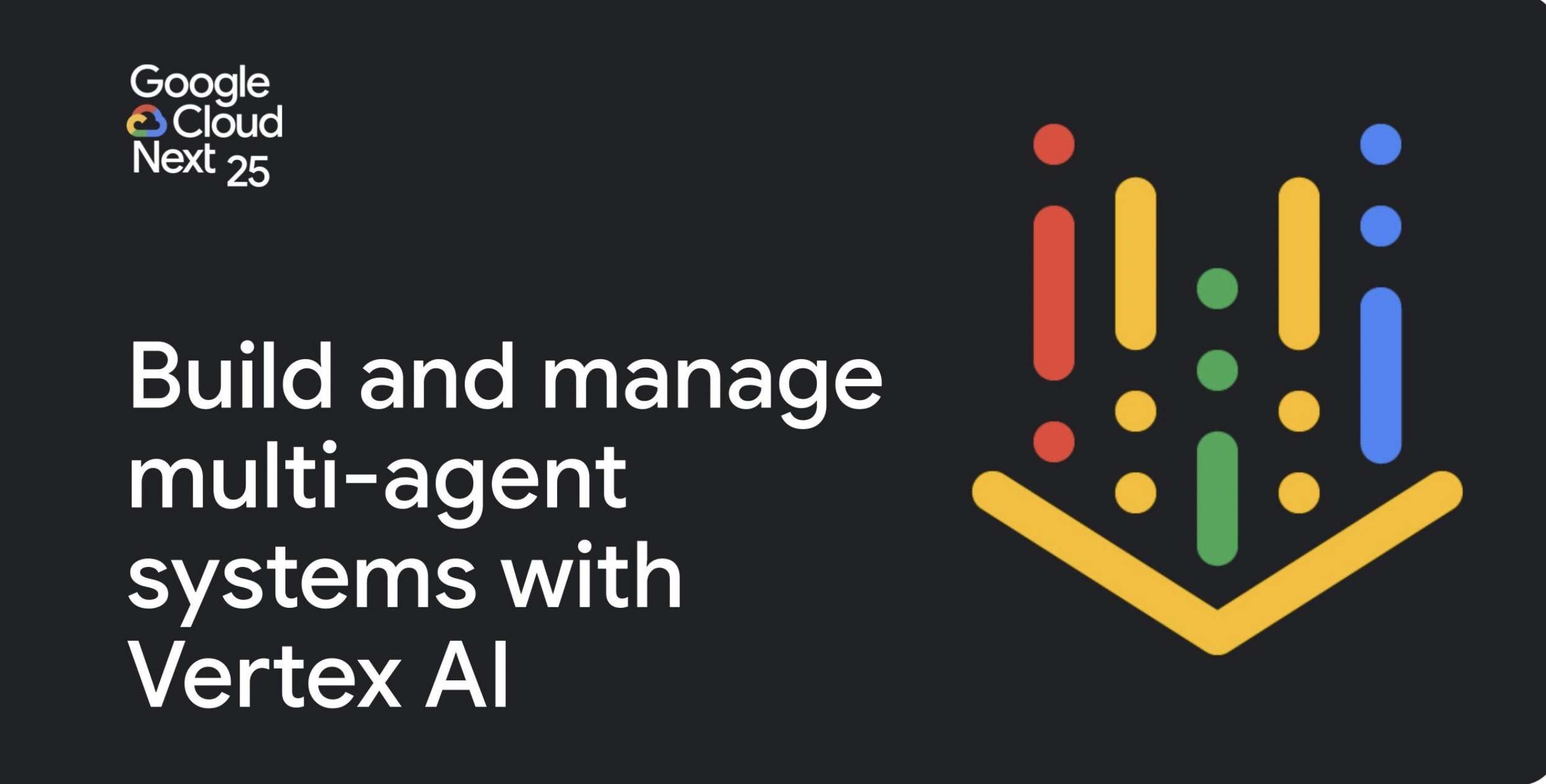
To address these concerns, Google announced a wave of new multiagent ecosystem capabilities in its Vertex AI that allow multiple AI systems to work together to accomplish complex tasks. The company introduced several components to enable this approach, including the Agent Development Kit (ADK), the Agent2Agent protocol, Agent Engine, and updates to Agentspace.
Minimizing the Data Collaboration Problem with the Agent2Agent Protocol
Most vendors claim they can provide fully autonomous AI agents. Still, most buyers prefer to deploy these agents semi-autonomously to reduce concerns about process failures or inaccuracies. To address the enterprise buyer issue of data access and execution across various applications, Google introduced the Agent2Agent protocol, an open standard for enabling communication between agents built on different frameworks and vendors. Google launched the protocol with the support of over 50 industry partners, including Salesforce, ServiceNow, and UiPath. The Agent2Agent initiative addresses one of the most significant barriers to enterprise AI adoption: painful integration challenges to create interoperability across disparate systems.
Making it Easier for Developers of All Skill Levels to Build AI
Meanwhile, the Agent Development Kit (ADK), agent engine, and other advances in the Vertex AI platform help bootstrap the development of agents. Agent Development Kit, an open-source framework, allows developers to build sophisticated agents with approximately 100 lines of code –dramatically reducing development complexity. It also offers pre-built samples through Agent Garden to further accelerate development. ADK offers compatibility with over 200 models from providers like Anthropic, Meta, and Mistral AI.
The companion Agent Engine provides a fully managed runtime for deployment, eliminating the traditional challenges such as rebuilding the agent to move from prototype to production. Agent engine also provides evaluation tools to measure and improve agent quality.
Security and data integration capabilities round out the platform, with configurable content filters, identity controls, and Google Cloud’s Virtual Private Cloud (VPC) service controls providing multi-layered protection. Equally valuable is the platform’s ability to connect agents to enterprise data through various methods, including standard protocols and direct API integration.
Improving Access to AI Agents
Once a company can design, manage, and secure agents, the biggest obstacle to success is getting agents ubiquitously adopted within the enterprise. Agentspace aims to help employees find, publish, and consume agents. Agentspace, launched in December 2024, allows employees (and agents) to find information from across their organization, synthesize and understand it with Gemini’s multimodal intelligence, and act on it with AI agents. Enterprises can discover and adopt agents quickly and easily with Agent Gallery and create agents with Google’s no-code Agent Designer. Firms can also deploy Google-built agents, such as its new Deep Research and Idea Generation agents, to help employees generate and validate business ideas and synthesize dense information.
At the conference, Google announced that Agentspace is integrated with Chrome Enterprise, letting employees leverage Agentspace’s unified search capabilities from the Chrome search box. Bringing Agentspace directly into Chrome will help employees easily and securely find information, including data and resources, right within their existing workflows.
Perhaps what was most surprising was to learn that actual businesses are deploying agents today. Client quotes during the keynote and on Google Cloud’s website demonstrated that business impact is already evident across diverse industries. For example, Revionics has implemented a multiagent system for optimizing retail pricing, while Renault Group developed agents to strategically place EV charging infrastructure using geographical analysis. Gordon Food Service is using Agentspace to change how it accesses enterprise knowledge with searches grounded in its data across Google Workspace and other sources like ServiceNow. These early examples demonstrate the potential for complex automation of previously human-intensive analytical workflows.
The Key takeaway: AI Agents Will Happen
The strategy provides elements for sophisticated developers, novice designers, and employees who must find and use agents to improve their workflow. The availability of models, connectors, and out-of-the-box agents will help eliminate painful trade-offs between model capability, enterprise integration, and production readiness. The result isn’t merely faster development but significantly more reliable agents prepared for mission-critical enterprise workflows.
As reasoning models and multi-agent systems evolve from experimental concepts to production realities, organizations should evaluate not only the capabilities of individual models but also the broader infrastructure required for responsible enterprise deployment. The key consideration for executives evaluating AI investments isn’t individual technical capabilities but rather the breadth of the portfolio and ecosystem to accelerate time-to-value while maintaining governance requirements. Google’s latest enhancements to Vertex AI and AI agent tooling suggest a maturing approach focused on practical enterprise adoption rather than merely advancing technical benchmarks.
The AI industry evolved from Generative AI to the Agentic AI era at a breakneck pace. Are AI Agents fact or fiction? The reality is somewhere in between, and buyers remain skeptical. As technology leaders race to implement artificial intelligence across the enterprise, many organizations are experiencing a paradox. Despite increasing investments in AI technology, the maturity of enterprise AI adoption has declined nine points year over year, according to ServiceNow’s latest AI maturity index survey.
Additionally, Lopez Research data shows that companies struggle to show meaningful business outcomes from early AI proof of concepts, leading to fewer than anticipated AI projects moving from pilot into production. The use cases shared at ServiceNow’s Knowledge 2025 conference revealed a crucial insight: there’s still tremendous business upside available in automating existing processes. However, organizations need effective orchestration, governance, and data quality to unlock the promise of these sophisticated AI tools without creating complexity.
Orchestration: Moving Beyond Isolated AI Tools
Agentic AI is the buzzword of 2025. Technology vendors, like ServiceNow, are racing to showcase maturing AI offerings that will deliver on the promise of automated work. ServiceNow used its Knowledge 2025 conference to showcase its vision for orchestrated, agentic AI, which are autonomous AI entities that can reason, plan, and take action independently across systems and departments.
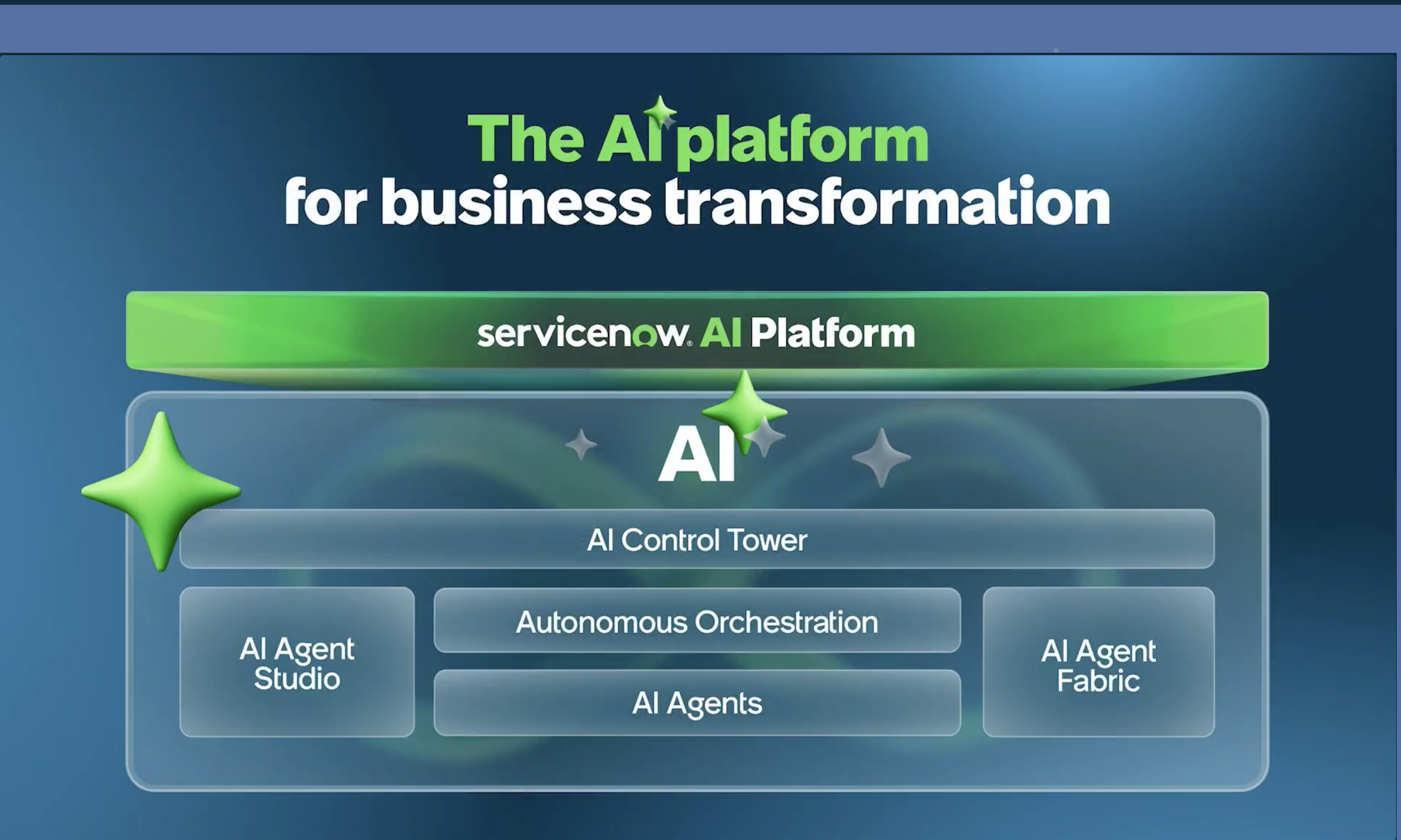
“What they are is a new digital workforce,” explained John Sigler, EVP of ServiceNow’s AI platform, during the keynote presentation. “And ServiceNow is in a great spot to provide the management of that new workforce with the AI Control Tower, where you can manage, govern, secure, onboard, and offboard, and update all your AI agents.”
ServiceNow’s focus on orchestration and governance addresses a critical gap Lopez Research has identified in the enterprise AI landscape. While many vendors have spent 2024 defining what agents are and how to create them, few have tackled the orchestration and governance challenges that would allow organizations to confidently deploy these agents autonomously across the various data and software silos. Even with fully baked technology, the potential brand, business, and compliance risk associated with automated workflows provides a significant roadblock to delivering production Agentic AI systems today.
Sigler showed how the AI Control Tower enables organizations to manage, govern, and secure their AI agents, provide visibility into agent actions, and monitor outcomes. The demo showcased how an employee can drill down into individual agents to see the tasks they perform and the benefits they deliver.
Orica has already realized these benefits in their IT Service Desk, boosting deflection rates from 18% to 94% and doubling the number of fully resolved cases without human intervention—a testament to the power of automation and agents.
Reimagining Processes, Not Just Automating Them
Unlike previous automation waves that often simply accelerated existing workflows, the next wave of agentic AI innovation will emphasize improving processes rather than automating them. The evolution beyond robotic process automation (RPA) was evident in how ServiceNow positions its AI agents.
In a software demonstration, Joe Davis, EVP of Engineering for Platform and AI, showed how a contract renewal issue typically involving multiple departments and taking days or weeks to complete can be compressed into minutes using autonomous agents working across systems. The key shift here is shepherding a process across what were previously disparate data and application silos.
Demo view of multi-agent orchestration of ServiceNow and third-party agents. Source: ServiceNow
Chris Taylor, Group CDIO at Stellantis, reinforced this approach: “What we see is an incredible momentum building. We’ve passed the initial fear factor, and people are starting to use it, adopt it, and create tangible value. It’s less of a threat, more of a way to enhance their productivity and enhance their job satisfaction.”
Stellantis has redesigned its processes around these capabilities, with Taylor noting, “In Europe, 85% of our cars are scheduled and loaded onto transporters using AI. It’s faster. We connect to the customer needs, and we get higher quality.”
Using Stellantis as an example, ServiceNow showcased a demo of a supply chain specialist alerted by an AI agent that detected a 25% increase in battery cell costs that could impact production. The agent recommended an alternate approved supplier and conducted a comprehensive analysis to ensure the new supplier could deliver the correct product requirements. This integration utilized ServiceNow’s Workflow Data Fabric to bring together data from internal and external systems, enabling the specialist to resolve a major supply chain issue.
When network transactions began dropping at a Jeep plant, AI agents diagnosed the problem by analyzing the scale of the issue, identifying that it was isolated to network services, and recommending rolling back a change to a Kubernetes container. After approval, the agents executed the rollback, confirmed network performance stabilization, and created a knowledge base article documenting the fix, preventing disruption to car production.
The demo highlighted more than just automation of existing processes, but a fundamentally better way to detect, diagnose, and resolve network issues, with AI agents working proactively rather than reactively.
Data Quality: The Foundation for Effective AI
A fundamental challenge for implementing effective AI remains data access and quality. During the keynote, ServiceNow referenced a Gartner statistic stating that 60% of AI projects will be abandoned by 2026 due to a lack of AI-ready data.
Gaurav Rewari, SVP and GM of Data and Analytics at ServiceNow, who presented on data strategy, underscored this point: “Here’s the uncomfortable truth. AI agents like the ones you just saw are only as powerful as your data.” This acknowledgment that “the journey to an agentic AI heaven goes through a data hell” represents a significant AI implementation challenge that Lopez Research sees in designing effective AI: data readiness. It’s 2025, and we still struggle with the “Garbage In: Garbage Out” problem.
To address this, ServiceNow unveiled its strategy for AI-ready data, which includes:
RaptorDB: A new database offering designed to handle billions of complex transactions supporting operational and analytical workloads in real-time.
Workflow Data Fabric: ServiceNow’s data integration and semantic layer that connects structured and unstructured data across the enterprise.
Workflow Data Network: An ecosystem of 100+ integrations with data platforms including Snowflake, Teradata, AWS, Cloudera, Databricks, Google Cloud, Microsoft, and Oracle.
Data Catalog and Governance: The announced acquisition of data.world to manage, harmonize, and govern data at scale.
It’s good to see a set of AI platform offerings that focus on data quality instead of just the mechanics of how agents work. Canada Life has already leveraged these data capabilities with their AI-powered catalog builder and Now Assist for Creator to automate self-service management, reducing catalog creation development time by 200%—showing how data-driven AI can transform specific business processes.
Simplifying Agent Creation
The low-code/no-code movement isn’t new. Still, we’re seeing a new round of innovation as we move into the AI era/ ServiceNow is making agent creation accessible to business users through AI Agent Studio, allowing non-technical users to create and deploy agents that can transform business processes. By putting these tools in the hands of those who genuinely understand the business, ServiceNow enables organizations to reinvent inefficient processes to be more intelligent and dynamic. To improve return on investment, Lopez Research sees enterprise buyers landing and refining a few specific AI use cases before expanding these tools across the organization.
“It’s important for everyone to be able to build these AI agents,” said Sigler, before Joe Davis demonstrated creating a research and development agent in about a minute. “You can see it’s low code. You provide instructions using natural language, and you give the agent access to a set of tools.”
Lloyds Bank has taken advantage of this approach, transforming HR and workplace services with Now Assist and GenAI virtual agents, automatically deflecting up to 90% of HR-related cases and saving teams over 4,000 workdays—demonstrating how business-led AI initiatives can drive significant operational improvements.
The conference also highlighted how AI agents can transform customer experience processes. Terence Chesire VP, CRM and Industry Workflows at ServiceNow stated during the keynote, “in customer service, you need more than just great omni-channel intake, you need to also orchestrate and automate the hard part, which is resolution and fulfillment, whether it’s a dispute in banking, ordering a telco service, or processing a warranty claim in manufacturing.” This approach to end-to-end process transformation, rather than simple task automation, represents a significant evolution in how organizations approach AI implementation.
Workforce Transformation: Connecting Front Office to Front Line
The true power of agentic AI extends beyond process automation to fundamentally transforming how the workforce operates. As CEO of UKG, Jennifer Morgan highlighted at Knowledge 2025, “About 80% of the workforce is made up of frontline, field hourly employees,” yet “only 23% of frontline employees feel that they have access to the technology and the insight that they need.”
There’s a significant opportunity for AI agents to bridge the gap between the front office and the frontline workers who are the face of the organization to customers. By creating what UKG describes as “a single point of interaction,” organizations can connect field employees back to enterprise systems and data.
AstraZeneca offers a compelling example of this transformation in action. By revolutionizing their onboarding process with ServiceNow, they’ve streamlined the integration of 20,000 new employees annually, saving over 90,000 hours through optimized workflows. As Cindy Hoots, Chief Digital Officer and CIO, AstraZeneca, explained: “We’ve been able to take processes that used to take 20 minutes, 30 minutes, and now get them to the point that we can do that in just mere seconds.”
This workforce transformation extends to scientific operations as well. In AstraZeneca’s laboratory environments, AI agents are helping lab managers monitor equipment, automatically detect issues through image recognition, determine warranty status, and even place supply orders based on sensor data. What previously required manual inventory checks and paperwork now happens autonomously, giving valuable time to researchers focused on life-saving discoveries.
The Missing Link: Governance by Design
AI Governance shouldn’t be an afterthought designed to remediate compliance issues. AI governance should start as a framework of policies, guidelines, and oversight mechanisms that guide the development, deployment, and use of artificial intelligence to ensure safety, fairness, and transparency. AI governance should be part of developing, deploying, and modifying AI models, systems, and agents.
ServiceNow emphasized governance as a foundational element of its AI strategy. The AI Control Tower provides a central hub for managing, monitoring, and governing AI agents across the enterprise.
This approach embeds governance into the design phase rather than treating it as an afterthought, allowing organizations to deploy autonomous agents more confidently. Yet, organizations must maintain a critical eye by continuously monitoring agents and processes. The system provides visibility into how agents are used across departments, what LLMs they use, and the specific tasks and benefits each agent provides. As AI agents become more autonomous and more widely deployed, this governance capability will be crucial for ensuring security, compliance, and alignment with business objectives.
Governance matters because real business value requires the right people and agents to have the correct permissions to manage and use data. In one demonstration, ServiceNow showcased how AI agents could help sales representatives prepare for doctor meetings by aggregating insights from various systems, generating presentation materials, and even remembering the doctor’s lunch preferences. When these AI capabilities extend to patient services, they can orchestrate complex multi-organization workflows, such as automatically generating insurance justification forms and rebate cards while protecting the patient’s data.
Strategic Partnerships: Accelerating the AI Journey
The conference highlighted ServiceNow’s partnership approach as crucial to its AI strategy. The company showcased collaborations with data and cloud providers like AWS, Cloudera, IBM, Snowflake, and Teradata, and strategic technology partnerships with Microsoft and NVIDIA.
These partnerships reveal that the AI capabilities showcased at Knowledge 2025 aren’t overnight developments. The first Knowledge 2025 keynote included a discussion between ServiceNow CEO Bill McDermott and NVIDIA CEO Jensen Huang, who noted they had been working together for six years to reach this point in AI development.
This historical context is important—it reminds us that we’ve reached a tipping point where we’re seeing the fruits of many years of research and development. The seemingly sudden explosion of AI capabilities is the culmination of sustained investment and strategic collaboration.
Orchestrating Tomorrow: The New Business Operating System
If done well, AI agents are not mere automation tools but transformative elements that can reimagine how work gets done across the enterprise. ServiceNow has addressed several key challenges that have limited the impact of AI initiatives by creating enhancements to orchestration, data quality, processes, and governance.
As enterprises navigate this transition, the shift from isolated AI tools to orchestrated AI agents working across departments represents a fundamental change in how work gets done, transforming tasks that once took days into processes completed in minutes, and turning the promise of AI from a technology buzzword into tangible business results.
The future of work isn’t just about automating what we do today—it’s about reimagining what’s possible when AI agents can work autonomously and collaboratively across systems, data sources, and departments. It’s about creating what Lopez Research calls Right-time Experiences that deliver the correct information to the right person or thing at the right time. The shift from what we discussed in the 2014 Right-time Experiences book is that those “things” are intelligent connected devices and AI agents working with humans to complete workflows round-the-clock. ServiceNow’s customer use cases and product demonstration suggest this future is well on its way to becoming a reality.