At Dell Technologies World this morning, Michael Dell introduced new metrics for measuring whether enterprise AI infrastructure is actually delivering. The AI infrastructure conversation has been dominated by GPU counts, cloud-versus-on-premises debates, and model benchmarks. Dell’s opening keynote added two measures that tie those inputs to outcomes. The first is how quickly your infrastructure generates tokens, and the second is at what cost.
Uptime, GPU capacity, and model advances are all foundational. GPUs are what get you to tokens in the first place. But they are not enough on their own to make infrastructure decisions. Organizations are now facing a more challenging optimization problem. Companies face a seemingly endless demand for AI compute and the energy required to support it. Businesses must also balance the performance of these evolving AI workloads within budgetary and location constraints.
Time-to-token and cost per token are the metrics that tie these competing priorities together. They measure how quickly and how cheaply your infrastructure converts data and compute into intelligence that agents and models can act on. Jensen Huang reinforced this on stage alongside Dell, and OpenAI’s Greg Brockman made the same point independently on X today: “tokens are rapidly becoming the universal input for solving problems.” When the infrastructure providers and the model providers converge on the same metrics within weeks of each other, that is a directional signal worth acting on.
What Michael Dell described was a two-year refinement of the Dell AI Factory with NVIDIA, informed by 5,000 enterprise customers now running production AI workloads on it. The announcements were substantial. What they mean for enterprise buyers is worth unpacking.
The Data Bottleneck Is the Real Constraint
Michael Dell said something on stage that every CIO needs to hear: “If your data is siloed, your agents are blind.” That is a concise description of why so many enterprise AI programs stall after the pilot. It also echoes what Irfan Khan and Muhammed Alam described as the need for business context at SAP’s Sapphire and in an online event about business data.
Most organizations are simultaneously trying to prepare data for AI and reengineer the data infrastructure needed to support it. Those are two hard problems happening at the same time, on top of each other. Dell’s announcements around the Dell AI Data Platform addressed both directly.
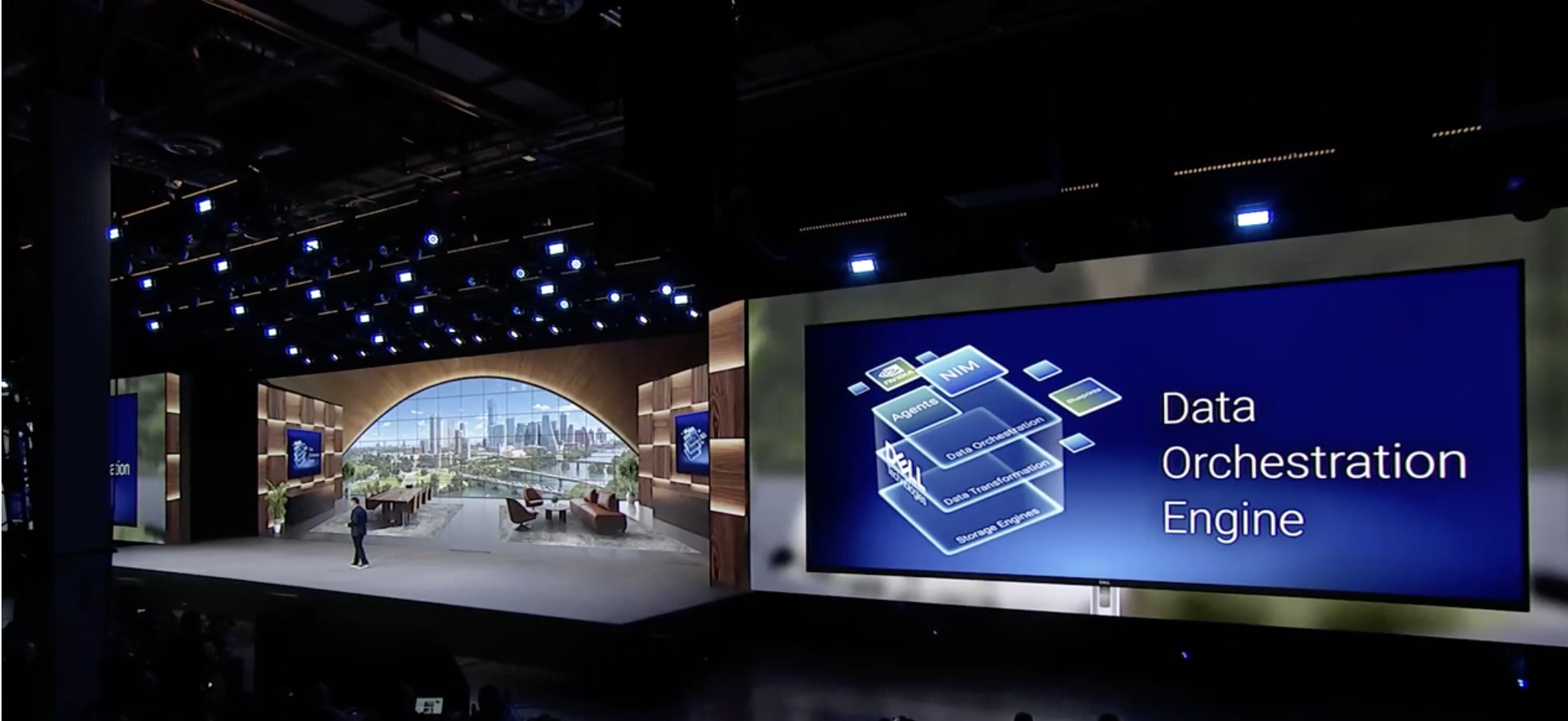
One of the things that has changed is the data orchestration engine, the intelligent control center within the Dell AI Data Platform that turns raw, fragmented enterprise data into production-ready AI fuel. It indexes billions of unstructured files of all types, builds governed data pipelines, connects them to the models and agents that need them, and delivers structured outputs at speeds that make agentic workflows viable. Dell claims the platform now delivers 12 times faster vector indexing, 6 times faster data querying, and 19 times faster time to first token than prior generations. While the claims still need to be verified, the direction is exactly what enterprise buyers need.
Why does this matter? AI agents need business context to be useful. An agent that can reason brilliantly but cannot reliably access your CRM, internal knowledge bases, operational systems, or proprietary data is not doing useful work. The data orchestration engine is what connects the model to the context. Without it, you have a powerful system with nothing meaningful to act on.
Dell’s approach integrates orchestration, search, and governed pipelines natively into the platform. Getting that platform connected to your actual data sources still requires integration work. Budget for it before you buy the hardware.
AI Infrastructure Is a Team Sport
The broader lesson from the Dell Technologies keynote is not about any specific product. It is about what has changed in two years.
When Dell announced the Dell AI Factory with NVIDIA in 2024, it was largely a hardware and partnership story. Today, with 5,000 enterprise customers running production workloads on it, the conversation has shifted to execution. How do you get from pilot to production? How do you keep agents from being blind to your actual business data? How do you manage cost curves as token consumption scales? How do you maintain security and governance when agents are operating autonomously at machine speed?
Part of Dell’s answer is its ecosystem. The new Dell AI Ecosystem Program gives AI software providers a validated path to certify solutions on Dell infrastructure. For enterprise buyers, this speeds AI deployments by reducing integration some of the integration burden. Rather than assembling a custom stack from scratch, you get pre-validated blueprints that automate the deployment of software, services, and models together. That automation is a direct lever for reducing time-to-token at the program level. Dell claims it can deliver hundreds of AI racks a week to a given customer and have them generating outcomes within hours. Part of this is also achieved with ecosystem partner blueprints for automation.
The ecosystem also extends to the agent layer itself. Jensen Huang described on stage how agents do not run directly on the large language model. They run on a harness. The harness sits in a secure, governed container called a sandbox. It manages the agent’s reasoning loop, handles tool use, controls what data and systems the agent can access, and determines when to call the larger model and when to use a smaller local model instead. NVIDIA’s OpenShell is the open-source sandbox now supported across the entire Dell AI Factory. For enterprise buyers evaluating AI infrastructure, the harness is not a detail. It is a primary evaluation criterion. An infrastructure stack that does not clearly define how agent harnesses are deployed, secured, and governed is not production-ready.
The ecosystem partners Dell named today include Google, Hugging Face, OpenAI, Palantir, ServiceNow, and SpaceXAI, among others. AI is not a solo deployment. The strength of the ecosystem around the infrastructure determines how fast you can actually move.
Michael Dell put the security dimension plainly: “You can’t protect what you can’t see, and you can’t manage what you can’t see.” That applies to agents as much as it applies to data. Agents have credentials, memory, and access to systems. When they operate autonomously at machine speed, the blast radius of a security failure is no longer contained to one system. It can propagate across workflows and infrastructure. There are also tech tools such as X that help with confidential computing.
The Token Economics of Hybrid AI
Sixty-seven percent of AI workloads already run outside the public cloud, on-premises, at the edge, or in co-location environments, according to Dell’s own survey data. Eighty-eight percent of organizations are running at least one AI workload on-premises. But, that does not mean cloud is going away. It means the real question for enterprise infrastructure leaders is not cloud versus on-premises. It is how to run both well.
Hybrid AI is not a compromise. It is the architectural reality for most large enterprises. Some workloads need the cloud, which offers speed, training, high capacity, and flexibility. Others belong on-premises because it may access sensitive data that a company doesn’t want in the cloud or regulations require to be in a certain place. There may also be high-volume, continuous inference, where unpredictable cloud token costs create real budget exposure. The strategic challenge is matching the workload to the right environment and doing it consistently at scale.
Jensen Huang described on stage why the compute requirements have shifted so dramatically. Agentic systems require 100x to 1,000x more computation than responding to a simple query because the agent has to reason, plan, use tools, evaluate results, and iterate. At that scale of consumption, every infrastructure decision has a direct cost consequence.
Dell’s answer for high-volume on-premises workloads is what it calls “unmetered intelligence.” The idea is that owning infrastructure converts variable cloud API spend into a fixed infrastructure cost. Dell claims organizations can break even on API costs compared to the public cloud in as little as 3 months with desk-side agentic AI configurations.
Balancing this correctly requires thinking about four variables simultaneously. Latency measures the time it takes for a system to process a request and return a response. Performance refers to the overall capability, accuracy, and capacity of the AI model to handle complex tasks. Cost is what you pay to get those outputs at the required latency and performance level. Energy is the fourth variable, and it is no longer theoretical. A single rack of NVIDIA Rubin GPUs can draw over 130 kilowatts.
Granted, the average enterprise won’t be running a rack of Vera Rubin’s, but energy availability is becoming a real constraint regardless of sustainability goals. And if you’re using the cloud, you pay one way or the other for that energy. The right infrastructure solution varies by workload type. The time to token and the cost per token let you compare options on the same terms.
Sovereign AI Is Becoming a Procurement Reality
Two years ago, sovereign AI was a concept mostly discussed in European regulatory contexts and by a small number of governments building national AI infrastructure. Today, it shows up in enterprise procurement conversations across regulated and unregulated industries.
Sovereign AI means the ability to independently develop, deploy, and govern AI systems entirely within an organization’s strategic, legal, and jurisdictional boundaries. For enterprises, this means your data does not leave your environment, your model choices are not constrained by a hyperscaler’s catalog, and your AI outputs are not subject to external policy changes.
The ecosystem Dell announced is designed to both speed AI deployments and address sovereign AI requirements. Google’s Gemini 3 Flash models running on-premises via Google Distributed Cloud on Dell PowerEdge servers. OpenAI’s Codex is connected to the Dell AI Data Platform for agentic workflows on enterprise data. Palantir’s Foundry and AIP platform is deployed on-premises with Dell ObjectScale and PowerFlex as the data layer. SpaceXAI’s Grok is available in on-premises or hybrid enterprise deployments. Reflection’s open-source frontier models for regulated industries and sovereign entities.
The pattern is consistent: bring the model to the data rather than the data to the model. For organizations in healthcare, financial services, defense, and government, this is not a preference. It is often a compliance requirement.
Planning for Hybrid AI
Today’s AI question is how to architect a hybrid AI solution that aligns with our organization’s specific workloads, data environment, cost constraints, and governance requirements. Some of that runs on-premises. Some runs in the cloud. The mix differs across organizations and will shift as workloads evolve and model costs change.
The questions worth asking now: What is your time to first token across your most important workloads? What is your cost per token at scale? Does your data orchestration layer connect your proprietary data to the models that need it? How are your agent harnesses deployed and governed? And do you have the security architecture in place before your agents start making autonomous decisions?
It’s not easy but nothing worthwhile ever is.