What Sam Altman’s Vision at the Cisco AI Summit Means for Enterprise Workforce Strategy
By Maribel Lopez
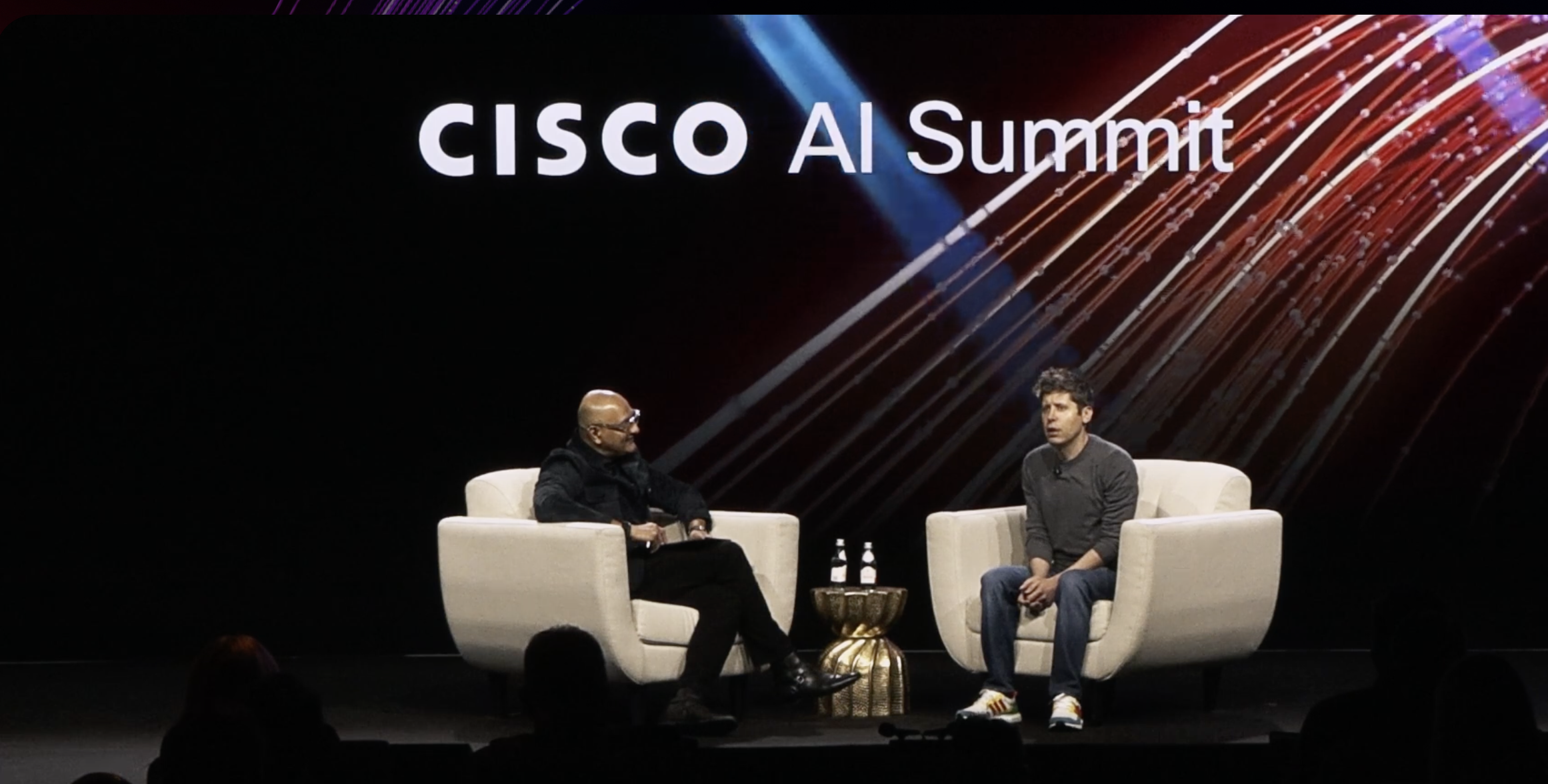
Cisco builds over 70% of its AI software products using AI. Not on a roadmap. Not as a pilot. Today, in production, through its partnership with OpenAI’s Codex platform. When Jeetu Patel, Cisco’s Chief Product Officer, shared this AI trend at the Cisco AI Summit alongside OpenAI CEO Sam Altman, the audience heard more than a product update. They heard a preview of how labor itself is about to be restructured.
For CIOs and CEOs rethinking workforce strategy, three shifts from this conversation demand immediate attention: AI that acts on your behalf, the transformation of software development roles, and the emergence of AI-only companies as a new category of outsourced labor.
Shift 1: AI That Acts on Your Behalf
AI is crossing from finding information to acting on it. For years, the promise centered on surfacing insights, answering questions, connecting dots across silos. What Altman described is an evolution of the agentic AI trend. He described an always-on AI that accesses your computer, browses the web, edits your documents, and executes tasks without waiting for human approval.
This shift is already underway. Consumers use OpenClaw’s Clawdbot as a personal assistant, granting it access to everything (risky, but the usefulness is undeniable). On the enterprise side, SaaS vendors are embedding agents into customer service platforms, IT operations workflows, and sales processes where AI doesn’t just recommend an action but completes it. These deployments remain narrow: an agent that resolves a tier-one support ticket, triages security alerts, or drafts and sends a follow-up email after a sales call. But they mark the beginning of a fundamental change in knowledge work. The AI no longer waits for you to act on its suggestion. It acts.
Altman described giving Codex full access to his computer and lasting only two hours before he couldn’t go back. He acknowledged the real challenges this creates around security, data access, and permissioning. Existing software, hardware, and even legal frameworks weren’t designed for always-on AI that watches what you do and takes action on your behalf.
For enterprise buyers, this reinforces a message I’ve been sharing for some time: the AI infrastructure conversation extends well beyond models and compute. Identity frameworks, governance stacks, observability, and security architectures all need rethinking, because they were designed for people, not AI agents. The good news is that organizations already investing in these foundational capabilities will absorb AI labor more safely and more quickly. But it requires treating security and governance as enablers of AI adoption, not obstacles to it.
Shift 2: Software Development Roles Are Being Redefined, Not Eliminated
Patel described how Cisco works with OpenAI and Codex to fundamentally change how it develops software. AI Defense, a security product Cisco launched last year, will have nearly 100% of its code written by Codex within weeks. This reflects a pattern that will spread across the enterprise.
Developers aren’t going away, but their job is evolving. The core competency shifts from writing code to constructing precise software requirements, evaluating whether AI output meets those requirements, and articulating what needs to change when it doesn’t. Running tests, writing documentation, producing boilerplate? AI handles that. Defining what the software should accomplish and judging whether it got there? Still human.
Altman described Codex as feeling less like a tool and more like a teammate: “The Codex app is the first time, to me, it has truly felt like interacting with a teammate.” That distinction matters. When AI shifts from tool to collaborator, the human role shifts from operator to supervisor. CIOs should already be rethinking team composition, performance evaluation, and career development within their engineering organizations.
Even with AI doing the heavy lifting, design still matters enormously. As Altman noted: “There’s so much value in how you package it, how you have users interact with it, how easy you can make it.” Better models alone don’t guarantee better outcomes. The interface, the workflow, the experience determine whether adoption accelerates or stalls.
A deeper shift sits underneath this AI trend. The future of software requires designing it to work equally well whether a human or an AI operates it. That’s not how software works today. Most software isn’t even easy for humans to use, let alone optimized for AI agents. Altman illustrated this with a telling example: his AI agent used Slack on his behalf, marked everything as read, and broke his workflows. Software built for one type of user doesn’t automatically serve another. This is a design problem as much as a technology problem, and product teams and CIOs need to tackle it now.
Shift 3: AI-Only Companies and the New Workforce Marketplace
The third shift is the most speculative but potentially the most disruptive. Altman described a future with “full AI companies”: a coding model creates a complete, complex piece of software and also interacts with the real world to build a company around it.
Consider what that implies. Not AI-assisted companies. AI-only companies: entities with no human employees, just AI systems performing the work. You would hire them the same way you hire a consulting firm or a staffing agency today.
The concept follows a natural progression from agentic AI. Today, leading enterprises build a variety agents with the aim of having the agents collaborate to accomplish specific goals. Agents perform a task here, an automated workflow there. As agents grow more sophisticated, more of a given role consolidates into a single agentic entity. That entity can then be sold as a digital employee, just as you would hire a temporary worker from an agency or outsourcing firm.
I can see a marketplace emerging where enterprise buyers source these agents. Today, you acquire them from software vendors and hyperscalers. But nothing prevents a person from building an entirely new AI workforce company. However, it’s probably too soon to call this an AI trend, but I expect we’ll see a variant of this soon. Envision your company hiring a cybersecurity agent from an AI agent company to build new security playbooks. The technology to support this is coming together now.
But CEOs and CIOs need to understand something: the existence of an agent marketplace doesn’t mean you can just show up and shop. It will be like facing a thousand choices in the cereal aisle. You need to know whether you want hot or cold cereal before you walk into the store, and that’s just the first filter. Cold cereal? Sweet like Fruity Pebbles or plain like Rice Krispies? True success requires knowing exactly what talents your organization lacks and targeting AI to fill those specific gaps. Skip the hard work of defining the skills and roles you actually need, and you’ll end up overwhelmed by options or acquiring agents that don’t solve your real problems. The companies that benefit most from this marketplace will be the ones that mapped their talent gaps first.
The implications run deep. Outsourcing firms that provide human labor for repeatable tasks face a direct competitive threat and must learn to integrate AI faster and better than their customers do. Companies struggling with persistent talent gaps in cybersecurity, data engineering, or compliance could discover a genuinely new category of solution. But it also raises hard questions about governance, accountability, and quality assurance when the “worker” is an AI system contracted from a third party.
The Real Shift Is in Software Itself
All three of these changes point to the same underlying transformation. The question isn’t whether AI will change your workforce. It already has. The question is whether your software, your infrastructure, and your design thinking are ready for a world where AI isn’t just a tool your employees use but a co-worker that uses your software right alongside them.
Software is changing not just in how it gets developed but in who the user is. When the cloud emerged, companies had to rethink applications for a new delivery model. When mobile took off, they had to redesign for a second screen. AI demands something bigger: a new UX paradigm where humans and AI agents work within the same systems, using the same data, without breaking each other’s workflows. The companies that design for that world will be the ones that capture the value from everything Altman described. Start there.