
Enterprises spent most of 2025 figuring out what AI agents are and which tools could build them. The conversation in 2026 is different. The question now is how to govern, monitor, and scale fleets of agents across the enterprise — without losing control of what they’re doing or why. That shift was visible at Google Cloud Next. One of the headline announcements — the Gemini Enterprise Agent Platform — is more than a product consolidation. It reflects where the enterprise AI market is actually headed: away from point tools and toward platforms that manage agents at scale, with governance and observability built in rather than bolted on afterward.Here’s what was announced, and more importantly, what it means for enterprise buyers trying to move from individual pilots to production-grade agentic systems.
What Google Actually Announced
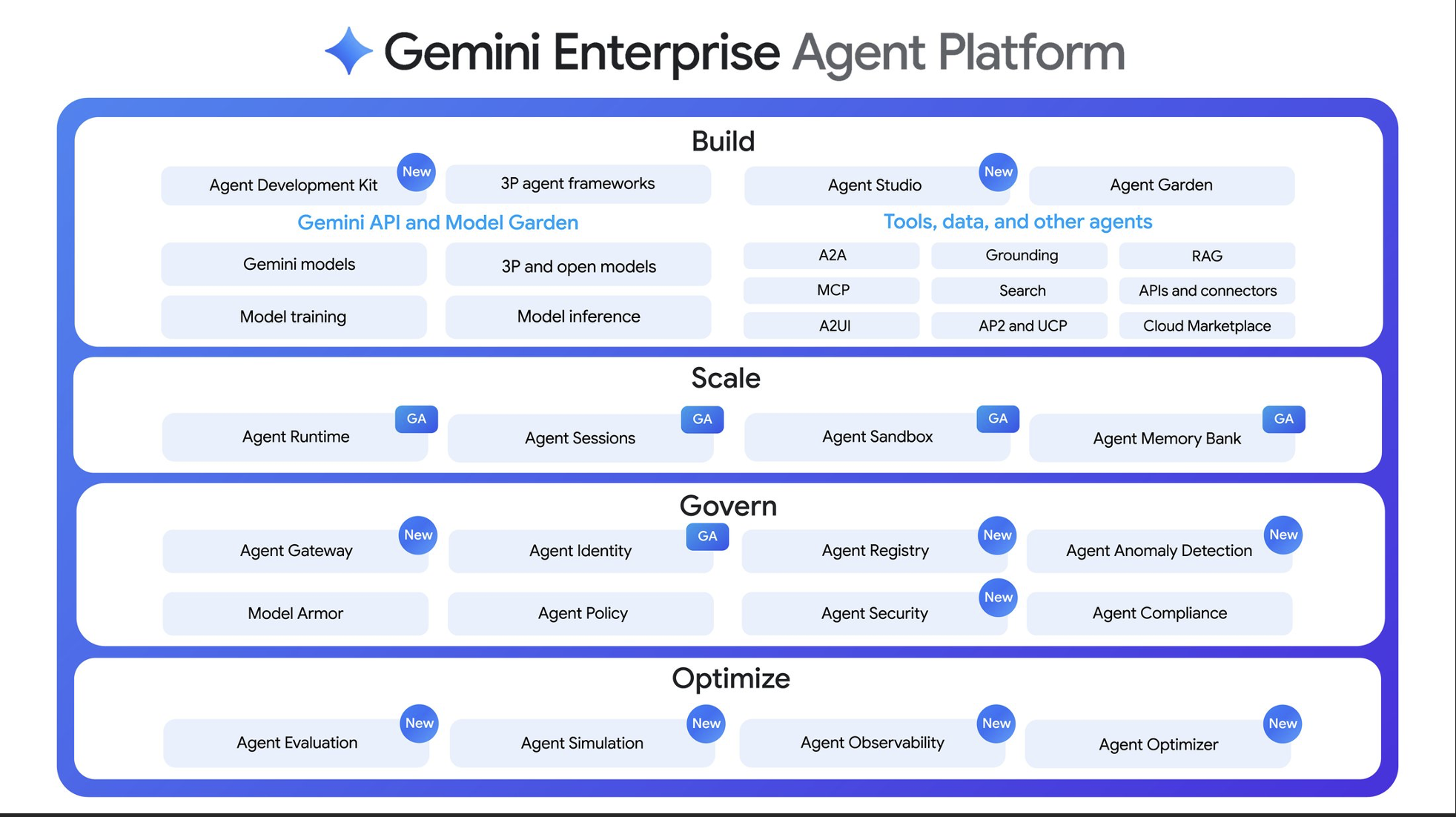
Google combined both Vertex AI and Agentspace into a single unified offering called the Gemini Enterprise Agent Platform. Vertex was its managed AI development platform, while Agentspace was its enterprise-focused platform for deploying and managing agents across organizational data and applications such as Jira, Salesforce, and Google Workspace. Neither Vertex AI nor Agentspace will exist as standalone products. The new platform combines what each did separately, such as Vertex AI’s model building and generative AI development capabilities, and Agentspace’s agent deployment, workflow automation, and enterprise application integration. The platform adds new or improved capabilities for orchestration, governance, security, and observability. That last part matters most. On the model side, enterprise buyers now have access to a model garden with more than 200 options. The model garden includes Google’s own Gemini 3.1 Pro, Gemini 3.1 Flash Image, and Lyria 3, alongside third-party models such as Anthropic’s Claude Opus, Sonnet, and Haiku. The breadth is notable. A single platform that spans first-party and third-party models gives enterprises flexibility to match the model to the task — rather than locking into one provider’s output quality for every workload.On the development side, the platform spans from low-code tooling via Agent Studio to a more capable Agent Development Kit for engineering teams. A new graph-based framework organizes agents into networks of sub-agents, allowing enterprises to define reliable logic for how agents collaborate on complex tasks. An Agent Garden provides access to a curated set of agent templates that cover use cases such as code modernization, financial analysis, economic research, and invoice processing. These templates serve as building blocks for multi-agent systems. The operational layer is where the platform makes its clearest argument for enterprise buyers. Agent Runtime delivers sub-second cold starts and supports long-running agents that maintain state for days, backed by a Memory Bank for persistent context. This allows agents to run more complex tasks. An Agent Gateway provides unified connectivity between agents and tools across environments while enforcing a consistent security policy. Agent Sandbox provides a hardened environment for executing model-generated code and browser-based automation tasks without exposing host systems. And critically, the platform includes Agent Identity and Agent Registry. Every agent — whether built internally or sourced from a third-party partner — carries a trackable identity and operates within defined guardrails. Model Armor protections guard against prompt injection and data leakage. Testing and observability round out the picture. Agent Simulation, Agent Evaluation, and Agent Observability provide execution traces and real-time insight into agent reasoning. Agent Optimizer goes further, automatically clustering real-world failures and suggesting refined system instructions rather than requiring teams to dig through logs manually.
Why the Consolidation Matters
Google also announced updates to its Cloud Data Cloud offering, which improves how agents access and interpret enterprise data. Better data grounding means agents work with accurate, current, enterprise-specific information rather than relying on general model knowledge, which hallucinates at rates that make it unsuitable for business-critical decisions. The Gemini Enterprise Agent Platform competes directly with Amazon’s Bedrock AgentCore and Microsoft’s Azure AI Foundry. All three hyperscalers are converging on the same recognition: enterprise buyers don’t need more ways to build a single agent. They need platforms that manage how hundreds or thousands of agents behave, interact, and scale — without requiring a dedicated engineering team to babysit each one. That’s the real shift in 2026. The challenge is no longer proof-of-concept. It’s production life cycle management with security and governance.For enterprises that had already deployed Agentspace, the consolidation raises a practical question: what happens to what you built? Google’s framing suggests continuity rather than migration — existing Agentspace capabilities carry forward into the new platform rather than requiring a rebuild. But enterprises currently running Agentspace workflows should verify specifically how their integrations, agent configurations, and user access models map to the consolidated platform before assuming a seamless transition. Consolidations that look clean on a slide often surface friction in production environments. Ask Google directly what the migration path looks like and what, if anything, requires rework.
What’s Hard About It
The technology being ready and your organization being ready are two different things. A few realities worth holding onto as you evaluate this platform. Model flexibility is only valuable when you define what you need for your workloads. Two hundred models in a garden is a resource if you have a framework for selecting among them. Without a clear use-case taxonomy — which tasks require higher accuracy versus lower latency, which workloads require on-premises data handling versus cloud inference — the abundance becomes a selection problem rather than a solution. Agent Identity and Agent Registry are necessary, not sufficient. Registering agents and assigning identities is a prerequisite for governance, not the governance itself. Enterprises still need to define what each agent is authorized to do, under what conditions it escalates to a human, and how they will audit agent behavior over time. The platform provides the infrastructure for those decisions. The decisions still belong to the enterprise. Observability tooling requires someone to act on what it surfaces. Agent Optimizer, which automates the suggestion of improved instructions, is genuinely useful. But organizations still need the operational capacity to evaluate those suggestions, test changes, and maintain accountability for agent behavior in production. Automation reduces the burden; it doesn’t eliminate the need for human judgment. The partner ecosystem is announced, not fully proven. Google named a broad set of integrations and ecosystem partners. As with every hyperscaler launch, the gap between announced partnerships and certified, production-ready integrations takes time to close. Before building production workflows on partner integrations, confirm what is shipping now versus what is on the roadmap.
What Enterprise Buyers Should Do
If you are evaluating the Gemini Enterprise Agent Platform — or any hyperscaler agent platform — three questions will tell you more than the demo. First, ask what the platform does when an agent fails. Not how it handles errors gracefully, but what happens when an agent takes a wrong action at scale, across a fleet of similar agents running the same logic. Failure modes at scale differ from those in a pilot. Platforms that offer real-time observability and automated clustering of failure patterns are meaningfully ahead of those that don’t. Second, ask how agent identities integrate with your existing identity and access management infrastructure. If agents need to be registered and governed separately from human users, the platform adds operational overhead. If agent identities extend naturally from your current IAM framework, adoption is faster, and governance is less fragile. Third, ask how data grounding works within your specific data architecture. The value of grounding AI agents in enterprise data depends entirely on the quality and accessibility of that data. If your data is scattered across disconnected systems with inconsistent formats, the grounding layer will struggle regardless of how capable the platform is. Google’s Cloud Data improvements are in the right direction. But no platform substitutes for data readiness on the enterprise side.
The Broader Signal
What Google announced at Cloud Next reflects something the enterprise AI market has needed for a while. Enterprise buyers need platforms from credible vendors that treat governance, security, and observability as core features rather than afterthoughts. We spent 2024 and 2025 building agents. The organizations that will succeed in 2026 are the ones that build the management layer around those agents — the identity frameworks, the observability infrastructure, the governance policies that define what agents are allowed to do and what requires human review. The Gemini Enterprise Agent Platform is a serious attempt to deliver that layer. It is not the only attempt. Amazon and Microsoft are building toward the same destination. But the consolidation of Vertex AI and Agentspace into a unified platform with built-in governance and observability signals that Google understands where the real enterprise challenge lies. That’s the right problem to be solving. Whether this platform solves it for your specific environment depends on how well it fits your data architecture, your existing security stack, and your organizational capacity to govern agents in production.
Subscribe to my AI with Maribel Lopez podcast on your channel of choice at https://www.buzzsprout.com/194744.Lopez Research is a market research and strategy consulting firm specializing in enterprise AI, AI infrastructure, agentic systems, AI governance, and AI-driven customer experience. Learn more at www.lopezresearch.com.
Lorem ipsum dolor sit amet, consectetur adipiscing elit. Ut elit tellus, luctus nec ullamcorper mattis, pulvinar dapibus leo