At Dell Technologies World in Las Vegas, Dell Technologies chairman and CEO Michael Dell made a pointed argument to a room full of enterprise technology leaders: the metrics organizations use to evaluate infrastructure are evolving.
GPU counts, cloud versus on-premises comparisons, and model benchmarks have dominated the conversation. Michael Dell’s day one keynote introduced two additional measures aimed at tying infrastructure decisions to actual outcomes: time to token, which measures how quickly a system processes a request and returns a usable AI output, and cost per token, which measures how cheaply that output is produced at scale.
“Time to first token is incredibly important with investments of this scale,” Dell said on stage, noting that the company now has 5,000 enterprise customers running production AI workloads on its Dell AI Factory with NVIDIA platform. The figure represents a significant increase from the program’s launch two years ago.
NVIDIA founder and CEO Jensen Huang, appearing alongside Dell, described why those metrics have taken on new urgency at both its NVIDIA GTC conference and at Dell Technologies World. Agentic AI systems, which reason, plan, and execute tasks autonomously over extended periods, require anywhere from 100 to 1,000 times more computation than a system simply responding to a query. “What took months now takes weeks, what took weeks now takes days, and what takes days now takes hours,” Huang said, describing the productivity transformation already underway at companies running agentic workflows. The demand implications for infrastructure are substantial.
OpenAI president Greg Brockman echoed the framing independently on X.com the same day, writing that “tokens are rapidly becoming the universal input for solving problems.” The convergence of infrastructure vendors and model providers on the same metrics within weeks of each other signals a broader shift in how enterprise AI spending will be evaluated.
The Data Problem Underneath the Infrastructure Problem
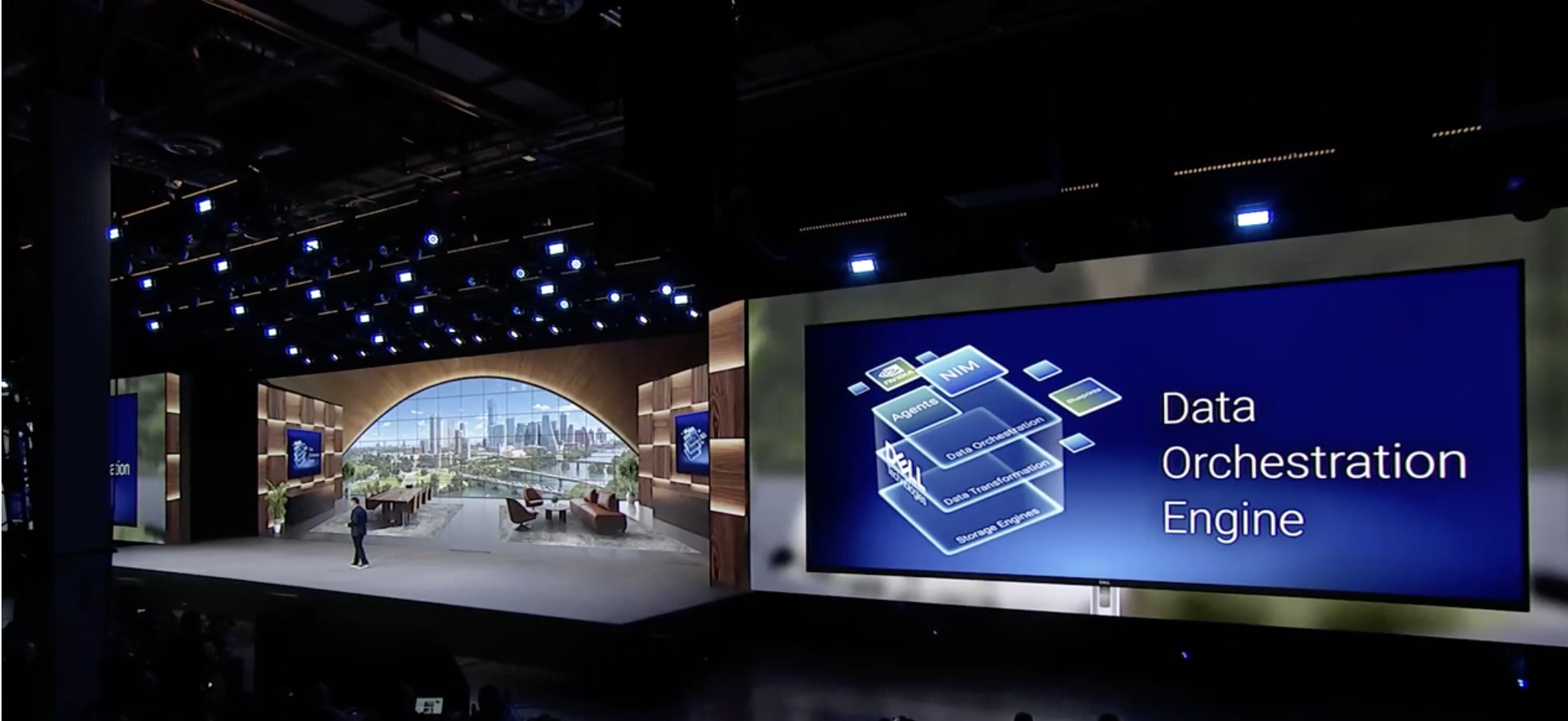
One of Dell’s significant AI product announcements centered on a new data orchestration engine in the Dell AI Data Platform, which the company positioned as the missing layer between enterprise data and production-ready AI agents.
The data orchestration engine is the platform’s intelligent control center. It indexes billions of unstructured files, builds governed data pipelines, and connects them to the models and agents that need them at speeds designed to make agentic workflows viable. Dell claims the updated platform delivers 12 times faster vector indexing, six times faster data querying, and 19 times faster time to first token compared to prior generations. While these claims still need to be validated, the proposed increase in performance is good news for enterprises looking to scale AI.
The underlying problem the engine addresses is one most large organizations know well. Enterprises are simultaneously preparing existing data for AI use and reengineering the data infrastructure required to support AI workloads at scale. Those two efforts compete for the same resources and skills simultaneously.
“If your data is siloed, your agents are blind,” Dell said. The statement is a precise description of why many enterprise AI pilots have not reached production. An agent operating without access to an organization’s proprietary data, internal knowledge bases, and operational systems cannot deliver the business context that makes agentic AI useful.
Dell also announced GPU-accelerated SQL analytics through the Dell Data Analytics Engine, powered by Starburst, delivering up to six times faster query performance on NVIDIA Blackwell GPUs. Bank of America, which already has a partnership with Starburst, NVIDIA, and Dell, is among the institutions expected to use the capability.
A Broad Ecosystem Built to Reduce Time to Production
Dell announced a new Dell AI Ecosystem Program alongside a significant expansion of frontier model partnerships, positioning both as mechanisms for reducing the time between infrastructure procurement and production AI deployment.
On the model side, Dell announced collaborations bringing several major AI providers on-premises to the Dell AI Factory. Google and Dell are collaborating to run Gemini 3 Flash models via Google Distributed Cloud on Dell PowerEdge XE9780 servers, enabling enterprises to run advanced generative AI workloads in a confidential computing environment that meets data residency and sovereignty requirements. OpenAI’s Codex will connect with the Dell AI Data Platform, giving enterprises a path to deploy agentic coding capabilities against their internal codebases, documentation, and business systems. SpaceXAI’s Grok is available in on-premises or hybrid enterprise deployments. Palantir’s Foundry and AIP platform is coming on-premises with its Ontology layer deployed on Dell ObjectScale and PowerFlex, allowing organizations to connect data sources and automate business workflows within their own environment.
The Dell Enterprise Hub on Hugging Face gives enterprises on-premises access to a curated collection of open-weight models including MiniMax-M2.7, DeepSeek Pro, DeepSeek-V4, GLM 5.1, and Kimi K2.6, optimized for Dell AI Factory infrastructure.
The Dell AI Ecosystem Program formalizes the partner relationship by providing software providers with a validated path to certify their solutions on Dell infrastructure. For enterprise buyers, the practical benefit is pre-validated deployment blueprints that automate the configuration of a specific software, service, or model, reducing integration work that has historically extended timelines from procurement to production.
The Agent Harness: An Evaluation Criterion Enterprises Are Not Yet Asking About
One of the more technically substantive moments in the keynote came from Huang’s description of how agents actually operate in production. Agents, he explained, do not run directly on the large language model. They run on a harness, a software layer that sits in a secure, governed sandbox. The harness manages the agent’s reasoning loop, controls tool access, determines when to call a large external model and when to use a smaller local model, and handles memory and context across multi-step tasks.
NVIDIA’s OpenShell, the open-source sandbox, is now supported across the entire Dell AI Factory from deskside workstations through PowerEdge data center servers. Dell also announced support for NVIDIA AIQ i.0 blueprints, which provide tested foundations for deploying multi-agent workflows.
For CIOs evaluating AI infrastructure, the harness architecture is a meaningful addition to the evaluation checklist. Infrastructure that does not clearly define how agent harnesses are deployed, governed, and secured leaves a significant operational and security gap, particularly as agents acquire credentials, access enterprise systems, and take autonomous actions at machine speed.
For example, “You can’t protect what you can’t see, and you can’t manage what you can’t see,” Dell said, framing the security challenge in terms that apply as directly to agents as to human users. An agent with compromised access or misconfigured permissions can propagate errors or security failures across workflows in ways that a single human user cannot.
Hybrid AI Infrastructure and the Energy Constraint
Dell’s survey data shows that 67% of AI workloads are already running outside the public cloud, and 88% of organizations are running at least one AI workload on-premises. The company positioned hybrid AI not as a transitional state but as the long-term architecture reality for most large enterprises.
The new Dell PowerRack, announced Monday, is a fully integrated rack-scale system that combines compute, networking, and storage, engineered and validated as a single unit. It is designed to reduce the integration overhead of assembling AI infrastructure from components while supporting thermal management and power optimization at rack scale.
Dell also introduced the Dell PowerCool CDU C7000, the first rack-mount cooling distribution unit designed to meet the cooling requirements of the NVIDIA Vera Rubin NVL72 platform, delivering more than 220 kilowatts of cooling capacity in a 4U form factor. A single rack of NVIDIA Rubin GPUs can draw over 130 kilowatts of power, and Dell noted that energy availability is an increasingly real constraint on AI deployment timelines, independent of sustainability considerations.
For high-volume on-premises workloads, Dell introduced Dell Deskside Agentic AI, pairing high-performance Dell Pro Precision workstations with NVIDIA NemoClaw. The company claims the configuration enables enterprises to break even against public cloud API costs in as little as 3 months, converting variable token costs into a fixed infrastructure investment.
What Changes for Enterprise Buyers
The announcements from Dell Technologies World day one collectively continue to move the enterprise AI infrastructure conversation from capability to faster execution. The core questions are how quickly a given infrastructure configuration can reach first token on a production workload, at what cost per token, and with what governance architecture underpinning the agents running on it.
The organizations best positioned to answer those questions are the ones that have already started rationalizing their data architecture, defined their hybrid workload placement strategy, and begun evaluating how agent harnesses will be secured and governed. The infrastructure improves almost daily, but the execution discipline required to use it remains the variable that separates AI programs that reach production from those that stay in pilot.
Maribel Lopez is the founder and principal analyst at Lopez Research, a market research and strategy consulting firm specializing in enterprise AI, AI infrastructure, agentic systems, AI governance, and AI-driven customer experience. I version of this article of originally posted on Forbes.com.